
Built to support the whole farm system
Some contracting businesses are built around a single machine or a single season.
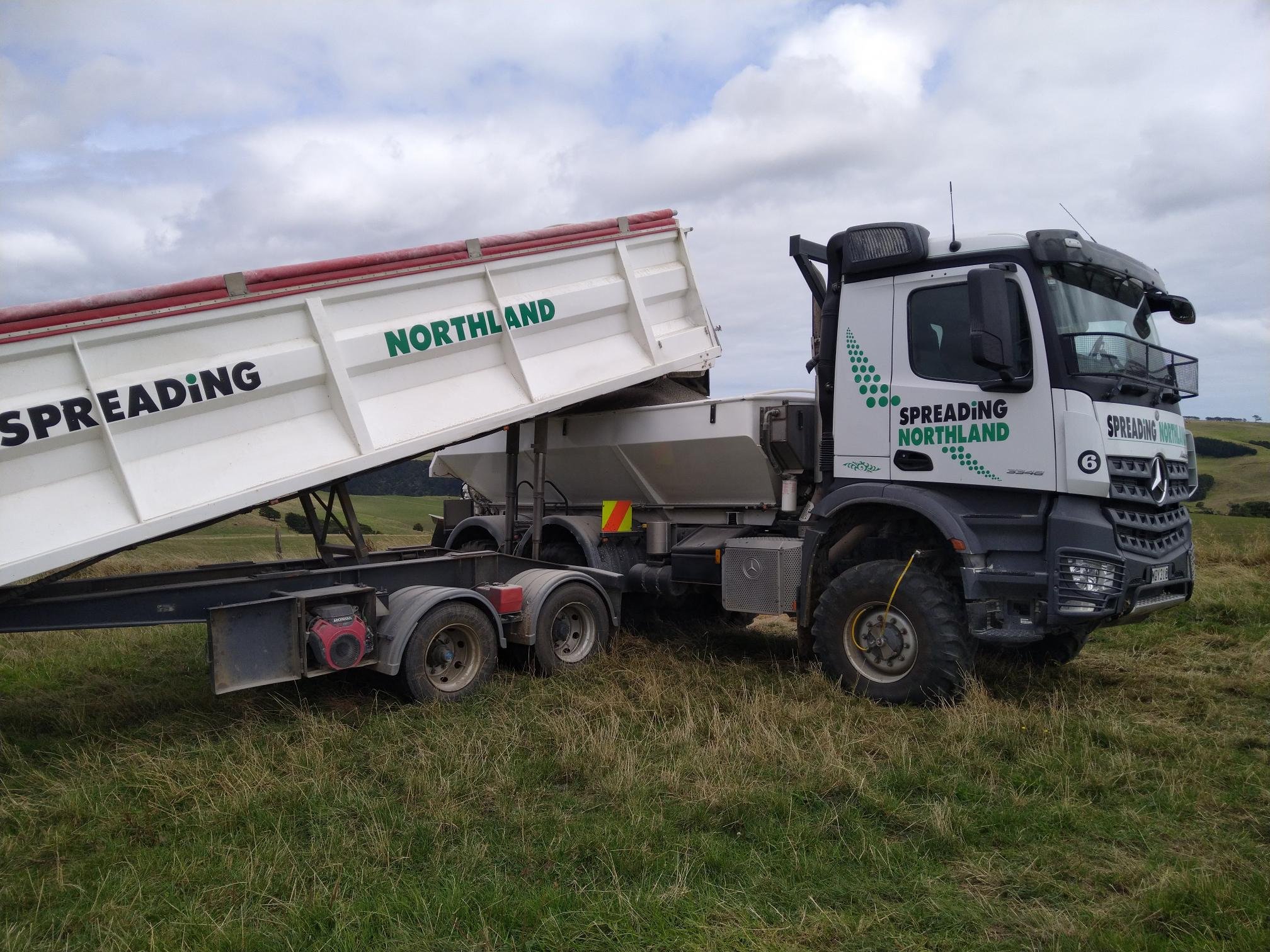
Others evolve by steadily adding capability until they become deeply embedded in the farming systems around them. Williamson Contracting falls firmly into the second category. After more than three decades operating across Northland, the business has become one of those names local farmers associate with getting the job done.
Based in Dargaville and working throughout Northland, Williamson Contracting combines bulk cartage, earthworks and fertiliser spreading into a broad rural support business. Its services reflect both the demands of Northland farming and the practical realities of working across one of New Zealand’s most geographically varied regions.
What started with a single fertiliser spreader in the early 1990s has steadily expanded into an operation covering everything from quarrying and farm drainage through to feed pads, effluent ponds, race construction and large-scale cartage. At the centre of that growth has been founder Jason Williamson, whose farming background has shaped the direction and philosophy of the business.
"Having grown up on a farm we not only talk the talk but more importantly we have a grassroots understanding of the needs of farmers and how today’s farms operate," the company says on its website.
That understanding matters in Northland, where farming rarely fits neatly into one category. The region combines intensive dairy systems with drystock, cropping, horticulture and mixed land use, spread across terrain that ranges from flat peat country to steep rolling hills and coastal landscapes. Conditions can vary dramatically between districts, and weather windows are often narrow, particularly through winter and spring.
For a contractor, that makes flexibility just as important as machinery capacity.
Williamson Contracting has built its reputation around providing that flexibility, particularly through the way its services complement one another. A fertiliser spreading job may lead into drainage work. Cartage may support feed pad construction. Earthmoving may tie directly into wider farm development. Rather than operating separate divisions, the business has developed an integrated system where machinery, operators and logistics work together across multiple job types.
That approach has become increasingly valuable as farm systems intensify and compliance requirements grow. Projects that once involved several contractors can now often be coordinated through a single business, reducing downtime and simplifying communication.
Earthworks have become a major part of that equation. Across Northland, improving farm infrastructure has become increasingly important as farmers respond to environmental pressures, wetter winters and the need for better feed and effluent management.
Williamson Contracting now carries out substantial work in areas including farm drainage, effluent ponds, feed pads, race construction and site preparation, supported by a fleet of bulldozers, excavators and heavy cartage equipment.
These services reflect the changing priorities of modern farming. Where contractors were once focused primarily on seasonal tasks, many are now involved in long-term infrastructure development. Better races reduce lameness and improve access. Effective drainage protects paddocks and extends grazing windows. Well-designed effluent systems improve compliance and nutrient management.
All of that requires contractors who understand farming systems as well as machinery.
That practical understanding appears to be one reason Williamson Contracting has remained relevant through changing conditions. The business has grown steadily rather than aggressively, adapting alongside the needs of local farmers.
The spreading division is perhaps the clearest example of that evolution. Originally established around fertiliser application, the business later expanded through a joint venture with Ravensdown to create Spreading Northland, a dedicated operation servicing farms throughout the region.
That move reflected wider changes within the fertiliser industry, where accuracy, traceability and proof of placement have become increasingly important. Fertiliser spreading is no longer simply about covering hectares quickly. Farmers now expect documented application, variable-rate capability and confidence that product has been applied accurately and consistently.
Spreading Northland operates multiple full-time spreaders alongside a specialised mini spreader designed for lighter soils and crop work, giving the business flexibility across the wide range of farming systems found throughout Northland.
The larger units are fitted with Ravensdown’s proof of placement technology and the operation is Spreadmark certified, providing farmers with immediate access to spreading records and application maps once jobs are completed.
That technology has become increasingly valuable as environmental scrutiny intensifies. Accurate placement and documented application are now central to nutrient management planning, particularly in sensitive catchments and high-rainfall regions such as Northland.
At the same time, practical spreading capability remains just as important as the technology behind it. Northland’s terrain presents plenty of challenges, from soft coastal soils through to rolling hill country where machinery stability and operator experience are critical.
Having a range of spreaders suited to different conditions allows the business to maintain productivity without compromising application quality. That flexibility becomes especially important during tight weather windows, when contractors are under pressure to move quickly between jobs.
Cartage has also become an increasingly important part of the business. Modern farming relies heavily on the movement of fertiliser, lime, palm kernel, metal and silage, and contractors who can handle both transport and application offer a clear logistical advantage.
Williamson Contracting now provides a broad range of bulk cartage services throughout Northland, including feed transport, limestone supply and general rural freight.
The addition of blower truck capability for silo filling further reflects the practical nature of the operation. Rather than limiting itself to traditional contracting services, the business has consistently added capabilities that solve real on-farm challenges and improve efficiency for its clients.
That approach reflects a broader trend across the rural contracting sector. Increasingly, contractors are becoming service providers who help farms operate more efficiently across multiple areas, rather than simply machine operators.
Supporting that level of service requires a substantial and versatile machinery fleet. While Williamson Contracting maintains a relatively low public profile compared with some larger South Island operators, the scope of its work points to a business built around dependable equipment capable of handling varied conditions throughout the year.
Northland places unique demands on machinery. High rainfall, softer soils and long travel distances create significant wear, while seasonal peaks demand reliability during the busiest periods.
That is particularly true in spreading and cartage, where downtime during narrow weather windows can quickly delay multiple clients.
Like many long-established contracting businesses, Williamson Contracting appears to have evolved through practical machinery decisions rather than chasing trends. The emphasis has remained on capability, reliability and maintaining enough flexibility to move between different job types as seasonal demand changes.
That diversity also provides resilience. When one area slows, another often picks up. Earthworks can support quieter agricultural periods, while spreading and cartage provide strong seasonal demand during key parts of the farming calendar.
Operating successfully in Northland also requires strong local knowledge. Conditions can vary dramatically between coastal areas, inland districts and heavier clay country, making timing and ground assessment critical.
Farm drainage depends on understanding soil structure and water movement. Race construction and feed pad development require materials and designs suited to local conditions.
The same applies to fertiliser application. Wind exposure, soil moisture and terrain all influence spreading performance, making operator experience just as important as machinery specification.
These are the details that separate contractors who simply operate machinery from those who become long-term partners within farming businesses.
Williamson Contracting’s longevity suggests it has made that transition successfully.
The company formally became Williamson Contracting Limited in 2000, although the contracting business began in 1991 with a single spreader.
That timing is significant because it means the business has operated through major shifts in New Zealand agriculture, including dairy expansion, environmental reform, increasing compliance requirements and the adoption of precision technology.
Many contracting businesses established during that period either remained small owner-operator businesses or expanded rapidly before encountering debt and labour pressures.
Williamson Contracting appears to have taken a more measured path, steadily adding capability while remaining closely aligned with the practical needs of farmers.
Relationships have almost certainly played a major role. Contracting, particularly in regional areas, remains a relationship-driven industry. Farmers tend to stay with contractors they trust, especially those who understand their properties and farming systems.
That trust is built through consistency, communication and reliability, particularly during difficult seasons.
Northland farmers frequently deal with challenging conditions, from summer droughts through to prolonged winter rainfall, making adaptable and dependable contractors especially valuable.
The company’s ongoing partnership with Ravensdown also reflects the growing importance of integration with wider industry systems. Fertiliser spreading is increasingly data-driven, linked with nutrient planning software and supported by mapping and reporting systems that farmers rely on for both management and compliance.
Providing proof-of-placement maps and integration with digital platforms such as HawkEye and My Ravensdown places Williamson Contracting firmly within that modern operating framework.
At the same time, the business remains grounded in traditional contracting values. Practical service, dependable machinery and a genuine understanding of farmers' needs continue to define its approach.
That combination of practical experience and modern capability is becoming increasingly important. Farmers value technology where it delivers real benefits, but they also want contractors who understand the realities of farming rather than simply selling systems.
Looking ahead, businesses like Williamson Contracting are likely to remain central to the future of rural infrastructure and farm support services, particularly in regions such as Northland where conditions demand adaptable operators with broad capability.
The role of contractors continues to expand beyond seasonal work into environmental management, infrastructure development and logistics support. As labour shortages, compliance requirements and capital costs continue to increase, many farms rely on contractors not only for machinery but also for expertise and operational flexibility.
Williamson Contracting’s evolution over the past three decades reflects that broader industry shift.
From a single spreader to a diversified rural support business covering spreading, cartage and earthworks, the company has grown by steadily adding practical capability rather than chasing scale for its own sake.
In many ways, that approach mirrors the farmers it works alongside. Northland farming has always demanded resilience, adaptability and a willingness to solve problems as conditions change. Contractors serving that environment tend to develop the same mindset.
For Williamson Contracting, that mindset appears to have remained remarkably consistent from the beginning: understand the job, understand the farmer, and build the capability needed to keep both moving forward.