
Cutting Smarter, Not Harder – Why KJR Contracting Switched to Grouping Mowers
Cutting smarter rather than harder has become the new standard for Kelvin Richardson, owner and operator of KJR Contracting who runs a busy operation based southeast of Te Awamutu. Every season brings the same familiar pressures, tight weather windows, large areas to cover and clients expecting quality feed when they need it. For Kelvin, staying ahead means constantly looking for better ways to work.
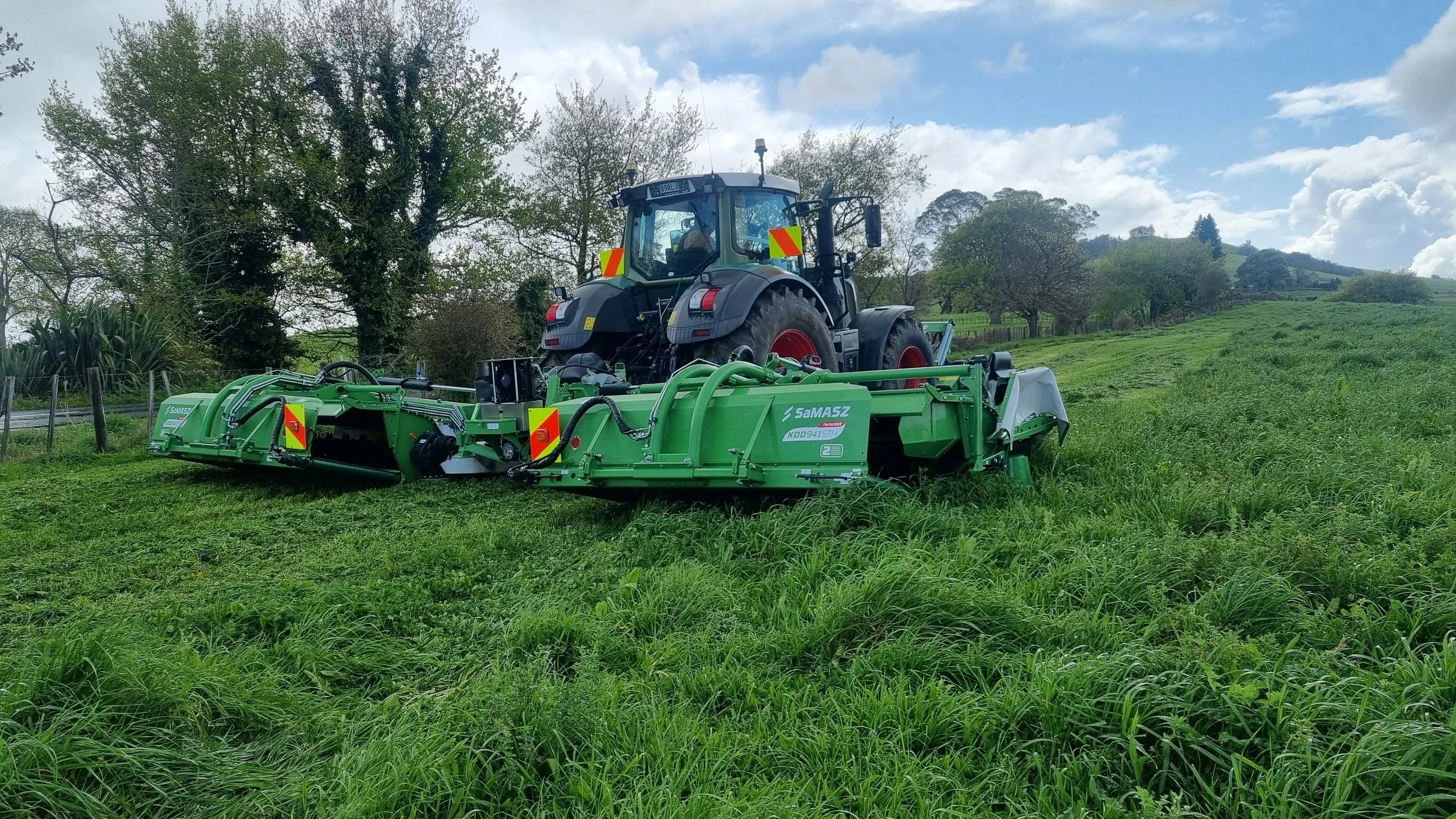
The KJR team handles everything from mini baleage through to pit silage with a fleet that includes modern Samasz grouper mowers, a self-propelled chopper, big square baler, round baler combi, two loader wagons, three trucks, a digger and a range of other essential gear to keep things moving. Most of their clients are dairy and drystock farmers spread throughout the district and reliability is what keeps the phone ringing.
A visit to Fieldays in 2023 ended up being a turning point. Kelvin hadn’t planned on making a major purchase but walked away with a new mowing system that would transform the way his business operates.
“It’s a bit of a funny story,” he says. “My wife Melanie and I went to Fieldays not intending to spend any money. We’d been talking about new mowers and had priced a couple of different brands around the $295,000 to $300,000 mark. Then we spotted the Samasz mowers, and they were closer to half the price. Melanie said, ‘They look pretty good and so does the price.’ So, we got back in touch afterwards and bought them. I’d seen them around but didn’t know much about them. We really liked the build quality.”
KJR started with a set of rear-mounted Samasz KDD941STH Groupers paired with a different front unit, mainly because Kelvin wasn’t sure about the earlier front designs at the time. “They looked a bit light,” he admits. “But we recently trialled the new XDF front mower and absolutely loved it. My son’s now pushing for one! We’ll look at that in the near future.”
While the dealership isn’t exactly on his doorstep, Kelvin says service has been exceptional. “I can’t fault them. We haven’t needed many parts and they’ve been great to deal with.” He recalls a job in Piopio late last year that really tested the mower’s strength. “We were about an hour and a half from our yard when my mower driver called me on the RT - ‘You got a copy, Kelvin? We’ve got a problem. I’ve just mowed a big post.’ I was expecting the worst. We hooked a chain on because it was jammed in one of the rear mowers and pulled it out and honestly, you wouldn’t even know that a number one strainer had gone through there. No parts were damaged. Unbelievable! I said to him, ‘Thankfully we had the Samasz on this job, not our old set we’d have been folding them up and taking them home.’”
Since making the switch, the efficiency gains have been obvious. “The groupers save us a lot of headaches,” says Kelvin. “We buy and sell a lot of grass through the forager, and the main reason for going with groupers was to cut out the rake. What used to happen was the mower would go out one day, then in the morning the rake would start rowing up in front of the chopper. By afternoon, the grass would be too dry. Now we can mow straight in front of the choppers and get it chopped up and away we go.”
That improvement in timing has made a big difference during changeable weather. “Last year we had a couple of heat showers come through. The mower stopped; we chopped up to it parked up and waited it out. Within a couple of hours, we were back into it. If we’d been raking the old way, all that grass would’ve been soaked and we’d have had to spread it back out. This way the grass quality held up and the farmers really appreciated that. Plus, we’re covering more hectares in a season.”
Kelvin also values the added precision and safety the groupers provide, especially around fence lines and troughs. “When we open up a paddock, we put the groupers down to form that first row around the fence line and water troughs so the rake doesn’t have to go near them. Just last week, we trained my sixteen-year-old stepdaughter on the twin-rotor rake - she did a fantastic job. Grouping the first row made it easier and safer for her while learning.”
The build strength and design of the Samasz mowers have impressed across the board. Fewer passes mean less fuel, less labour and less wear, advantages that quickly add up through the season. When asked what he looks for in gear, Kelvin says it always comes down to affordability and quality. “These mowers tick both boxes, they’re well built and make financial sense.”
Looking ahead, Kelvin is already eyeing up new equipment that could further streamline operations. “I saw the new four-rotor rake online at the Agritechnica show, really keen to see how that progresses. We’re also looking at purchasing a new tedder from Samasz off Farmshop too. Another good product.”
For KJR Contracting, the switch to grouping mowers has proven to be more than just a change in machinery, it has reshaped how the team tackles each job. With greater efficiency, reduced downtime and cleaner results the business has become more resilient to the unpredictable nature of the season. What started as an unplanned purchase at Fieldays has turned into one of Kelvin’s best business decisions, delivering exactly what every contractor wants; reliable performance, lower costs and the confidence to keep cutting smarter, not harder.