
Double the cut, not the cost
For many contractors and large-scale farmers, a rear mower has long been the backbone of pasture management. It is familiar, proven and dependable and for years it has done the job well. But with operating costs rising and labour pressure showing no sign of easing, efficiency has become critical to staying profitable. That has prompted more operators to look closely at how much output they are really getting from every tractor hour and every litre of diesel.
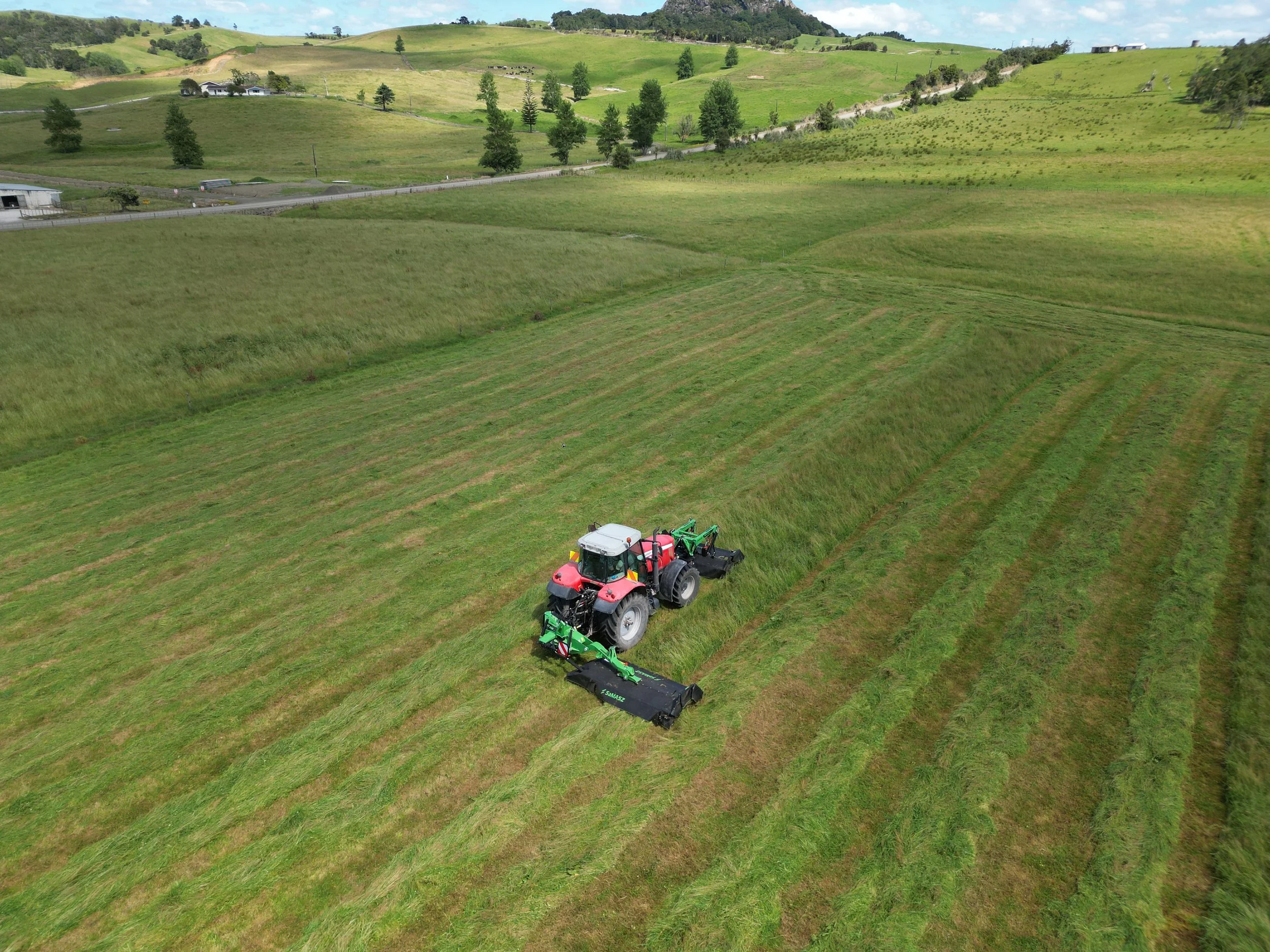
Pairing a Samasz front mower with a rear mower shifts mowing from a steady operation into a high-output system without fundamentally changing how the job is done. The combination of the KDF302 front mower with the XT350 rear mower delivers a working width of around 6.3 metres allowing for 200mm overlap, and it does so while requiring only a modest increase in fuel use. The idea of doubling the cut without doubling the cost is not marketing talk, it is something that starts to make sense once the numbers are laid out.
One of the common misconceptions around running front and rear mowers together is diesel consumption. There is an assumption that adding a second mower automatically means a big jump in fuel burn, but in practice contractors report increases of roughly 10 percent compared with running a rear mower alone. What changes far more dramatically is productivity. A 3.5 metre rear mower operating on its own typically averages around 4 hectares per hour in real paddock conditions once headlands, turning and overlap are factored in. With the KDF302 front mower working alongside the XT350 rear mower, output increases to around 7 hectares per hour using the same tractor and the same operator. That equates to roughly 75 percent more area covered per hour for a relatively small increase in fuel use.
When those gains are applied to real fuel costs, the commercial logic becomes even clearer. Using a realistic New Zealand diesel price of around $1.90 per litre, 100 litres of fuel costs approximately $190. With a rear mower only, that 100 litres typically equates to around 10 hours of mowing, covering roughly 40 hectares putting fuel cost at about $4.75 per hectare. With the front and rear mower combination the same 100 litres delivers closer to 9 hours of mowing, but at a higher work rate of around 7 hectares per hour. Total area covered lifts to approximately 63 hectares, bringing fuel cost down to roughly $3.00 per hectare. The outcome is a lower cost per hectare, fewer tractor hours and significantly more work completed from the same fuel spend.
For contractors in particular, those gains translate directly into time savings that compound quickly across a season. Increasing output from 4 to 7 hectares per hour reduces mowing time per job by around 40 percent which in turn means more jobs completed per day, reduced labour hours per hectare and less wear on tractors and mowers. Over a busy season, that difference can be the line between staying ahead of the weather or chasing it and in many cases the value of the time saved can pay back the front mower far sooner than expected. Rather than being viewed as an added cost, the front mower starts to function as a revenue-generating attachment.
Efficiency gains are not limited to hectares per hour either. Running a front mower changes how paddocks are approached and opened up. With a rear mower alone operators often need to mow around the edges first before settling into longer, more efficient runs. A front mower allows contractors to drive straight into the paddock and begin mowing immediately, cutting cleanly on entry and exit. The workflow is smoother, turning is reduced and large paddocks can be opened up faster with a more consistent and professional finish.
That practical focus carries through into the design of the Samasz KDF302 front mower itself, which has been refined using direct feedback from New Zealand contractors. Recent design enhancements include improved blade carrier and storage solutions that make blade changes quicker and tidier, along with a clear mowing height indicator that allows operators to accurately set and repeat cutting heights across different paddocks. These small but important details reduce setup time, simplify daily operation and help maintain consistent results during long working days when efficiency matters most.
For many contractors, adopting a front mower is also easier than expected. A large number of modern tractors are already fitted with front linkage and PTO capacity, meaning the addition of a KDF302 front mower is often a straightforward upgrade rather than a major machinery change. When paired with an XT350 rear mower, the setup makes full use of existing tractor capability while delivering a substantial jump in output without adding complexity.
That has been the experience of Ruawai-based contractor Scott Ramsey, who recently added the KDF302 front mower to his setup, pairing it with his existing XT390 rear mower.
“It’s good. It changed how I work straight away,” says Scott. “It saves money and speeds the job up. It’s still early days, but we can already see we’ll cover a lot more ground. It’s also way easier to open up the paddock. Once you buy a front mower, you’d never go back to the old rear-only setup.”
In the end, running a Samasz KDF302 front mower with an XT350 rear mower is not about working harder. It is about making better use of time, fuel and machinery. With a 6.3 metre cutting width, lower fuel cost per hectare and meaningful time savings, the front and rear combination offers a practical way to lift productivity and profitability without changing tractors or operators.