
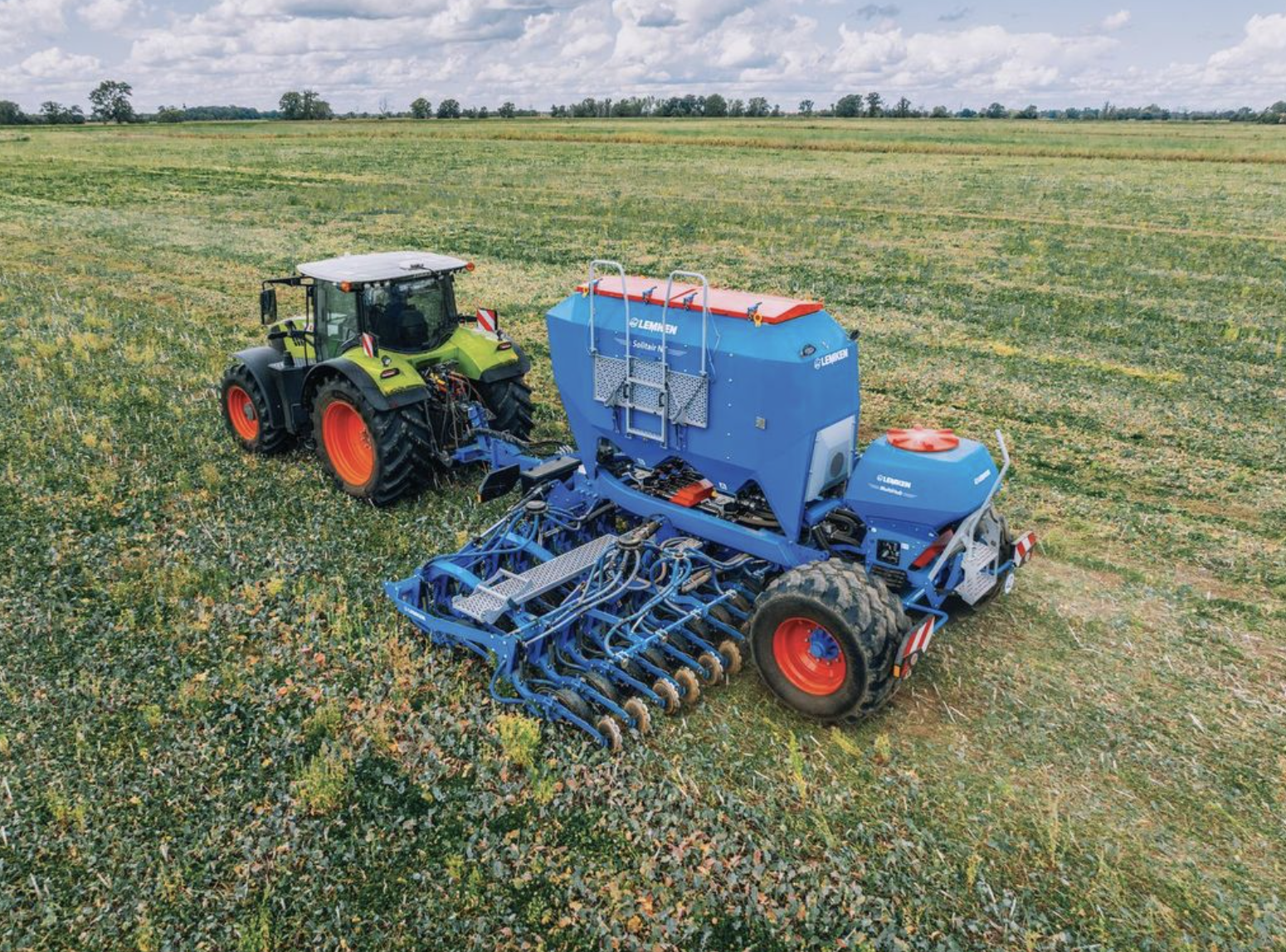
Lemken completes its seed drill technology range with the new Solitair NT
Successful crop establishment has always been one of the biggest determinants of yield, but today's New Zealand growers face a more complex challenge than ever before.
From Canterbury's large arable operations to mixed farming systems throughout the North Island, growers are balancing productivity with improving soil health, reducing cultivation costs and making the most of increasingly narrow planting windows.
These changing priorities have driven greater interest in minimum tillage and direct drilling systems, where preserving soil structure and moisture is just as important as achieving accurate seed placement.
As more growers adopt conservation farming practices, the demand for machinery capable of delivering consistent establishment across a wide range of conditions continues to grow.
Recognising this shift, Lemken has introduced the Solitair NT, a direct drill developed specifically for conservation tillage and direct drilling applications.
Incorporating the proven Equalizer seeding technology, the Solitair NT has been designed to establish crops accurately with minimal soil disturbance while maintaining the versatility needed for New Zealand's diverse cropping systems.
One of the greatest engineering challenges in direct drilling is maintaining consistent seed placement as soil conditions change across a paddock.
Lighter free-draining soils, heavier clay areas, cultivated headlands and wheel tracks all place different demands on the drill. Any variation in sowing depth can affect emergence, resulting in uneven crop development long before the season gathers momentum.
At the heart of the Solitair NT is the ProDisc single-disc coulter, designed to achieve excellent penetration while keeping draft requirements relatively low.
Wide depth-control wheels maintain consistent operating depth, while electro-hydraulic coulter pressure of up to 340 kg can be adjusted from the tractor cab or regulated automatically as field conditions change.
Rather than relying on fixed mechanical settings, the system continually adapts the downforce applied to each coulter, helping maintain uniform seed placement across varying soil types and residue levels.
The result is more even emergence, improved crop uniformity and greater confidence that every hectare has the opportunity to achieve its full yield potential.
That adaptability extends well beyond the coulter itself.
Modern cropping systems rarely follow a single establishment recipe, with growers increasingly looking to combine seed, fertiliser and companion crops in a single operation.
The Solitair NT has been designed around that requirement, offering large-capacity hopper configurations capable of carrying multiple products while maintaining accurate metering throughout the drilling process.
The optional MultiHub system introduces an additional product stream, allowing operators to establish cereals, cover crops, companion species and fertiliser simultaneously.
Completing several operations in one pass not only improves efficiency but also reduces machinery traffic across the paddock, helping preserve soil structure during crop establishment.
Electronic integration has become equally important as mechanical performance, particularly as precision farming technologies become standard equipment on many New Zealand farms.
ISOBUS compatibility allows the Solitair NT to integrate with existing tractor terminals, while half-width section control improves input accuracy by reducing overlap and minimising unnecessary seed and fertiliser use.
As input costs continue to rise, the ability to place every kilogram precisely where it is required has become an increasingly valuable part of overall machine performance.
Direct drilling also presents another challenge that is often underestimated: managing crop residue.
Heavy cereal stubbles and surface trash can interfere with seed placement by trapping residue in the seed slot, a phenomenon commonly referred to as hair-pinning.
To overcome this, the Solitair NT can be equipped with an optional row cleaner that clears residue immediately ahead of the coulter, ensuring the disc operates directly in the soil rather than through surface material.
This simple but effective solution helps improve seed-to-soil contact, creating more favourable conditions for rapid and even germination.
Behind the coulter, Lemken has incorporated a serrated closing wheel that seals the seed furrow while restoring capillary moisture around the seed.
Maintaining good soil contact is essential for moisture transfer during germination, particularly where direct drilling leaves much of the surrounding soil undisturbed.
Both the row cleaner and closing wheel can be adjusted quickly without tools, allowing operators to respond efficiently as soil conditions, residue levels and moisture change throughout the day.
The overall design reflects a broader trend within modern seeding equipment.
Rather than developing machines dedicated to a single cultivation system, manufacturers are increasingly producing establishment platforms capable of operating across conventional cultivation, minimum tillage and true direct drilling.
This flexibility allows growers to adapt their establishment strategy according to seasonal conditions rather than being limited by machinery capability.
Matt Tew, sales manager New Zealand, believes the Solitair NT has been developed specifically with those changing farming systems in mind.
"New Zealand growers are looking for equipment that can establish crops consistently across a wide range of soil types and cultivation systems," he says.
"The Solitair NT combines proven direct drilling technology with the flexibility to adapt to changing conditions, giving growers confidence that every seed is being placed in the best possible environment for establishment."