
Preparing the row, protecting the soil
When the conversation turns to strip-tillage, it is rarely about fashion or trend. It is about finding a practical balance between agronomy and efficiency, preparing a seedbed that supports strong early crop growth while avoiding unnecessary soil disturbance. The Horizon SPX Strip-Till Cultivator sits firmly in that space offering a system that works the soil only where it matters, directly in the planting row, while leaving the remainder of the paddock protected and undisturbed. In farming systems where soil structure, moisture retention and input efficiency are under constant scrutiny that targeted approach continues to gain relevance.
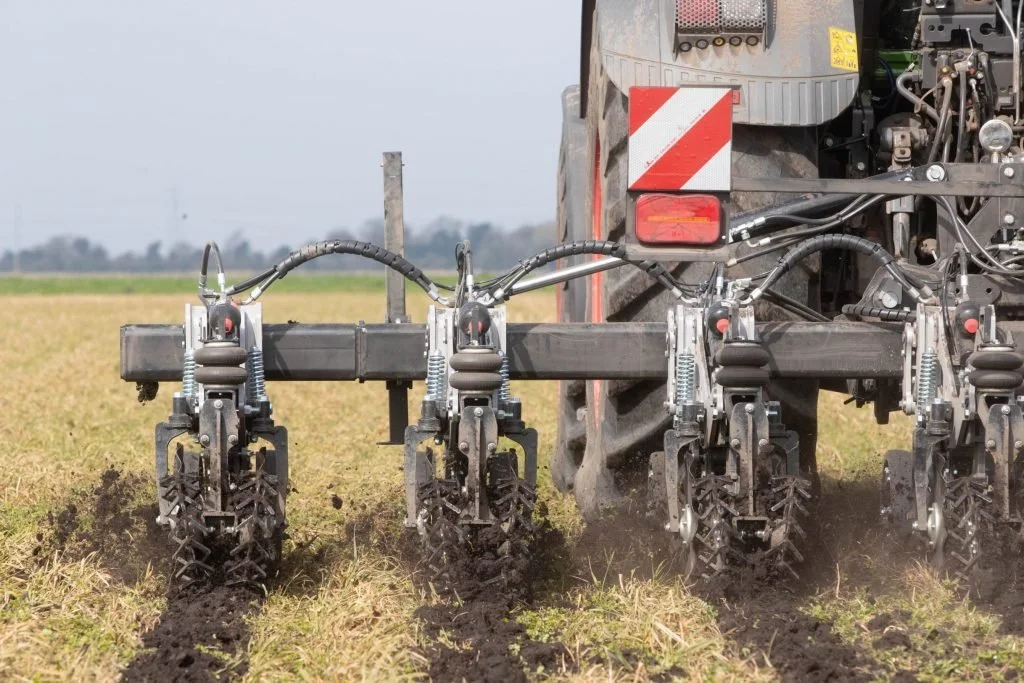
The principle behind strip-tillage is straightforward, but execution matters. Rather than cultivating the entire paddock the SPX forms narrow, tilled strips where seed will be placed while residue and undisturbed soil remain between the rows. That residue acts as protection reducing erosion, slowing moisture loss and helping maintain organic matter. The SPX is designed to deliver that outcome consistently even in paddocks with heavy residue, variable soil types or changing moisture conditions.
At a practical level, the SPX is a well-balanced machine rather than an aggressive one. Its modular row units and adjustable configuration reflect a design philosophy built around adaptability. Row spacing and working width can be tailored to suit different crops and farming systems, making the machine relevant across a range of row-crop applications including maize, sweetcorn, beet and brassicas. This flexibility allows operators to integrate strip-tillage into existing systems rather than reshaping their entire operation around a single implement.
The row unit itself is where the SPX does its most important work. A robust tine fractures and lifts the soil in the strip breaking compaction and creating a zone of loose, workable soil without disturbing the entire profile. Depending on soil type and desired finish, different points and wing options can be fitted to control the amount of lift and soil movement. This ability to tune the machine to conditions is central to strip-tillage success, particularly in environments where paddocks can vary significantly from one block to the next.
Managing residue in the seeding zone is another critical aspect of the system. Optional row cleaners ahead of the tine gently move surface trash away from the strip without excessive soil disturbance. This clears the path for effective soil conditioning while retaining residue between the rows where it continues to perform its protective role. Pneumatic adjustment allows operators to fine-tune row cleaner pressure from the cab, making it easier to respond to changing residue loads and ground conditions as the day progresses.
Depth control and consolidation are equally important. The SPX operates at depths that address shallow compaction and prepare a suitable seedbed, typically working in the range required to encourage early root development and soil warming without unnecessary depth. Following the tine, packing wheels firm the tilled strip, leaving a zone that is neither too loose nor overly compacted. This balance helps retain moisture, supports consistent seed placement and reduces the risk of the strip collapsing or drying out before planting.
One of the advantages of strip-tillage systems like the SPX is the ability to integrate nutrient placement into the same pass. Options for banding fertiliser into the tilled strip allow nutrients to be placed precisely where emerging roots will access them, rather than spread across the entire paddock. This targeted placement can improve fertiliser efficiency, support early crop vigour and reduce overall input requirements. For operators focused on reducing passes and improving input efficiency, this integration makes practical sense.
The SPX is designed to work seamlessly with modern guidance systems. Mounted on a tractor’s three-point linkage, it follows GPS guidance accurately ensuring strips are formed consistently across the paddock. That accuracy becomes particularly valuable when planting follows directly behind the strip-tiller or when maintaining precise row alignment is critical for crop establishment. Matching guidance between strip-till and planting operations removes uncertainty and supports repeatable results.
Beyond the mechanics, the appeal of strip-tillage lies in its alignment with longer-term soil stewardship. By limiting disturbance to narrow strips, the SPX helps preserve soil structure between rows, supports biological activity and reduces the risk of erosion during heavy rainfall. In heavier soils the tilled strip can warm more quickly in spring, helping bring planting windows forward while still retaining surface cover across most of the paddock. These outcomes are increasingly important as growers seek systems that balance productivity with resilience.
In practical terms, strip-tillage also offers efficiencies that matter in tight seasons. Fewer passes mean lower fuel use, reduced labour hours and less compaction from repeated traffic. For contractors, the ability to deliver a targeted cultivation pass that sets paddocks up for planting without extensive follow-up work can improve productivity and scheduling during peak periods. For farmers, it offers a way to prepare land effectively without committing to full cultivation across every hectare.
The Horizon SPX Strip-Till Cultivator reflects a broader shift in how soil preparation is being approached. It does not reject tillage outright, but it refines it focusing effort where it delivers the greatest benefit and stepping back where disturbance is unnecessary. In farming systems where efficiency, soil health and consistency all matter that approach continues to resonate.
Ultimately, the SPX is a tool built around practicality rather than ideology. It provides operators with control over soil disturbance, residue management and nutrient placement in a single integrated pass. For those looking to adopt strip-tillage or refine an existing system it offers a measured, adaptable solution that fits comfortably into modern cropping workflows while respecting the soil beneath it.