
A business that grew with the family
There is something steady about a family contracting business that has been built over time, not through rapid expansion or outside investment, but through a series of decisions made around the kitchen table and tested out in paddocks, on job sites and across seasons that do not always go to plan.
When Knight Contracting was last featured several years ago, it was a business still finding its shape, built around the foundation Steve Knight had established through Tabard Limited and the early involvement of his sons. Revisiting it now, what stands out is not just how much has changed, but how deliberately that change has been managed, with succession sitting quietly at the centre of it all.
The original structure was always practical. Steve Knight had built Tabard Limited over 15 years, developing a reputation across North Canterbury for land development, irrigation work, mechanical fit-outs and civil projects. It was a business grounded in capability and adaptability and, like many operations of its kind, it followed the work as it came, from farm development through to large-scale infrastructure. When the opportunity came through the Central Plains Water scheme, Steve stepped into a project that would ultimately run far longer than first expected, a short-term job that turned into months of continuous work across two stages of development. That period helped define the scale the business could operate at, with multiple machines, staff and the ability to deliver on technically demanding work.
At the same time, the next phase was already forming. Eric Knight and his brothers had grown up around farming and development, with a background that included dairy conversions and large-scale land transformation projects. The sale of the family dairy farm marked a shift, but not a departure from the sector. Instead, it created space for the next generation to step into something different and, importantly, something of their own.
That was the thinking behind Knight Contracting. As Steve put it at the time, “Knight Contracting is now the trading name for Tabards. I branched out once Eric and the boys started doing different things.” It was not a clean break from the original business, but rather a layering of capability, allowing each part of the operation to focus on what it did best while still supporting each other when needed.
For Eric, that meant building a contracting arm that was grounded in practical, on-farm work. He had already spent time working for another contractor after leaving school, gaining experience and developing a clear sense of what he enjoyed. “I love driving tractors,” he said, a simple statement that still reflects the hands-on nature of the business today. What followed was a series of decisions that would define Knight Contracting’s direction, starting with a relatively niche but highly practical service.
Rut filling does not carry the profile of large-scale cultivation or harvesting, but in irrigated systems it is essential. Poorly maintained pivot ruts create safety issues, damage machinery and reduce overall efficiency. Eric identified that need early and invested in front-tipping trailers designed specifically for the job.
“It is a twelve-tonne front-tipping trailer, which David came up with to fill in pivot ruts,” Eric explained. “It fills pivot ruts twenty percent faster than the gear most other contractors have.”
That focus on efficiency and outcome became a consistent theme. The trailers could use on-farm material, reducing costs for clients and simplifying logistics. The design also ensured the fill was properly compacted, something Eric was quick to point out as a key difference. “If you use other rut busters they don’t roll it and if the pivot goes around and it’s a bit wet, it oozes all the shingle out. Farmers like our ones better than other trailers and they are faster than anything else. Our clients know for sure they are getting exactly the right amount of fill packed into the trench.”
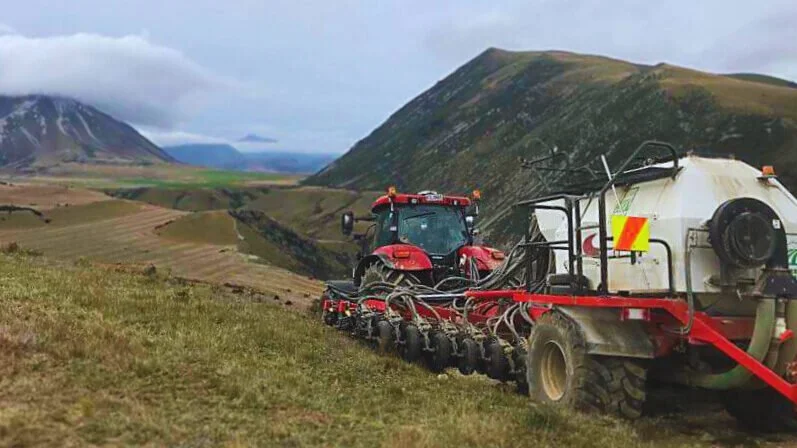
From there, the business expanded in a way that mirrored the needs of the region. Direct drilling was a natural extension, particularly given the range of conditions across Canterbury. The addition of a Bourgault drill allowed Knight Contracting to move into a space that required both technical capability and a willingness to take on more challenging environments.
“The drill can handle stony ground, tall grass, low scrub and other types of rubbish. It can direct drill into almost anything and you don’t have to do any preparation,” Eric said. “The drill can hold up to two tonnes of seed and fertiliser and it’s really robust.”
Those capabilities opened up opportunities in the high country as well as more conventional arable systems, with work extending into properties like Flock Hill and Mount White. It also shifted the scale of the operation, with hundreds and then thousands of hectares being drilled each season.
Alongside that, the business maintained its roots in land development and vegetation management. The addition of a MeriCrusher mulcher provided another tool that could handle the tougher end of the spectrum, from broom and gorse through to breaking in new ground. It was a reflection of the broader approach that has defined Knight Contracting, not chasing volume for its own sake, but building a suite of services that complement each other and respond to real demand.
Through all of this, the relationship between Steve and Eric remained central. It is not uncommon in family businesses for there to be tension between generations, particularly as roles evolve and responsibility shifts. In this case, the structure has allowed both to operate in their own space while still working together when required.
“When Eric is flat out I will send staff to him or he comes and helps me if I’m busy,” Steve said. “The whole business works together, even though we try to keep a little bit separate.”
That balance has been critical in allowing succession to happen gradually rather than through a single defining moment. Instead of a handover, it has been a progression, with Eric building his own client base, investing in equipment and developing the agricultural contracting side of the business, while Steve continues to focus on civil and development work through Tabard. It is a model that provides continuity for clients and stability for the business, while also giving the next generation the space to take ownership.
Carlos Knight’s involvement adds another layer to that progression. While not as directly tied into the day-to-day contracting work, his role in managing the trucking side and his interest in developing a helicopter spraying capability point to where the business could head in the future.
“He will drive if he needs to but drivers are the easiest staff to find,” Steve said. “If I need him I will use him, but in the future he wants to get a helicopter and go spraying and run the trucks and tie that into the business.”
It is a reminder that succession is not just about replacing one generation with another, but about allowing each person to bring their own ideas and direction into the business.
What has not changed is the underlying approach to work. The scale of projects may vary and the mix of services may evolve, but the emphasis remains on reliability, practicality and delivering outcomes that matter to clients. That is particularly evident in the way the business manages staffing. Rather than maintaining a large permanent workforce, Knight Contracting scales up and down depending on the work available, bringing in people when needed and focusing on keeping overheads manageable.
“I don’t normally have any permanent full-timers. We employ people full-time while we are doing contracts but we just find staff when we need them,” Steve said. “I don’t have too many problems finding people, and we normally pick up quite good people. We pay a reasonably good wage, so it’s not a big problem.”
It is a model that suits the variability of both civil and agricultural work, particularly in a region where weather and seasonal demand can change quickly.
The broader operating environment has also played a role in shaping the business. The slowdown in large irrigation projects has reduced the scale of some civil work, prompting a shift back towards smaller, more consistent jobs. “We are waiting for all the cowboys to leave Christchurch and then we will get back in, so we are just doing little stuff at the moment,” Steve said at the time, a comment that reflects both the competitive nature of the sector and the importance of timing in securing work.
For Knight Contracting, that variability has reinforced the value of diversification. Having a mix of civil, development and agricultural contracting work provides a level of stability that a single focus would struggle to achieve. It also aligns with the way the business has been structured around the strengths and interests of each family member.
Looking at the journey from the outside, it would be easy to see it as a straightforward progression, from a civil contracting business into a broader family operation. In reality, it has been more nuanced than that, shaped by opportunities, constraints and a willingness to adapt without losing sight of what the business does well.
Succession, in this context, is not a single event but an ongoing process. It is visible in the way Eric has built his side of the business, in the support that continues to flow between different parts of the operation and in the opportunities being explored by the next generation. It is also evident in the culture of the business, where practical decisions and a focus on doing the job properly remain at the forefront.
There is no sense of urgency about handing over control, and perhaps that is the point. By allowing the business to evolve naturally, with each generation taking on more responsibility over time, Knight Contracting has created a structure that can sustain itself beyond any one individual. It is not reliant on a single skill set or a single market, but on a combination of capabilities that have been built up over years of work.
In an industry where change is constant, whether through technology, regulation or market conditions, that kind of resilience is not easily achieved. It requires a clear understanding of what the business stands for, a willingness to invest where it matters and the ability to adapt without losing direction.
As the business continues to develop, the next phase will likely bring its own challenges and opportunities. What remains consistent is the approach that has carried the business this far, grounded in practical experience, supported by family and built around a clear sense of purpose.
In many ways, that is what defines Knight Contracting. It is not just the machinery or the services offered, but the way those elements come together through the people involved. And that, ultimately, is the strength of it.