
A contracting legacy adapts
In many parts of rural New Zealand, contracting businesses evolve slowly, shaped as much by people and relationships as by machinery and balance sheets.
BT Contracting, based in Mangaroa near Upper Hutt, is one such business. Its story is less about rapid expansion and more about continuity, service and adaptation.
The landscape surrounding Upper Hutt has changed dramatically over the past half century. Once dominated by dairy farms, the region has gradually shifted toward lifestyle blocks, horse properties and smaller grazing units. Where there were once around thirty dairy farms within easy reach of Mangaroa, there are now none. That transformation has reshaped the type of contracting work required in the district. Large-scale silage and cultivation operations have largely disappeared, replaced by a steady demand for small bale hay, haylage and a range of property maintenance services for landowners who often farm part time.
As Graeme and Mary Taylor moved towards their seventies, they saw it was time to hand the business over to younger and more energetic hands. Adam Doughty’s connection with the Taylors began when he was still at primary school. He worked with BT Contracting throughout his school days before going fencing full time. In time, Adam was keen to expand his fencing work into hay and haylage making. Graeme and Mary were keen to ease back from the seasonal pressures of making bales for their many customers, so Adam took on that role.
Throughout these changes, BT Contracting retained all the necessary equipment to make and sell mini haylage and conventional hay bales.
Graeme and Mary continue to supply their customer base who have bought their haylage and hay bales for many years. BT Contracting now supports Adam and other local contractors by providing help when needed. When a contractor has machinery issues, staff shortages, or the weather unexpectedly closes in, they are ready to assist. In that way, BT Contracting has become something of a “contractor to the contractors”.
“Rather than working directly to make haylage and hay on lifestyle blocks, our customers are now buyers of our mini bale haylage and conventional hay bales,” Graeme explains.
Haylage in particular has become a cornerstone of the operation. When Graeme first introduced haylage into the area there was some scepticism among horse owners, many of whom were more familiar with conventional hay.
“When we first started making haylage some people said horses couldn’t eat it,” Graeme recalls. “But in England they had been feeding haylage to horses for years so I knew it worked. We bought the machinery anyway and offered the service, and now there is a steady demand for it.”
Getting moisture levels right is key to producing quality haylage. Graeme explains that while cattle can tolerate wetter feed, horses generally prefer haylage that is slightly drier.
“Small bale haylage is best baled at about fifty to sixty percent moisture,” he says. “Cattle will eat it wetter than that, but horses usually prefer it on the drier side.”
The roots of the business stretch back much further than the contracting operation itself. Graeme Taylor’s connection to agriculture began when his family moved onto a dairy farm near Otaki in 1963. Like many farming families of the era, they also carried out contracting work for neighbours, making silage and hay during the busy summer months.
Graeme and Mary later ran their own dairy operation until the mid 1980s, when a change in direction took them away from farming for a time. The couple became involved in youth work in Upper Hutt and later spent time in Papua New Guinea. Beginning in the mid 1990s they spent thirteen years working with Prison Fellowship International, supporting prisoners, ex prisoners, their families and victims of crime.
Eventually the Taylors returned to rural life, settling on a five hectare block in Mangaroa near Upper Hutt. Retirement, however, proved to be a relative term.
“Farmers never really stop working,” Graeme says with a smile. “We moved onto the block thinking we might take things a bit easier, but it didn’t take long before we were looking for something to do.”
The catalyst for the contracting business came in 2007 when Graeme received a bill from a contractor for making hay on their small block. Looking at the invoice, he decided the job might be something he could do himself.
“So we bought a forty five horsepower Massey Ferguson 135, an old New Holland baler and a mower, and started making hay.”
That first season they completed four small jobs around Whitemans Valley and Mangaroa. The following year the number doubled to eight. Gradually word spread among lifestyle block owners and the customer base expanded.
“People talk to each other,” Graeme says. “If you do a good job someone tells their neighbour and before you know it you have another paddock to mow.”
BT Contracting grew to more than forty customers before the more recent shift toward supporting local contractors and producing mini bale haylage and hay for sale. Grass is bought from landowners who choose not to run livestock on their properties. High quality pasture is purchased from local blocks totalling around 20 hectares.
In spring and autumn it is easy to make mini bale haylage as it does not need to be fully dry like hay. Summer provides ideal haymaking weather on the same blocks as second cut crops are harvested to make high quality hay. BT Contracting produces enough mini bale haylage to supply customers across the Wellington region and up the Kapiti Coast as far as Levin. All the hay is made to order. The same customers return year after year for the hay their horses prefer. Rather than storing hay through winter, the focus is on producing high quality mini bale haylage year round for their many customers.
From the beginning the operation developed a distinctive theme in its machinery choices. Massey Ferguson tractors have been a constant presence in the Taylor family since Graeme first drove a TEA 28 in the early 1960s.
“There has always been a lot of red machinery around here,” he says. “Our family farm had Masseys from the start and I’ve always found them reliable.”
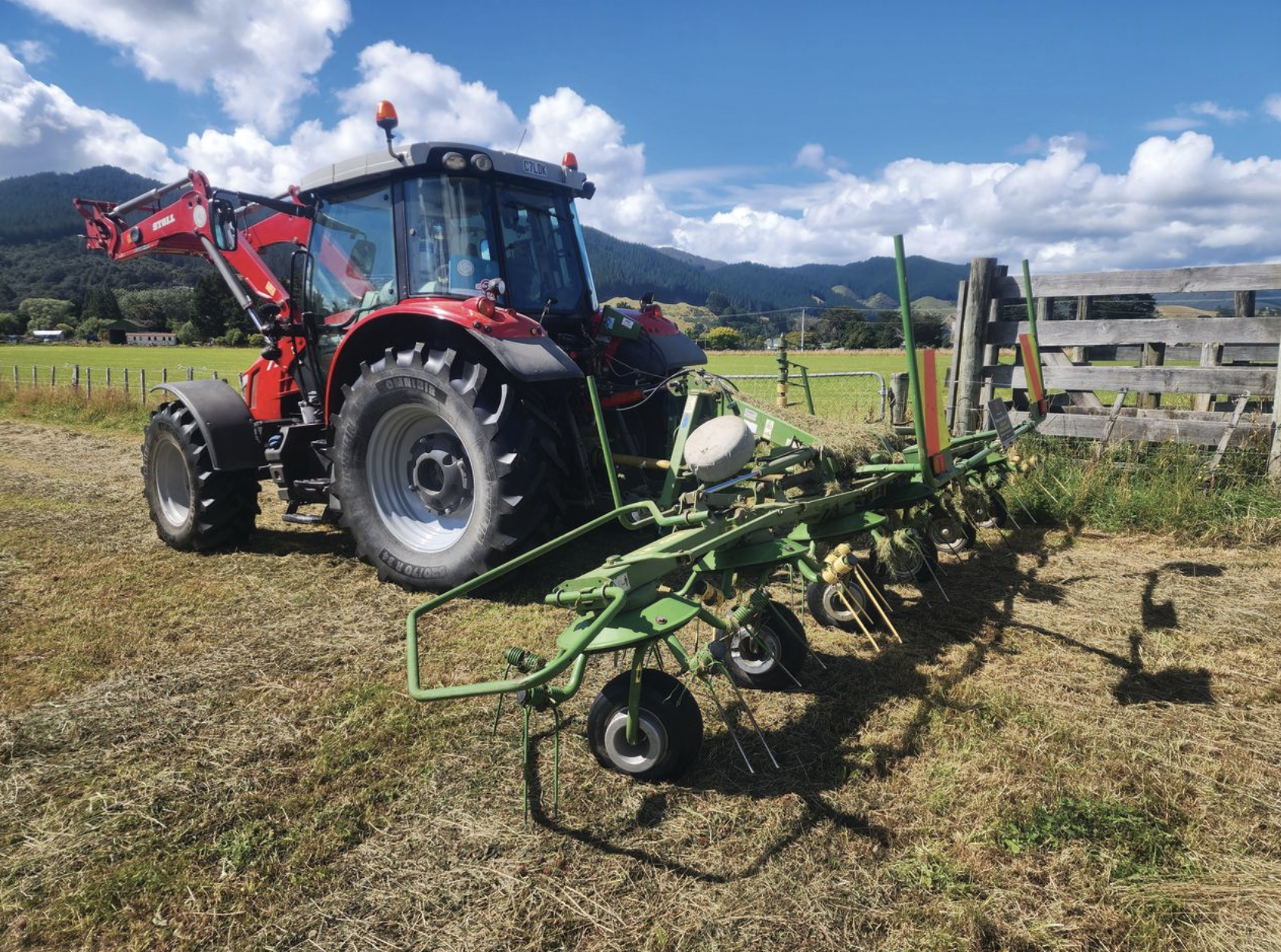
Over the years the contracting fleet has included a long list of Massey Ferguson models, from the MF 165 and MF 188 through to later machines such as the MF 390 and MF 4255 that have carried much of the workload in recent seasons. More recently the fleet has been updated with two Massey Ferguson 5712 tractors equipped with Dyna 4 and Dyna 6 transmissions to handle the demands of mowing, turning, raking, baling, wrapping and transport.
The rest of the haymaking equipment reflects a similar emphasis on practical reliability. A Krone EC280 CV mower conditioner handles mowing duties, supported by a Krone KW6.02/6 tedder and a Massey Ferguson RK662 twin rotor rake. Baling is carried out with a Massey Ferguson 1840 inline baler, producing the small rectangular bales preferred by many horse owners.
Wrapped haylage bales are handled by an Inagra high speed mini wrapper, allowing the team to wrap bales quickly after baling to preserve quality. In earlier years BT Contracting had two different mini bale wrappers, but together they could not wrap enough bales in a day. The Inagra has changed everything and can wrap as many as 100 to 120 bales per hour in a good paddock. It is now not uncommon to wrap 500 to 700 bales in an afternoon. A windrow moisture meter is also used to ensure the crop is baled within the ideal moisture range.
Another development in recent years has seen BT Contracting extend beyond traditional contracting work and into agricultural machinery importing. As Graeme and Mary began to look ahead and gradually reduce the physical workload associated with contracting, they also began exploring ways to remain involved in the agricultural sector while drawing on the experience they had built through decades of working with machinery.
That search led them to the Hummel range of agricultural trailers, a brand manufactured in Turkey for the European market. After seeing the trailers and assessing their construction and specifications, Graeme and Mary made the decision to introduce them to the New Zealand market under the BT Imports banner.
For Graeme the attraction was straightforward. After years of operating equipment across small blocks and lifestyle farms he had developed a clear view of what makes machinery practical and durable in everyday use.
“I’ve spent a lifetime around tractors and machinery,” Graeme says. “You quickly learn what is well built and what isn’t. When we saw the Hummel trailers we were impressed with the strength of the construction and the simplicity of the design.”
The trailers are built to European Union standards and designed for demanding agricultural use, featuring heavy duty chassis construction, hydraulic tipping systems and a range of configurations suited to farm and contracting work. Graeme believes the simplicity of the design is one of their biggest advantages.
There are now more than forty Hummel trailers at work across the length and breadth of New Zealand.
For BT Contracting the move into machinery importing represents a natural extension of a lifetime spent working with equipment. While haylage and haymaking continue during the summer months, the trailer business provides another connection to the rural sector and reflects Graeme and Mary’s ongoing interest in agricultural machinery.
It also allows them to remain active in the industry while gradually stepping back from the more physically demanding aspects of contracting. After decades of working through long summer days making hay and haylage, the shift represents a subtle change of direction rather than a complete departure.
In many ways it reflects the same practical approach that has shaped BT Contracting from the beginning. Rather than standing still, the business continues to adapt, finding new ways to stay involved in the rural community that has supported it for so many years.
“As we’ve got older we’ve looked for ways to stay involved with machinery without doing quite as much of the heavy work,” Graeme says.
One recent addition to the BT Contracting fleet is the purchase of a 1973 Massey Ferguson 135. This is the same model of tractor they started with 18 years ago.
“It’s like going back to the past to remind us of where we started all those years ago. Looking at the two 120 horsepower tractors we run today, we wonder how we did it!” Graeme says.
The 135 is being set up for use as a yard tractor to move pallets and carry out light duties.
Even in semi retirement Graeme remains active during the winter months. Delivering hay and haylage to customers across the Wellington region and Kapiti Coast provides steady off season work.
BT Contracting focuses firmly on maintaining strong relationships with its customers. Graeme believes reliability and communication are the foundations of a successful business.
For Graeme the most satisfying aspect of the journey has been watching the next generation take on the challenge.
“It’s great to see someone younger picking up the baton,” he says. “Contracting is hard work but if you enjoy machinery and working outdoors it can be very rewarding.”
In many ways the story of BT Contracting reflects the broader changes taking place across rural New Zealand. Dairy farms have given way to lifestyle blocks, contracting jobs have become smaller but more numerous, and machinery has evolved to suit different types of land use. Operators grow older and hand over to the next generation. This is the way it has always been and always will be. Change and adaptation are not something to resist but to embrace.
Yet the fundamentals remain the same. Good service, reliable machinery and strong relationships with customers continue to underpin successful contracting businesses, regardless of their size.
For the Taylors, the future of BT Contracting lies not in dramatic change but steady adaptation, maintaining the fundamentals while allowing the next generation to take the lead. In a district where farming has steadily transformed over the past half century, that steady adaptation may be the most valuable asset of all.
Graeme Taylor continues to play an active role in BT Contracting, drawing on decades of experience in farming and machinery.