
All in for farming life – Brodie and Kevin Game
It takes grit and determination to become farm owners without a family farm to fall back on.
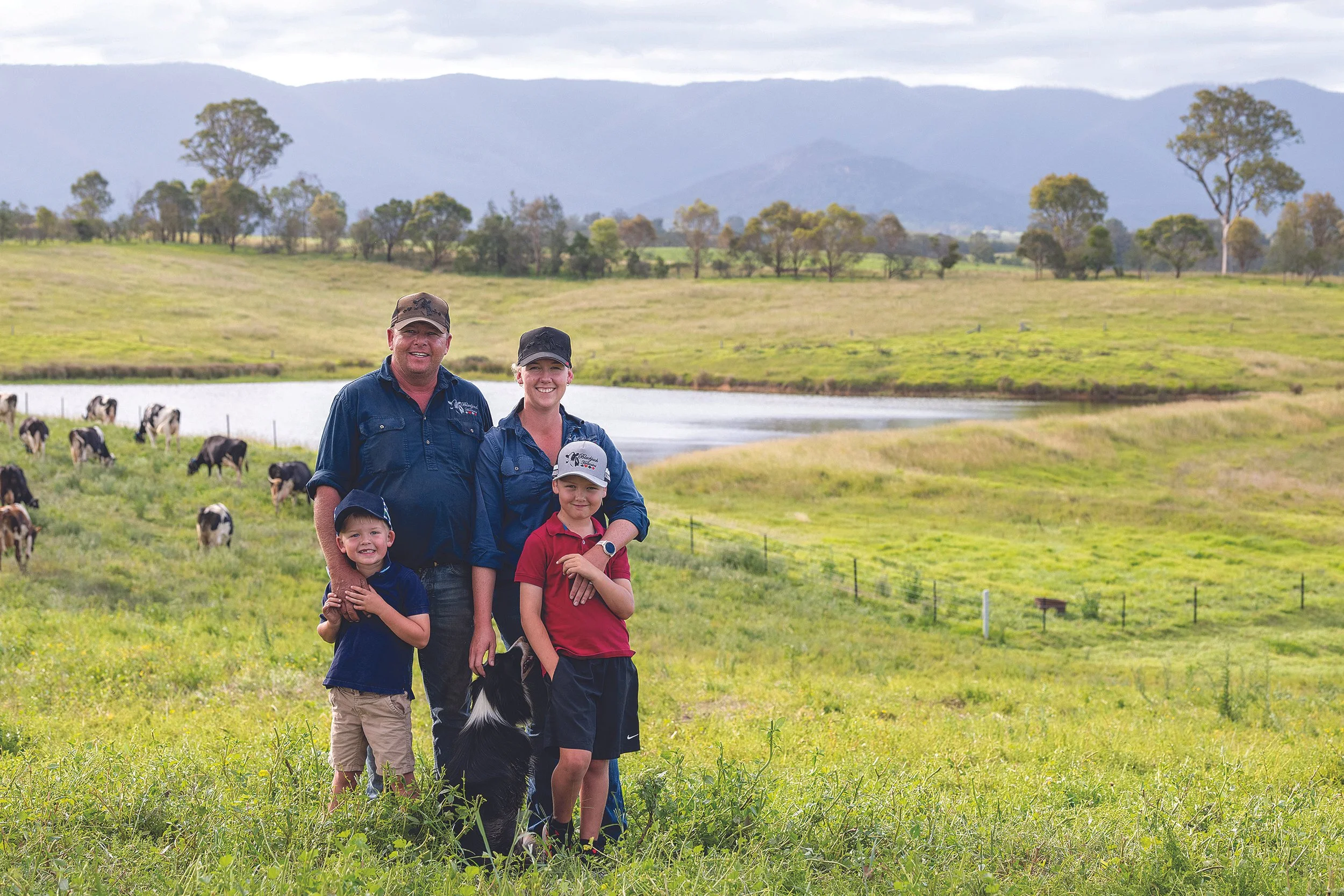
Brodie Game was thrown in the deep end of farm management at a very young age, after inexperience and bad luck saw her and husband Kevin nearly lose it all at the beginning of their dairying careers.
The cowgirl
When she was 10, moving onto a 25-acre lifestyle property at Cootamundra in New South Wales, was the beginning of a love for country living and livestock for Brodie.
The move had seen her mother fulfil her dream of keeping horses.
But despite her best efforts to instil the same enthusiasm in her daughter, Brodie was much more interested in their cattle.
This interest was encouraged by her father who had been a stock and station agent at one time, and firmly held the view that horses spend money while cattle make money.
The Santa Gertrudis steer Brodie got for Christmas one year was one of the first animals she showed on her own.
“Once I realized horses weren't for me, there was plenty of space for cows and shows every weekend because we didn't have that commitment of a full time farm.”
This saw her involved with Hoof and Hook competitions for livestock animals and meat on the hook at secondary school.
As she looked to the future it took some time for Brodie to figure out what kind of a job she could do that would see her able to build a career around country life and livestock.
She toyed with stock and station agency work like her father.
Veterinary science appealed for a time but Brodie found she wasn’t interested in dealing with small animals nor felt she had the emotional capacity for putting animals down and dealing with distraught owners.
Her pathway became clearer when she started doing ‘work experience’ in year 10 at school.
The Cootamundra area wasn’t really dairy country but when Brodie did a stint on a dairy farm, she found it ticked a lot of boxes.
She enjoyed the close daily contact with the cows and the immediacy of decisions in the operation.
Some veterinary type work was also involved with the job, and there were other areas in the dairy industry she could get involved with.
Looking seriously at dairying as a career, it wasn’t long before Kevin Game, who was working in the industry, came on the scene.
Kevin also didn’t have a family farm to fall back on but was determined to eventually own a dairy farm.
Soon, they were planning their dairy future together.
The gamble
Brodie had began working full-time in livestock administration for an agricultural business in Wagga Wagga, while Kevin was working as a farm hand and doing contract fertiliser spreading.
To get a foot in the door they decided they would both work hard and save as much as they could.
They also started raising calves on small leased parcels of grazing land locally, initially with the purchase of two dairy cows, and using the milk to rear any bobby calves they could find.
“An Angus cross dairy calf was always the premium, but we reared a lot of Holstein calves as well.”
In 2012, after two solid years of saving, they felt they had enough in the bank that they could start looking at share farming or leasing.
Brodie credits Kevin’s tenacity with finding a farm.
“He was the one who was sort of just driving down farm driveways knocking on doors to see where we could find that next opportunity, whether it be a share farm or a lease, it was really his focus and drive that got us to that next step.”
Having grown up in Bega, four and a half hours drive away near the coast, Kevin was keen to get back to the area.
He managed to find a farm there that had a lease coming to an end, as the farm needed a bit of work.
After spending their savings on 60 cows, these were trucked to the farm, with the farm owner buying another 140 locally.
But they had no sooner arrived and settled in when disaster struck.
Their animals started to get sick and dying with theileriosis.
“In the first five months, we lost 30 cows with that. We had some amazing support in the local vets that sort of helped us through that period.”
But the problems didn’t end there with a very dry, hard summer and low milk prices.
On top of that, they hadn’t had a formal share farming agreement drawn up with the owner, who then decided he didn't want to continue with the arrangement.
“So the gentleman that owns the farm cancelled and we completely understood, but it was a shit time.”
It was a real ‘fork in the road’ moment for the couple.
Devastated at the thought of their dream ending just as it was beginning and after so much hard work, they looked hard for a Plan B.
This saw them reach an agreement with the farm owner to vendor finance the whole herd.
“We went into full staff management, all of the quality assurance, all the HR, all the financial management. Yeah, we just jumped in headfirst.”
The gamble saw Brodie putting all her admin experience to use and learning a lot more in a very short time, to run the financial and administration side of the farm at just 22 years of age.
Blackjack Holsteins was underway.
Calling in the cavalry
Over the next three years they worked hard and made good progress with the run down property, continuing to grow on young stock.
Another local farmer had been quietly keeping an eye on what they were doing and when they decided not to renew the lease as they had by now outgrown the farm, he offered them the lease on his farm not far away at Bemboka.
Their herd had increased from 270 cows to 400 cows when they were hit hard by another big drought in 2018.
This led to another ‘fork in the road’ moment.
Efforts to stay afloat had seen them drop a second farm they had begun leasing and selling half their herd.
But it still didn't rain and then some significant bush fires started.
Struggling to recover from that drought saw them once again contemplate leaving the industry.
But instead they decided to throw their hat in the ring and try to get into the Focus Farm mentoring programme with Dairy New South Wales.
“We won that opportunity and we got two and a half years with a sort of a peer-supported group of our choosing, with a facilitator that every six weeks met on the farm.
It did mean that we had to share everything - all our financial records, physical records, everything.
We also had to hold about four open days.
So, nothing was hidden.”
By the end of the programme, after making a lot of changes including selling unnecessary assets, not only were their milking cow numbers back up but their finances were solid enough they were able to buy the farm.
Changes afoot
Having ownership has made a big difference not only to their peace of mind but also to the way they farm.
While there is still a mortgage to pay and the inevitable ‘bottom line’, they can now invest in the farm in a way that they wouldn’t have done while they were still leasing.
“When you're leasing a farm you need to sort of work out your payback period as to whether you're going to get your money back in the time that you're leasing that farm.
Now that we know that our home farm is ours and we're a little bit more secure, we're able to do a bit more over longer payback periods.”
This has seen management changes to build climate resilience into the operation along with looking at ways to make a product that is more attractive to consumers - that’s been produced as sustainably as we can, Brodie reckons.
This has seen carbon and emissions become part of their farming vernacular.
“Carbon emissions are becoming such a hot topic.
They're becoming more and more of an issue that it's not going to be a choice of whether we are on board with [reducing] carbon emissions.
Pretty soon it's going to be a requirement to be able to supply a product.
We’re on a path now of trying to adapt.”
Operating as a ‘partial mixed ration’ farm, fresh pasture is included in their feeding system along with silage and some grain.
Pasture management is Kevin’s area and has seen him make changes to help retain soil structure, reduce erosion and retain water, including the use of deep ripping.
A more diverse mix of pasture seed is also used which includes four different clovers, chicory, phalaris, lucerne, and a perennial ryegrass.
As well as drawing up helpful minerals, the deeper rooting perennials in the mix make the pasture more resilient to drought and erosion, while also adding carbon and encouraging more diverse soil life.
“I do understand that farmers can get a bad rap, but that 30 centimetres or however much topsoil is on your paddock is what our livelihood depends on. So, if anyone's going to look after it, it's going to be us.”
Concerns around the carbon footprint of synthetic fertilisers has seen the couple exploring farm effluent and other options for fertilizer which they hope will reduce their footprint, increase microbial activity in the soil along with soil carbon, and reduce input costs.
Synthetic fertiliser use in agriculture, especially urea/nitrogen, is responsible for around five per cent of global greenhouse gas emissions.
While manufacture accounts for a third of these emissions, use on agricultural land accounts for the remaining two thirds.
Over use is widespread among farmers and increasing nitrogen-use efficiency is generally seen as the most effective strategy to reduce these emissions without reducing production.
“I was very naive as to the contribution that synthetic fertilizers actually have on our carbon emissions - we didn't realize how big that contribution was.”
Along with reducing emissions, Brodie and Kevin also want to improve their biodiversity around the farm while maintaining and increasing production.
This has seen them planting trees and different plant species as they can afford it.
Along with increasing biodiversity, this also helps to provide more shade for the animals.
Along with animal welfare concerns - cows start experiencing heat stress once the temperature increases past 20 degrees - this also sees a reduction in milk production as they don’t eat as much.
Being neighbourly
Along with the home farm with a milking platform of 174 hectares and 430 cows the couple also now lease a second 250 hectare farm on their boundary to grow silage, run dairy heifers and dry stock.
While the climate may be considered mild temperature wise, it is fairly volatile in terms of rainfall Brodie reckons.
“We’re often described as being six weeks between a drought and a flood,” she says.
This sees grain production off the table and needing to be brought in.
“You really have to plan to have at least 12 months feed reserves up your sleeve.
But also having your pastures and your fertilizer program ready so that if it does rain, that you are ready to just to go for it because it, it is very hit-and-miss.”
Not having the luxury of being able to wait for contractors, along with Kevin being mechanically minded so they don’t usually have to pay to fix equipment, the couple have invested in their own farm planting/harvesting equipment.
Centred around their John Deere tractors - a 6110M, a 6R 215 and a smaller 950, their attachments are mostly Claas.
“We do all our own [cropping work] with the exception of maize silage.
This really affects our labour costs but we are able to make a higher quality product because we have the gear ready to go when the grass is at its peak.”
Having the gear also sees them happy to help out and contract on small farms close to them with spraying, sowing and silage-making, but they don’t have time for more and also don’t want to get off side with the local contractors they use themselves.
The Homestead
Along with tractors, John Deere’s operation site and satellite connections are also used extensively in their paddock management.
“All our records are on it and it's very simple for staff to use as well.
We can record yields, application rates, rainfall, and mark out different hazards in paddocks.
It just makes it really easy if you've got a changeover of staff in the tractor.
They can just have a map that goes exactly to the paddock that they should be in.
There's a job already created and they can just go out and do the task.
That is filtered back to me in the office and it then fits into all our quality assurance programs.
So I've got withholding reports, applications, wind speeds - it just ticks a lot of boxes and makes life a lot easier.”
They have also been trialling another satellite based program Pasture.io, which looks at pasture growth rates, leaf emergence and grazing availability.
The dairy program is run through Easy Dairy with other production meters in the dairy linking into that including their SenseHub cow collars.
With Brodie looking after the admin and animal side of things and Kevin the machinery and pasture they make a pretty good team.
And while their farm may be fairly middle-of-the-road size wise for the area, it is a farm they have worked hard for with a hand up through advice rather than succession.
Going ‘all in’ early on has paid off for the couple and sees them enjoying the kind of country life they always wanted.
And should their sons, nine-year-old Roy and Harry at six, also decide to go farming in the future they are likely to have an easier path.