
Built for scale: Massey Ferguson’s double baler steps In
There is a point in every haymaking season where output becomes everything. Weather windows tighten, labour becomes stretched and the margin between a good result and a compromised crop narrows quickly. It is in that environment that machinery has to do more than simply work, it has to lift productivity without adding complexity. That is the thinking behind the introduction of the Massey Ferguson MF SB.1436DB double small square baler into the New Zealand market, a machine that is clearly aimed at commercial operators looking to increase output while maintaining bale quality.
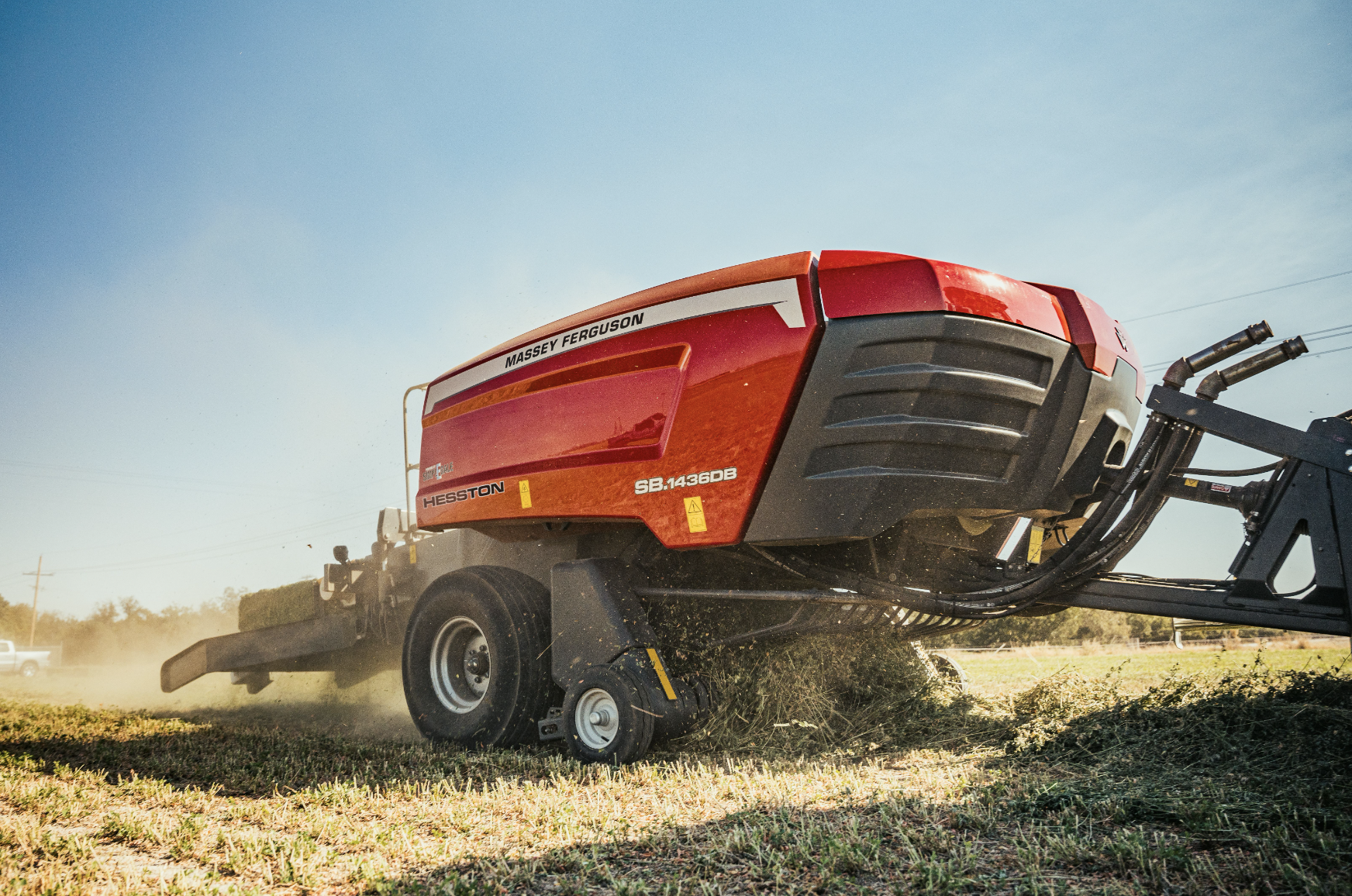
At the centre of the SB.1436DB is a simple but significant shift in how small square baling is approached. Rather than producing a single row of bales per pass, the machine delivers two, effectively doubling output compared to a conventional 14 by 18 inch baler. That change alone has direct implications for labour, fuel use and overall efficiency, particularly in larger scale operations, where time in the paddock is critical.
As Josh Vroombout, Senior Marketing Manager for Massey Ferguson Australia and New Zealand, explains, the machine has been developed with those pressures in mind.
“The SB.1436DB is built to meet the needs of modern hay producers who face increasing pressure from labour shortages, tight harvest windows and demanding quality standards,” he said.
“With its heavy-duty design and groundbreaking technology, this baler helps operators achieve better efficiency and superior results, reducing costs while increasing profitability.”
That focus on output is supported by the machine’s physical design. A 2.1 m wide pick up when measured tine to tine, one of the widest in the high-capacity small square baler category, allows for greater intake of crop and more efficient movement through the machine. In practical terms, that reduces the number of passes required across a paddock and ensures the baler can keep up with high-volume windrows without bottlenecking.
However, capacity on its own is not enough. In a market where small square bales are often destined for premium uses, consistency is just as important as output. The SB.1436DB addresses this through a single chamber design that produces a 14 by 36 inch flake, which is then split into two uniform 14 by 18 inch bales. This process is supported by a common density system, ensuring both bales receive the same level of compression.
The result is a product that is consistent in weight, shape and density, regardless of variations in the windrow. Independent knotter trips on either side of the chamber allow each bale to be tied to a preset length, maintaining uniformity even when crop conditions change. For operators supplying demanding markets, that level of consistency is not just beneficial, it is essential.
Technology plays a key role in delivering that outcome. The SimplEbale system is central to the SB.1436DB’s operation, providing automated control over key baling functions. From the cab, operators can monitor flake thickness, flake count, bale length and bale weight in real time. It is a level of visibility that allows for immediate adjustment and ensures the machine is operating at optimum performance.
More importantly, the system removes a level of operator variability that has traditionally impacted productivity. Vroombout highlights the impact of small inconsistencies, noting that
“With a target of 18.1 kilograms and 12 flakes per two-tie bale an operator can lose seventy-one bales per hour and 1,300 kilograms per hour of productivity by just averaging two extra flakes per bale. This can cost over eight hours of additional baling time.”
By automating these settings, SimplEbale ensures that output remains consistent, regardless of operator experience.
Performance is further supported by the machine’s operating speed. Running at 90 strokes per minute with a 556 mm stroke length, the SB.1436DB is designed to maintain high throughput without compromising bale integrity. That level of output requires a suitable power unit, with the baler needing a minimum of 120 PTO horsepower and a tractor weight of at least 5,000 kg. This places it firmly in the commercial category, aligned with larger operations and contractors.
Uptime is another area where the SB.1436DB has been engineered with practical use in mind. Increased twine capacity allows for up to 8,000 bales before refilling, effectively doubling the capacity of comparable machines. In a high-pressure harvest window, reducing the frequency of stops can make a significant difference to daily output.
The inclusion of automated knotter lubrication further reduces maintenance requirements, ensuring consistent performance while minimising manual intervention. Combined with service-friendly access to key components, the machine is designed to keep operators in the field for longer periods, reducing downtime and improving overall efficiency.
Handling and logistics have also been considered in the design. By dropping completed bales into two separate rows, the SB.1436DB simplifies collection and transport. This may seem like a minor detail but, in practice, it improves workflow, particularly when using bale wagons or loaders and reduces the time required to clear paddocks.
From a New Zealand perspective, the introduction of the SB.1436DB aligns with broader changes in the hay and forage sector. As operations scale up and labour becomes more constrained, the focus is increasingly on machines that can deliver more output with fewer inputs. The ability to double production per pass directly addresses that challenge, while the emphasis on consistency ensures that quality is not sacrificed in the process.
The machine’s recognition as a 2026 AE50 Award winner by the American Society of Agricultural and Biological Engineers reinforces its position as a significant development in baling technology. It reflects not just incremental improvement, but a step change in how small square baling can be approached.
There is also a legacy aspect to consider. Massey Ferguson has been involved in hay equipment for more than 75 years, with a history of introducing machines that have shaped the industry. The SB.1436DB sits within that lineage, building on established principles while introducing new technology to meet current demands.
As Vroombout puts it,
“The SB.1436DB is not just another baler, it is a testament to Massey Ferguson’s commitment to innovation and to the producers who depend on our equipment to succeed. With this baler we are delivering the tools needed to achieve better productivity, better quality and better profitability.”
For contractors and large-scale hay producers in New Zealand, those outcomes are what matter. Machinery is judged not on specification alone but on its ability to deliver results in a narrow window of time, often under pressure and in variable conditions. The SB.1436DB has been designed with that reality in mind.
It is a machine that recognises where the pressure points are in modern haymaking and addresses them directly through increased capacity, automated control and a clear focus on consistency. In doing so it offers a different approach to small square baling, one that reflects the scale and demands of the systems it is designed to serve.