
Built for the ground that fights back
There is a certain type of contractor who is shaped as much by place as by trade, and on the West Coast that shaping tends to be uncompromising.
The country is tight, the weather is unpredictable and the ground rarely gives anything away easily. It is the sort of environment that exposes weaknesses in both people and machinery very quickly, but it also produces contractors who understand their ground better than most and who build businesses around doing the difficult work properly.
Fairhall Agri Services sits firmly in that category. Based out of Greymouth and working across a wide stretch of the Coast, the business has evolved into a specialist operation focused on cultivation, direct drilling, fertiliser spreading and earthmoving, with a reputation built less on scale and more on consistency and finish.
Darryn Fairhall’s path into contracting was never in doubt. As a fifth generation West Coaster, raised in a family where contracting and gold mining were part of daily life, the exposure came early and it came hands on. By the age of eight he was driving tractors and by 10 he was on bulldozers, learning not just how to operate machinery but how to read ground and conditions.
That early grounding still underpins the way the business operates today.
“We don’t touch green grass. We did harvest when we started, but we made a conscious effort to pick one service and do it well,” Fairhall says.
That decision to narrow the focus has proven to be one of the defining moves in the business. Rather than spreading resources across multiple services, Fairhall Agri Services has concentrated on the areas where it can add the most value, particularly in ground preparation and finishing work, where attention to detail separates contractors very quickly.
Over time that focus has seen the business involved in a wide range of projects, from large-scale dairy conversions through to sports field construction and specialist land development work. At one point dairy conversions formed a significant part of the workload, with the company completing 11 major projects that involved everything from bulk earthmoving through to final pasture establishment.
When the dairy payout dropped and that work dried up almost overnight, the business had to adjust. It is a moment that many contractors will recognise, where external factors force a rethink, but in this case the shift played to an existing strength.
“Our attention to detail, high quality of finish and understanding of drainage solutions allowed us to take on sports field work,” Fairhall says.
That willingness to prioritise finish over speed opened up a different type of work. Sports fields, golf courses, bowling greens and even croquet courts demand a level of precision that is rarely required in standard agricultural work. The tolerances are tighter, the expectations higher and the margin for error much smaller.
On the West Coast, achieving that level of finish brings its own challenges. The terrain is broken, the soils variable and the weather can shift within hours. Long, narrow valleys create microclimates that mean conditions can differ dramatically over relatively short distances, so timing and local knowledge become critical.
That is where experience comes to the fore. Knowing when to move, when to hold off and where to work can be the difference between a job that progresses smoothly and one that becomes unnecessarily difficult. It is also why the business tends to operate within a defined geographic range, generally working between Reefton in the north and Franz Josef in the south, where that local understanding can be fully utilised.
While the workload has diversified over the years, the core of the business had remained grounded in cultivation and drilling. Direct drilling, in particular, had become an increasingly important part of the operation, reflecting wider industry trends towards efficiency and soil management, but also the practical realities of working in challenging conditions.
Finding equipment that can cope with those conditions has never been straightforward. Early on, Fairhall found that standard approaches were not delivering consistent results, particularly when it came to seed placement on uneven ground.
At a time when seed was commonly mixed with fertiliser and spread, the limitations of that method became clear, especially in windy conditions where distribution could be uneven. Rather than accept that, he built his own solution.
To address the issue, in 2001 he designed and constructed a folding six metre frame fitted with an Accord air seeder, towing harrows behind it to ensure better seed placement. It was a practical response to a practical problem and one that is still in use today.
“Back in the day there was nothing like a folding air seeder over here,” he says.
That willingness to modify or build equipment to suit conditions remains a defining feature of the business. Much of the machinery in the fleet has been adapted in some way, whether to improve durability, increase efficiency or allow work to continue in marginal conditions.
On the Coast, where timber and stone are often hidden beneath the surface and ground conditions can change rapidly, standard specifications rarely hold up without some level of reinforcement or adjustment.
“We have to work around the weather. We modify gear to work both earlier and later in the day and as rain approaches and then leaves,” Fairhall says.
That approach extends across the fleet. Bulldozers and excavators are fitted with laser systems to ensure accurate shaping and grading, particularly on projects where finish is critical. What began as a requirement for sports field construction has since been applied more broadly across building sites, yards and general earthworks.
The move into dozer work itself came from necessity. Early attempts to use tractors for earthmoving resulted in excessive tyre damage, particularly in stony conditions, which led to the decision to bring in six-way blade bulldozers to handle the bulk work.
Over time that evolved into ownership, with Komatsu machines forming a key part of the operation. Their low ground pressure and long track frames make them well suited to levelling work, allowing for both efficiency and a higher quality finish.
Levelling itself has become something of a speciality after building his first I-Beam leveller in 1991. After its initial success they redesigned it to be hydraulicly operated like a six-way blade; four were subsequently built which are still in use today. These custom built levellers allow significant volumes of soil/gravels to be mixed and swept across the surface removing large stones/debris while filling ruts and holes maintaining a controlled finish, effectively acting as a grader blade behind the tractor.
These tools played a role in securing early work with large scale developments and continue to underpin the finishing side of the business today. The ability to reshape land accurately and efficiently is a skill that translates across multiple job types, from agricultural conversions through to civil style work.
Cultivation equipment is selected with a similar mindset. Where light work is required, disc harrows provide an efficient solution, but for more intensive reshaping the business relies on heavy duty rippers capable of working deep into the profile.
“If the paddock doesn’t need much work, then discs are good, but to cultivate deeper we use a set of Hubbard’s Hercules rippers. They are real grunters or one of our bulldozers to pre rip,” Fairhall says.
Seeding is handled through a combination of machinery; their six-metre Taege drill formed the backbone of the operation. The ability to handle multiple products, including fertiliser, seed and insecticide, allowed flexibility across a wide range of crops, from pasture species through to brassicas and forage crops.
“It was a huge success. I needed the productivity and it had to be really robust,” Fairhall says of the Taege drill.
Productivity and durability are recurring themes. On the Coast, machinery does not get an easy life, so equipment that can maintain output without excessive downtime is essential. At the same time, maintaining relationships with manufacturers and suppliers has become increasingly important, particularly where modifications and feedback can lead to incremental improvements.
Fertiliser spreading remains another key part of the workload. The business has invested in equipment that can handle large payloads while maintaining accuracy, particularly important given the cost of inputs and the need for precise application.
“They are very accurate, especially with nitrogen,” Fairhall says.
Accuracy in this area is not just about product placement but about efficiency. With input costs continuing to place pressure on farmers, the ability to apply fertiliser consistently and without waste is increasingly valued, and contractors who can deliver that reliably are in strong demand.
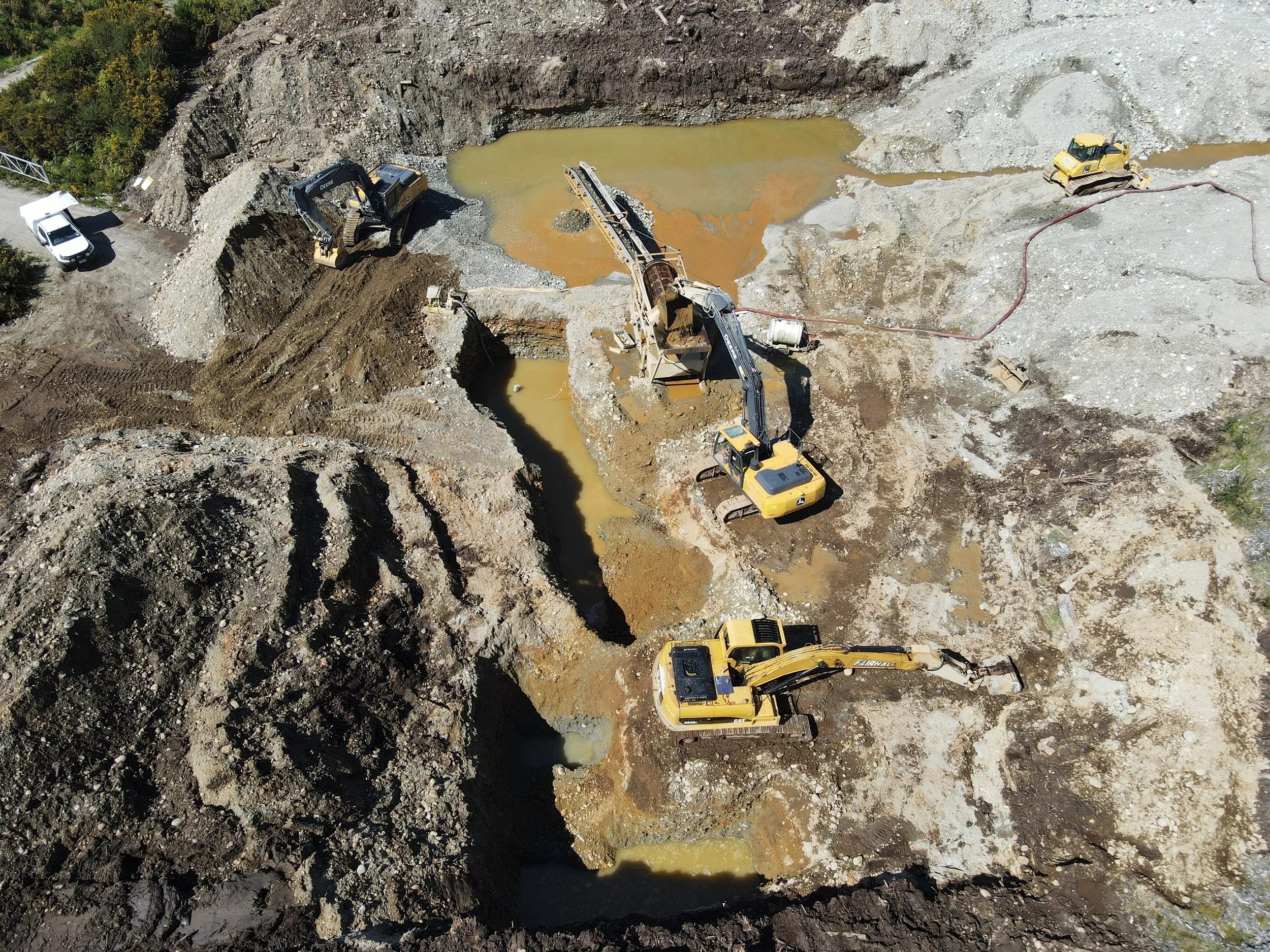
Beyond agriculture, the business has also developed a niche in land restoration work, particularly around historic gold mining sites. On the West Coast, where legacy mining activity has left its mark across large areas, there is ongoing demand for contractors who can work with challenging ground and reshape it for modern use.
That type of work requires a different mindset again, combining an understanding of ground conditions with an appreciation for the history of the land and the expectations of landowners looking to improve it.
The client base itself reflects the diversity of the work. They have also undertaken significant farm flood repair works after both the 2019 Franz Josef floods and the 2021 Ashburton flood events, spending many months with bulldozers and tractors reinstating farm paddocks back into production.
Dairy farmers remain a core component, but are now joined by lifestyle block owners, local authorities and forestry companies, particularly in areas such as road maintenance and access development.
Forestry, in particular, also added another dimension, with work around logging infrastructure providing additional consistency in what can otherwise be a seasonal workload.
Staffing, as with many contracting businesses, presents its own challenges. The nature of the work means demand can fluctuate, making it difficult to maintain a large permanent team. As a result, the business operates with a small core group supported by casual labour as required.
Experienced operators, particularly those with local knowledge, are highly valued. The ability to step into a job and understand both the machinery and the ground conditions without extensive oversight is a significant advantage in a business where efficiency is closely tied to experience.
At the same time, the next generation is already involved. Fairhall’s son Cody is working in the business full time, bringing both formal agricultural training and practical experience. That transition is an important part of the long-term outlook.
“My son wants to take over, so the business has to remain economic and sustainable,” Fairhall says.
That focus on sustainability is not about expansion for its own sake. If anything, the approach is measured, with an emphasis on maintaining a manageable workload while ensuring the business remains profitable and resilient.
“We are not just growing the business, but we do want to make it more economic,” he says.
It is a pragmatic view, shaped by years of operating in an environment where margins can be tight and conditions unpredictable. Growth without control can quickly create pressure, particularly in a region where work can be inconsistent through winter months.
Winter itself remained a quieter period, often used for maintenance and preparation. While occasional earthmoving projects provide some continuity, the seasonal nature of contracting is still very much present.
Against that backdrop, the ability to deliver consistent results across a broad range of work has become the defining strength of Fairhall Agri Services. Whether it is reshaping a paddock, establishing pasture, building a sports field or restoring land, the underlying approach remains the same.
There are no shortcuts, particularly on the type of ground the business operates on. Each job requires an understanding of conditions, the right combination of machinery and a willingness to take the time needed to achieve the desired result.
“We know how to get results in the difficult stuff. There are no shortcuts,” Fairhall says.
That philosophy, combined with a practical approach to machinery and a deep understanding of the local environment, continues to position the business strongly within its region. In an industry where scale is often emphasised, Fairhall Agri Services demonstrates that there is still significant value in doing a specific set of tasks exceptionally well.
In 2024 Fairhall Agri Services decided to have a serious look at complementing their income with their own gold mining operation to ensure continuity of work and income all year round, giving the security of full-time employment to staff. Although it has taken significant financial input, this has proved to be very timely and prudent move, with the lift in the gold price over that period making it a sound economic decision for the business.
This, coupled with their solid reputation, previous gold mining experience, knowledge, ability and commitment to putting the ground back to “better than before”, has provided access to mineable ground going forward.
This venture balances the business well and is an area Fairhall has a special interest in.
Looking ahead, Fairhall Agri Services has recently sold the direct drilling side of the operation, which has been a key component to the success of the business over the last decade. A local contractor has taken this on who will continue to provide the high standard of work their customers expect.
“This has given us back 600–700 machine hours/annum to refocus on our gold mining operations, along with our increasing role in gold mine restoration work for ourselves, and other local mine operators. We will continue our agri operations for our current clients, which will keep us well grounded and busy enough going into the foreseeable future.”