
Built for the long haul
Contracting businesses often evolve in response to opportunity. A farmer asks if you can tackle another job while you're already on the property, a neighbouring contractor retires, or a piece of machinery opens the door to work that wasn't previously available.
Before long, what started as a single service has grown into something much broader. That has very much been the story behind Coastal Contracting, a Northland business that has steadily expanded by responding to what its clients needed rather than chasing growth for its own sake. Today, the Waipu-based operation carries out everything from mowing, baling and cultivation through to direct drilling, mulching, roadside maintenance and hedge trimming, providing a year-round service to dairy, sheep and beef, lifestyle and forestry clients across the region.
Looking back, however, the business began much more simply. Matt Sandford grew up on the family dairy farm at Waipu, where machinery quickly became the attraction. Like many young contractors, he enjoyed the farming lifestyle, but it was always the tractors, implements and the variety of contracting work that held his attention. School holidays were spent working for local contractor Graham Borck before another opportunity came along with Waipu contractor Garry Coutts, who specialised in cultivation work. After spending a season driving for Garry, Matt was presented with an opportunity that few 19-year-olds ever receive. Garry decided it was time to sell the business and, together with his father Wayne, Matt purchased the operation in January 2012.
While father and son bought the business together, there was never any doubt who would be driving it forward. Wayne remained heavily involved during those early years, providing advice, support and an experienced sounding board whenever required, but the intention was always for Coastal Contracting to become Matt's own operation. The business initially came with a New Holland T7040 tractor, together with the cultivation equipment needed to establish a customer base throughout the district, while Kelly took care of the administration and bookkeeping, allowing Matt to concentrate on developing the business and building relationships with clients.
Like many young New Zealand contractors, Matt also looked overseas to broaden his experience. Rather than sitting through the New Zealand winter waiting for spring to return, he spent three seasons working in Lincolnshire in the United Kingdom, where the scale of contracting was unlike anything he had previously experienced. Operating large square balers, driving a wide range of tractors and eventually learning to use a McConnel reach mower exposed him to different machinery and different ways of approaching contracting. It also reinforced an important lesson that has remained with him throughout the development of Coastal Contracting. Machinery should earn its keep. If a machine can create another income stream or allow the business to work when others are parked up waiting for the weather to improve, then it is worth considering.
That thinking became particularly important once Matt returned home. Northland contracting is rarely straightforward. Farms are spread across a wide geographical area, the terrain varies enormously and weather windows can disappear almost as quickly as they arrive. For much of the year contractors are balancing travel time, changing conditions and customer expectations, while trying to make the most of every available hour. Simply relying on spring cultivation or silage work was never going to provide the consistency needed to build a sustainable business. The challenge was finding complementary services that would both strengthen the operation and provide clients with additional value.
One of the first opportunities came from existing customers who began asking if Coastal Contracting could also provide baling. Having already operated New Holland balers in the United Kingdom, Matt was confident the work was there, but he also recognised that labour would quickly become one of the biggest costs if he wasn't careful about how the business developed. Instead of purchasing separate baling and wrapping equipment, he chose to lease a New Holland Roll-Belt 125R combination baler-wrapper. The combi unit allowed one tractor and one operator to complete the entire job, reducing labour requirements while improving output during the busiest periods of the season. It was a practical decision that reflected the way the business continues to invest today. Every machine needs to improve efficiency or create another opportunity.
The move into baling proved to be the right one. Within only a couple of seasons demand had increased sufficiently to justify purchasing a new Kuhn combibaler, giving Coastal Contracting a modern baling platform while continuing to keep operating costs under control. It also opened another opportunity with the purchase of a medium square baler, allowing the business to produce hay during January when silage demand traditionally eased. Again, it wasn't simply about owning another machine. It was about making better use of the calendar. Rather than accepting quieter periods, Matt was steadily adding services that filled those gaps and generated additional revenue throughout the year.
The same thinking eventually led to the purchase of a second-hand McConnel reach mower. What had started as experience gained in England quickly became another valuable part of the Coastal Contracting operation back home. Farm hedges, shelterbelts, forestry access tracks and roadside vegetation all required regular maintenance, and, importantly, that work existed through winter when many agricultural contractors traditionally found themselves with less to do. The reach mower gave Coastal Contracting an entirely different customer base while allowing existing clients to keep using the same contractor throughout the year. It also offered obvious safety advantages over trimming trees and hedges with chainsaws, while leaving a tidy finish that required little further clean-up.
That ability to provide work across every season has arguably become one of the defining characteristics of the business. While spring remains dominated by cultivation, direct drilling and early silage, summer quickly moves into mowing, baling and hay production before autumn returns to pasture renewal, under-sowing and grass establishment. Winter then becomes the time for hedge trimming, roadside maintenance, machinery servicing and preparing for another season. It creates a much more balanced workload than relying on one or two seasonal peaks and, just as importantly, helps justify investment in machinery that might otherwise spend months sitting in the shed.
The machinery fleet has naturally evolved alongside that growth. What began with a single New Holland tractor and a handful of cultivation implements has developed into an operation capable of handling multiple jobs across the season without compromising efficiency. One of the biggest investments came with the purchase of a New Holland T7.245, a tractor Matt still describes as being the right balance of power and agility for Northland conditions. Producing around 190 hp, with additional boost available when required, it was selected not simply because it could handle the existing workload but because it also provided capacity for larger cultivation and drilling equipment as the business continued to grow.
That decision highlights something that becomes obvious when looking through the Coastal Contracting fleet. Very little has been purchased on impulse. Every machine has been chosen because it fills a specific role and complements the equipment already in the shed. In many contracting businesses there can be a temptation to chase horsepower or invest in machinery that spends much of the year parked up. Matt has largely avoided that trap by ensuring every purchase broadens capability or improves efficiency. It is a philosophy that not only controls capital costs but also allows machinery utilisation to remain high throughout the year.
Direct drilling is a good example of that thinking. While conventional cultivation remains an important part of the business, changing farming systems have seen increasing demand for reduced tillage and direct establishment. Farmers are often looking to minimise cultivation costs, preserve soil moisture or simply make the most of increasingly tight weather windows. Rather than viewing direct drilling as a replacement for cultivation, Coastal Contracting has developed the capability to offer both systems, allowing farmers to choose the approach that best suits individual paddocks and seasonal conditions.
The Allen Custom triple disc Drill has become an important part of that operation. Built with 24 runs on five-inch spacings and capable of placing seed and fertiliser together, it handles crops including chicory, rape and sorghum while also performing well when under-sowing through existing kikuyu pasture. Matt has spoken previously about how impressed he has been with the drill's ability to cut cleanly through heavy pasture and establish consistent crops, particularly during seasons where conditions have challenged more conventional establishment methods.
At the same time, conventional cultivation equipment remains fully utilised. A combination of Super Grubber rippers and a 5 m power harrow with air seeder that gives the business flexibility across different soil types and a one pass seeding application. Much of that work supports maize establishment, where achieving a quality seedbed remains critical, but the equipment is equally valuable across a wide range of pasture renewal programmes. The important point is that Coastal Contracting has resisted becoming locked into one establishment philosophy. Farmers face different conditions every season and every paddock presents its own challenges. Having the ability to move between direct drilling and conventional cultivation allows recommendations to be based on practical outcomes rather than machinery ownership.
Grass harvesting, however, remains one of the cornerstones of the business. Northland's climate often creates narrow opportunities for producing quality silage, and contractors who can work efficiently during those windows quickly become valuable partners for their clients. Coastal Contracting's mowing combination of now a set of Kuhn Triple mowers allows 8.5 m of cutting width while still maintaining good contour following across the rolling country that characterises much of the region. Matt has consistently praised the ability of the mower conditioner's combination to handle uneven ground while producing a clean cut, an important consideration when working across everything from dairy support land through to steeper beef country.
Equally important is the raking operation. On paper, a rake may not attract the same attention as a high-horsepower tractor or modern baler, yet it has a significant influence on crop presentation and ultimately bale quality. The Kuhn two-rotor rake used by Coastal Contracting features independent rotor lift, allowing operators to manage awkward paddock shapes without dragging material into outside rows. On Northland farms where streams, gullies and irregular boundaries are common, that flexibility becomes much more than a convenience. It improves presentation to the baler, reduces contamination and helps produce a more consistent finished product.
The Kuhn combi baler-wrapper represented another major step forward for the business. Beyond simply increasing output, Matt was quick to recognise the advantages offered by film-on-film technology. Customers immediately noticed improvements in bale density and grass fermentation, with tighter bales also improving storage and handling during transport. The ability to carry additional rolls of wrap reduced downtime throughout the day, keeping the machine productive during the short harvesting windows that often define Northland silage making.
Over the past two years Coastal Contracting has continued to expand its services with their silage equipment.
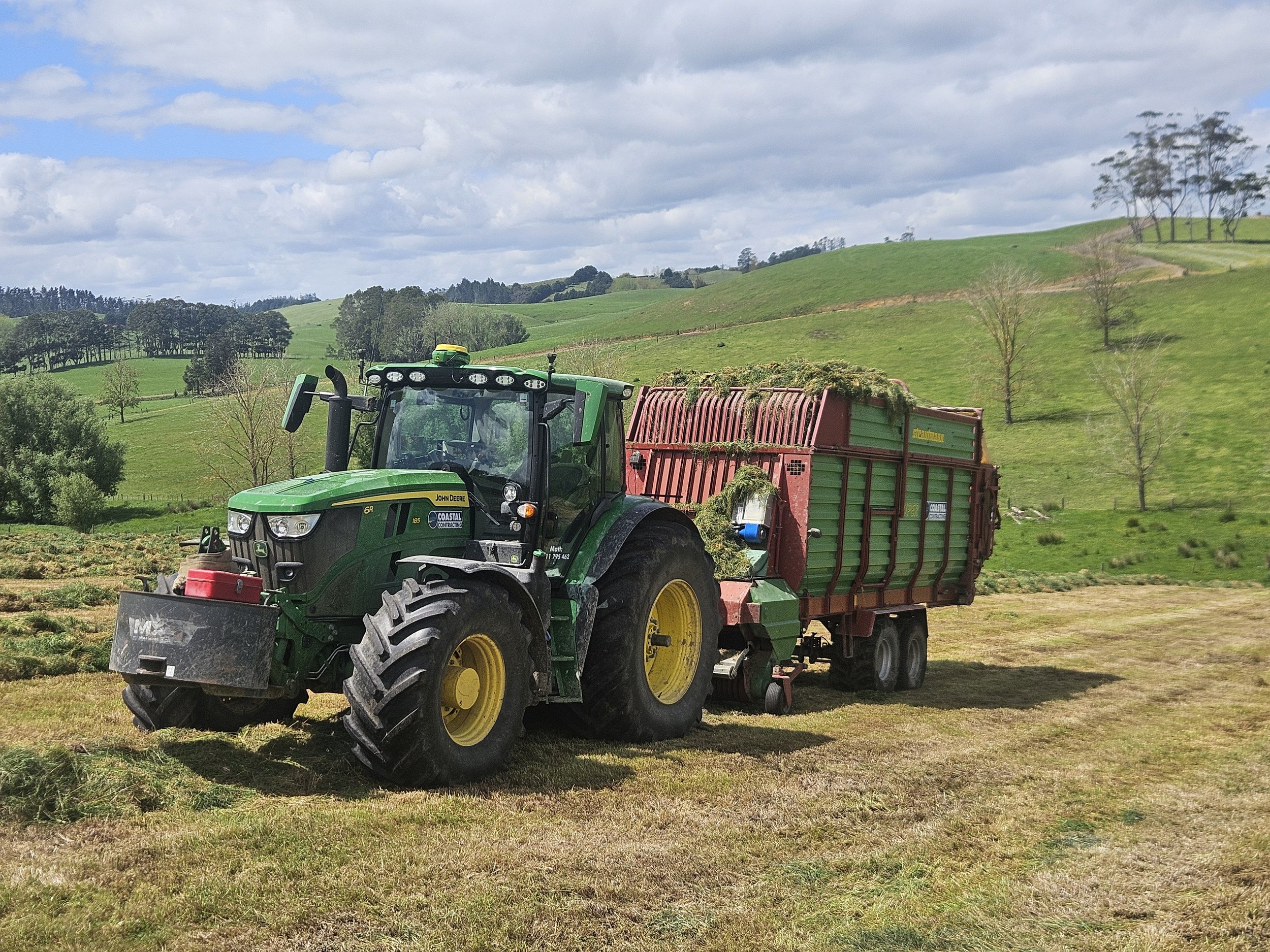
Coastal Contracting has continued to grow, expanding its services to meet the evolving needs of local farmers. This has included the purchase of a Strautmann loader wagon, which has now been operating for two seasons and allows the business to offer pit silage alongside its baled silage operation. The business also leases a 20ha block, harvesting up to five cuts per season when conditions allow, with each load weighed and supplied to local dairy farms. Following the retirement of a long-standing Waipu contractor, Coastal Contracting added a second combi baler and seed drill, further increasing its workload and capacity. Today, the team has grown from two to three staff and the fleet now includes four tractors, reflecting the steady expansion of the business and the range of services it provides.
Quality has always been a strong focus throughout the baling operation. Inoculant application forms part of the process, particularly during the early part of the season when crops can be exceptionally lush and moisture levels remain high. Producing good silage has never been simply about making bales. It is about helping clients produce better feed, improve animal performance and maximise the return from every hectare harvested. Those are the details that often separate experienced contractors from those focused purely on output.
Like every contracting business, Coastal Contracting has also experienced its share of difficult seasons. Northland weather has a habit of testing both farmers and contractors, sometimes within the same year. Extremely wet springs can delay cultivation and silage, while dry summers can dramatically reduce grass growth and alter the entire workload. Matt has experienced both ends of that spectrum. One particularly challenging season began with persistent wet weather before quickly swinging towards drought conditions, reducing silage production and creating significant pressure once rain finally returned. Crops that would normally have been planted over several months suddenly needed to go into the ground within a matter of weeks. For contractors, those sorts of seasons demand flexibility, careful planning and a willingness to adapt quickly as conditions change.