
Built on trust, carried forward
When Rural Contractor & Large Scale Farmer first featured Wolland Contracting in 2003, the business was already deeply embedded in the rural fabric of the Tararua district, known for dependable service, well-kept gear and a straightforward approach to getting the job done properly.
More than two decades on, that original story still matters, not because the business has stood still but because it provides a reference point for how carefully managed growth, generational transition and a strong family culture can carry a contracting operation through periods of enormous change without losing its identity. Wolland Contracting today is a very different business in scale, capability and complexity, yet it remains unmistakably shaped by the same values that defined it in those earlier years.
The roots of the business stretch back to the early 1970s, when Maurice Wolland took his first steps into agricultural contracting after growing up immersed in rural life around Pahiatua. Like many of his generation Maurice learned early that farming and contracting were built on long days, physical work and a willingness to turn up regardless of conditions. After leaving college in 1968 he spent time milking cows, gaining a practical understanding of farm systems and seasonal pressures that would later shape how he approached contracting work. With encouragement from his parents, Maurice and his brother began doing small contracting jobs using their father’s tractor and baler, servicing neighbours and local farmers who needed help at peak times. It was modest work by today’s standards, but it laid the foundation for a business built on trust, reliability and a strong work ethic.
By 1974, Maurice had bought out his brother’s share of the operation and committed fully to building his own contracting business. At a time when many farmers still owned and operated much of their own machinery, choosing to specialise in contracting required confidence and a clear understanding of where farming systems were heading. Maurice invested carefully, upgrading machinery as demand increased and reinvesting profits back into the business rather than chasing rapid expansion. Early tractors such as the Ford 3000 gave way to larger and more capable machines, including the Case 970 and later the International 1086, which opened the door to more intensive silage work and broader cultivation services. Each investment was made with purpose, aligned to the needs of local farmers and the realities of working in the district’s soils and climate.
The arrival of a John Deere 4440 in the early 1980s marked a significant moment for the business not just in terms of horsepower and productivity, but in establishing a machinery philosophy that would endure. The reliability and performance of that tractor left a lasting impression, and over time John Deere became the backbone of the Wolland fleet. This was never about brand loyalty for its own sake, but about choosing machinery that operators trusted and that could be supported effectively in the region. As the business grew through the 1980s and 1990s, that approach allowed Wolland Contracting to maintain consistency across its fleet, reduce downtime and focus on delivering quality work rather than managing constant machinery issues.
Those decades were characterised by steady growth rather than dramatic expansion. Maurice built the business by listening to farmers, understanding their systems and responding to changes as they emerged. The rise of outsourced silage and cropping work, increasing farm scale and tighter seasonal windows all contributed to growing demand for professional contractors who could bring both machinery and expertise to the job. Wolland Contracting expanded its services accordingly, investing in fine chop harvesters, mower conditioners and transport capability to support full silage operations rather than isolated tasks. By the time the business was featured in this magazine in 2003, it had already earned a reputation for being organised, reliable and capable of handling complex seasonal workloads.
Looking back across the decades also highlights how dramatically the contracting environment has shifted, particularly since the early 2000s. When Wolland Contracting was first featured in this magazine, machinery size and complexity were increasing but still largely mechanical, seasonal pressure existed but was manageable and compliance sat largely in the background of daily operations. Today, contracting sits at the intersection of technology, logistics and regulation with operators expected to manage sophisticated machinery, digital systems and strict safety and environmental standards simultaneously.
Farm systems have scaled up, weather patterns have become less predictable and seasonal windows have tightened, increasing the reliance on contractors who can deliver accurately and on time. The modern contractor must plan weeks ahead, communicate clearly and adapt quickly when conditions shift, often across multiple jobs running in parallel. That evolution has reshaped the skill set required to succeed in the industry and has reinforced the importance of businesses that combine technical capability with experience and judgement. Wolland Contracting’s longevity reflects its ability to move with these changes rather than resist them.
Behind that growth sat a strong family partnership. Maurice’s wife Christine played a central role in the business, managing administration and providing the organisational backbone that allowed the contracting side to function smoothly. In many ways, her contribution reflects a reality common to family contracting businesses, where success depends not only on what happens in the paddock but also on the systems, records and relationships managed behind the scenes. Together, Maurice and Christine created a business environment where staff were valued, customers were treated fairly and long-term relationships mattered.
As the years progressed, succession became an increasingly important consideration. Like many family businesses, Wolland Contracting faced the challenge of balancing respect for the founding generation with the need to prepare the next. Their son Jamie joined the business after leaving college, starting as an operator and learning the trade from the ground up. Rather than being handed responsibility, Jamie worked through the practical realities of contracting gaining experience across cultivation, silage, transport and farm services while developing an understanding of the operational pressures that define peak seasons. That hands-on pathway proved critical in building credibility with staff and customers alike.
Succession in a family contracting business is rarely about a single decision or a clean handover and at Wolland Contracting it has been shaped by time, trust and a shared understanding of what the business stands for. For Maurice, letting go of day-to-day control has never meant stepping away from the business or losing interest in its direction. Instead, it has been about recognising when experience should guide rather than direct, and when space needs to be created for the next generation to make decisions and live with the outcomes. That process requires restraint as much as confidence, particularly in a business built over decades through personal effort and hard-earned reputation.
For Jamie, stepping into greater responsibility has carried its own pressures. Taking over operational leadership in a business with long-standing customers means earning trust not once but repeatedly, across seasons and situations where expectations are high and margins for error are slim. Decisions that once sat with his father now land at his desk, often under time pressure and in conditions that allow little room for hesitation. The transition has been made easier by continuity, by Maurice remaining involved as a mentor and sounding board and by customers recognising that the standards they value are being upheld rather than rewritten. In that sense, succession at Wolland Contracting has been less about change and more about continuity carried forward with intent.
Today, Jamie plays a leading role in the business, overseeing day-to-day operations, staff coordination and customer relationships while continuing to work closely with Maurice. This transition has been gradual and deliberate, allowing knowledge to be passed on while ensuring continuity for clients who value familiarity and trust. Maurice remains actively involved, providing guidance and drawing on decades of experience to support decision-making, while Christine continues to oversee administration, ensuring the business retains the strong organisational structure that has always underpinned its success.
At an operational level, Wolland Contracting has evolved into a highly diversified agricultural service provider, reflecting both changes in farming systems and the expectations placed on modern contractors. Cultivation remains a core component of the business, encompassing ploughing, discing, power harrowing, cultivating, levelling, rolling and soil aeration. These services are delivered with an understanding that no two paddocks are the same and that timing, soil condition and machinery setup all influence the final result. Direct drilling and precision seeding have become increasingly important as farmers look to improve efficiency, manage costs and protect soil structure and Wolland Contracting has invested accordingly to ensure it can deliver consistent establishment across a range of crops and conditions.
Silage and hay work continue to sit at the heart of the operation, and the scale of Wolland Contracting’s capability in this area reflects decades of refinement. From grass and maize planting through to mowing, harvesting, carting and stacking the business offers a full end-to-end service that allows farmers to focus on livestock and overall farm management during busy periods. The ability to handle big square balage, round balage and conventional hay provides flexibility, while investment in transport and storage solutions ensures material moves efficiently from paddock to stack. A certified portable weighbridge adds another layer of service, supporting accurate measurement and record-keeping for clients who increasingly require data to support feed planning and compliance.
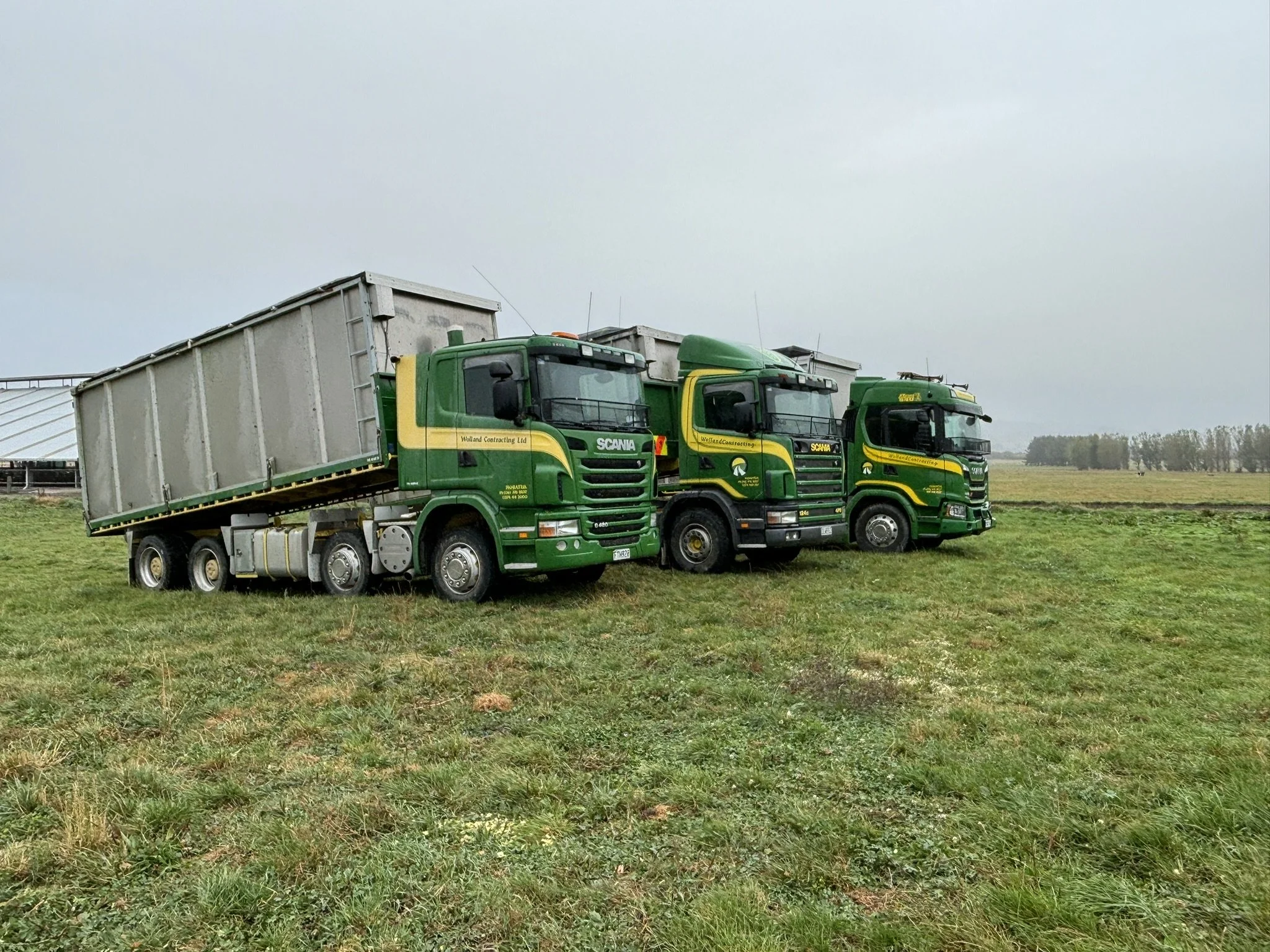
Transport and cartage have become a significant part of the business in their own right, growing from a supporting function into a core service. By investing in modern Scania trucks and building an experienced driving team, Wolland Contracting has been able to maintain control over logistics during peak periods reducing delays and improving coordination across complex harvest operations. This integration of contracting and transport has proven particularly valuable during silage season, where timing is critical and any bottleneck can compromise quality.
The business has also expanded into excavation, earthworks and farm maintenance recognising that many clients prefer dealing with a contractor who understands their property and can provide multiple services without the need to bring in additional operators. Diggers, telehandlers and specialist equipment are used for tasks ranging from drainage and track maintenance through to muck and slurry spreading, while spraying services are delivered by Growsafe-approved operators with a strong focus on safety and compliance. This breadth of capability reflects a broader trend in contracting, where versatility and reliability are increasingly valued as farming systems become more complex.
Despite this growth, the defining characteristic of Wolland Contracting remains its people. Long-serving staff form the backbone of the operation, bringing experience, local knowledge and pride in their work. The culture within the business emphasises responsibility, professionalism and mutual respect with operators trusted to represent the company well on farm and to maintain high standards in both workmanship and presentation. That culture has helped Wolland Contracting retain staff in an industry where skilled operators are in constant demand, and it contributes directly to the consistency that customers rely on year after year.
Behind the machinery and services, the strength of Wolland Contracting continues to sit with its people and the culture that has been deliberately maintained as the business has grown. Long-serving staff provide continuity and institutional knowledge that cannot be replaced by systems or equipment and their familiarity with local farms, conditions and customers contributes directly to the quality of work delivered. Expectations around professionalism, care of machinery and respect for clients are clear, and those standards are reinforced daily rather than written down once and forgotten.
As leadership has transitioned, protecting that culture has been as important as any operational change. Succession brings new ideas and energy, but it also carries the risk of unsettling what already works. By keeping values consistent and involving staff in the journey, Wolland Contracting has avoided that disruption. The result is a business where experience and progression sit comfortably together, supporting stability through change and ensuring that the Wolland name continues to mean the same thing to customers today as it has for generations.
The contracting landscape today is vastly different from that of the 1970s or even the early 2000s. Machinery has grown larger and more technologically advanced, with GPS guidance, data capture and increasingly sophisticated control systems now standard across much of the fleet. Compliance requirements around health and safety, environmental management and chemical handling have expanded significantly adding administrative complexity and raising the bar for professionalism. Wolland Contracting has responded to these changes through ongoing investment in training, systems and equipment, ensuring the business remains compliant while continuing to operate efficiently.
At the same time, the pressures on farmers have intensified, with tighter margins, regulatory uncertainty and increasingly unpredictable weather placing greater emphasis on timing and reliability. For contractors, this has reinforced the importance of clear communication, realistic scheduling and the ability to adapt quickly when conditions change. Wolland Contracting’s long-standing relationships with clients provide a strong foundation in this environment, allowing for open discussions about priorities and constraints and enabling practical solutions when challenges arise.
Succession within the business continues to be a central theme. Rather than a single handover moment, the transition from Maurice to Jamie has been a process, shaped by shared decision-making and a mutual respect for experience and new ideas. This approach has allowed the business to modernise while retaining its core values, and it has provided reassurance to customers that the Wolland name continues to stand for the same standards it always has. The involvement of multiple family members also reinforces the sense of continuity that is particularly important in rural communities, where businesses are often judged over generations rather than seasons.
Looking ahead, Wolland Contracting is well positioned to navigate the next phase of its journey. The business has the scale and capability to meet the demands of modern farming, supported by a strong fleet, experienced staff and integrated services. At the same time, its family ownership and local focus provide resilience in an industry that is increasingly influenced by external pressures. For Maurice and Christine, seeing the business evolve under the stewardship of the next generation represents the culmination of decades of hard work and careful planning. For Jamie it brings both opportunity and responsibility, building on a legacy while shaping the future.
The story of Wolland Contracting is ultimately one of continuity, adaptation and family, a reminder that successful succession is not about replacing the past but about carrying it forward with purpose. In an industry defined by change, that ability to evolve while staying true to core values remains one of the strongest indicators of long-term success.