
Catros+ 12003-2TX: 25 years on and still setting the standard
Twenty-five years is a long time in agricultural engineering, particularly in the soil engagement space where fashion can often outpace function. Yet the Amazone Catros has not simply survived a quarter of a century. It has steadily evolved, refined and strengthened its place as one of the benchmark compact disc harrows in modern farming systems. Now, with the launch of the Catros+ 12003-2TX at Agritechnica 2025, Amazone has again lifted the bar for high-output shallow cultivation.
The Catros story began in 2001 following Amazone’s acquisition of BBG Leipzig in 1998, laying the foundation for what would become one of the company’s most successful soil tillage platforms. From its original compact three-point linkage design with aggressively angled concave discs mounted on maintenance-free rubber buffer blocks, the Catros was built around speed, simplicity and efficiency. Over time, it gained hydraulic depth control, oil-immersed maintenance-free bearings, wider working widths, trailing chassis options and eventually the larger 510 mm discs that defined the Catros+ generation.
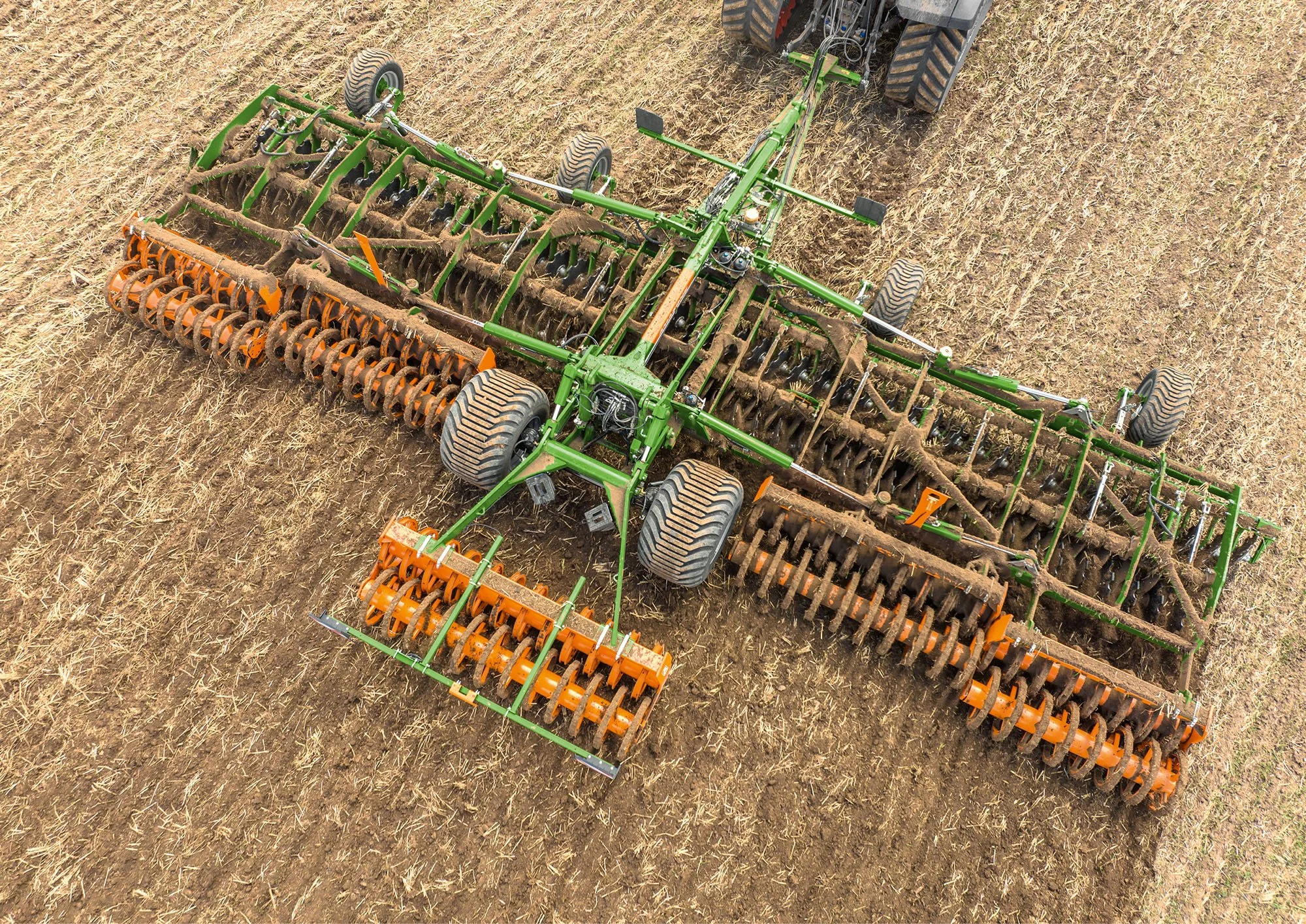
Fast forward to 2026 and the new Catros+ 12003-2TX represents the most technically advanced iteration yet. At its heart is the integration of the TX mid-mounted chassis with an entirely new five-part folding system. This new folding concept allows the 12 metre and 12.25 metre working widths to be packaged into a machine that remains stable, well-balanced and road-friendly. The centrally integrated running gear delivers excellent road manners, aided by generously dimensioned transport tyres that make long-distance moves between blocks both safer and smoother.
The 12.25 metre option is particularly significant for operators running controlled traffic farming systems. Amazone now offers an optional extended disc element that matches CTF wheel track systems precisely, allowing cultivation to remain aligned with established tramlines. A height-adjustable end disc ensures clean matching to the previous pass, reducing ridging and leaving a consistent finish across the full working width.
In practical terms, the Catros+ 12003-2TX is designed for fast, shallow and intensive soil tillage. It excels in stubble cultivation where breaking capillarity is essential for conserving soil moisture, particularly in drier regions. By working at depths typically between 5 and 14 cm with the standard 510 mm discs, operators can stimulate volunteer cereals and weed seeds to create an effective stale seedbed. For even shallower surface work, the optional 480 mm X-Cutter disc allows cultivation at depths of just 2 to 8 cm making it well suited to moisture retention strategies and minimal disturbance systems.
Disc options include smooth, fine-serrated and coarse-serrated profiles giving operators flexibility to match soil type and residue levels. For those dealing with heavier organic loads, larger disc configurations within the Catros family have expanded the range over time, including the CatrosXL introduced with 610 mm discs for deeper more aggressive mixing in heavy or wet conditions.
The engineering beneath the frame is just as important as the disc choice. The Smart Frame System allows fully hydraulic working depth adjustment directly from the cab, eliminating the need for manual frame adjustment. Depth is controlled via the leading guide wheels and the rear roller, allowing precise and repeatable changes on the move. Crucially, when working deeper the discs rotate further into the soil and swivel away from both the main frame and the rear packer. This increases clearance within the implement, significantly improving residue flow in moist, heavy ground with high organic matter. It is a simple concept but one that makes a tangible difference when conditions are challenging.
ContourFrame technology further enhances performance across uneven terrain. Hydraulically pre-pressurised frame sections and individually suspended discs allow the 12 metre platform to follow ground contours accurately, maintaining consistent depth across the full width. For large-scale contractors and corporate farms, that uniformity is essential to achieving even seedbeds and consistent crop establishment.
Headland behaviour has also been carefully considered. The Catros+ 12003-2TX turns on its packer rollers while the disc elements are lifted hydraulically via the drawbar. This keeps the machine stable and controlled during headland manoeuvres, even where surfaces are uneven or rutted. It is a detail that reduces stress on both operator and machine.
The range of rear packer rollers has expanded over the years to suit differing soil types and finishing requirements. Combined with front-mounted tools such as knife rollers for shredding residue or a Crushboard for levelling and crumbling, the Catros platform can be tailored for specific systems. The GreenDrill catch crop seeder remains available for simultaneous cover crop establishment.
Ease of use has not been overlooked. The optional ComfortClick electric switch box allows rapid and convenient changeover between transport and working positions directly from the tractor seat. For operators covering large acreages and moving frequently between fields, that convenience translates directly into efficiency.
Despite its enormous output capacity, the Catros+ 12003-2TX maintains relatively low tractive force requirements. The compact disc principle remains inherently efficient, delivering high work rates without demanding excessive horsepower. That balance of output and efficiency is precisely why the Catros platform has remained relevant for 25 years.
The Catros+ 12003-2TX is not simply a wider machine. It is the culmination of a quarter of a century of refinement, bringing together folding innovation, controlled traffic compatibility, hydraulic depth control and high-speed efficiency in a format built for modern large-scale farming.
For contractors and progressive farms looking to cover ground quickly while maintaining soil structure and moisture, the latest Catros is not just an update. It is a statement that shallow cultivation, when done properly still has a central role to play in the systems of tomorrow.