
Contour without compromise
The challenge with modern direct drilling has never been putting seed into the ground. It has been putting every seed into exactly the right place when the ground refuses to cooperate. Uneven paddocks, stones, wheel tracks, ridges, heavy residue and changing soil conditions all conspire to move drilling elements away from their target depth, creating inconsistent establishment long before germination begins.
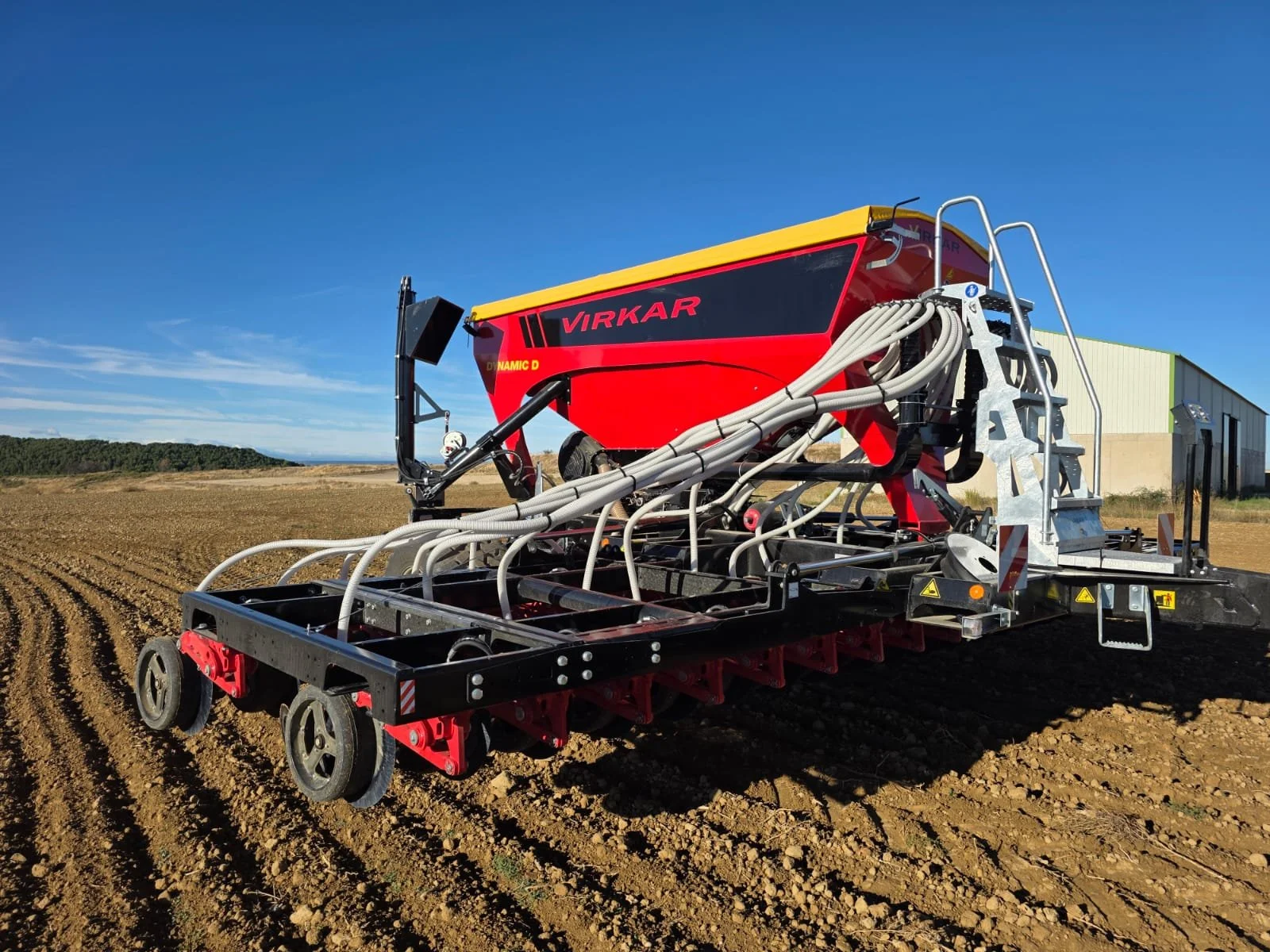
The Virkar Dynamic Disc Drill, recently introduced by FarmChief, approaches that problem differently. Rather than relying on the drill frame to control every coulter, it gives every individual drilling element the freedom to react independently to the ground beneath it.
That philosophy sits at the centre of the machine's engineering. FarmChief's TotalContour system allows every single disc to move hydraulically independently through up to 350 mm of vertical travel while maintaining controlled downforce. Instead of one section of the drill lifting adjacent rows whenever it encounters a rise or obstacle, every coulter follows the contour individually, allowing neighbouring rows to continue operating at the required depth. In practical terms, it means the drill is constantly adapting to the paddock rather than asking the paddock to conform to the drill.
Independent movement has become an increasingly important feature as direct drilling expands into more challenging conditions. Modern drills are expected to work through heavy cereal stubbles, sprayed-out pasture, maize residue and stony hill country while maintaining consistent seed placement. Every time a rigid frame forces one coulter to ride over an obstacle, neighbouring rows are also affected. The Virkar largely removes that compromise by treating each drilling element as an independent suspension system, allowing it to absorb changes in ground level without influencing the rest of the machine.
Controlling movement, however, is only half the equation. Downforce determines whether a disc maintains its target depth or rides out of the soil when conditions become difficult. Rather than relying on rubber torsion, mechanical springs or mechanical adjustment, the Virkar uses an electro-hydraulic system with nitrogen accumulators that allows operators to vary ground pressure directly from the tractor cab. Each disc can apply up to 350 kg of pressure, providing enough force to maintain penetration in hard ground while remaining adjustable as soil conditions change across the paddock. For contractors working across multiple farms in a single day, eliminating manual adjustment can significantly improve productivity.
The hydraulic architecture also provides another advantage. Because every coulter remains hydraulically independent, the system maintains more consistent pressure across the full working width than traditional frame-based designs. Instead of pressure being redistributed through a common frame, each row maintains its own contact with the soil. That consistency becomes particularly valuable when establishing small-seeded species, where even slight variations in sowing depth can affect emergence and ultimately crop uniformity.
Mechanical durability has clearly been another design priority. Every drilling arm pivots on an oversized pivot pin designed to withstand the constant loading experienced during direct drilling in rough conditions. Larger bearing surfaces distribute load more evenly, reducing stress concentrations that can accelerate wear over thousands of hectares. FarmChief has also eliminated grease points from the drilling elements, replacing them with heavy-duty, replaceable bushings. Reducing routine servicing not only lowers maintenance requirements but also removes one of the more common causes of premature wear associated with poor lubrication practices.
The single-disc coulter itself reflects the continuing evolution of low-disturbance establishment. Rather than cultivating a wide strip of soil, the disc opens a narrow slot with minimal disturbance before placing seed at the desired depth. Maintaining soil structure has become increasingly important as growers seek to preserve moisture, reduce erosion and retain surface residue. Less soil movement also means existing crop residues remain largely undisturbed, providing ongoing protection against evaporation while improving trafficability during difficult seasons. The engineering challenge is achieving that minimal disturbance without compromising penetration, particularly where residue loads are high or soils become compacted.
Capacity has received equal attention. Depending on configuration, the Virkar offers hopper capacities of up to 6,800 L while remaining within practical transport dimensions. Larger hopper volumes reduce refill frequency, allowing operators to spend more time drilling and less time travelling between paddock and supply point. During narrow seasonal drilling windows, where weather often dictates available working hours, reducing downtime can contribute as much to productivity as increasing operating speed.
The hopper itself has also been designed with flexibility in mind. Operators can divide the available capacity into as many as four compartments, allowing different seed types or fertiliser products to be carried simultaneously. More importantly, the machine allows different products to be placed at different depths through the same pass. Placing fertiliser separately from seed, or establishing companion crops at different depths, eliminates additional field operations while improving placement accuracy. As mixed-species pasture establishment and precision nutrient placement become more common, this level of configurability offers considerably greater flexibility than traditional single-hopper drills.
Transport and manoeuvrability have not been overlooked either. One of the more unusual features is Virkar's FreeDrive electronic steering axle. Rather than forcing the seeding frame to drag across the ground during headland turns, the steering system allows the frame to pivot in conjunction with the axle by up to 20 degrees. Maintaining the alignment of the drilling elements reduces side loading on the parallelogram coulter arms while helping preserve consistent row spacing throughout the turn. Lower mechanical stress also contributes to longer component life, particularly for contractors covering large hectareage each season.
Electronic integration has become another defining characteristic of modern drilling equipment and the Virkar reflects that trend. The EasyVario controller allows hydraulic functions to be adjusted from the cab, while the underlying system is compatible with IsobusSOBUS technology and precision farming platforms. Variable-rate seeding, GPS guidance and prescription mapping are becoming increasingly common across New Zealand arable and mixed farming systems, making electronic compatibility just as important as mechanical performance.
Perhaps one of the simplest but most practical engineering features is the drill's maintenance mode. Hydraulic lifting raises the chassis approximately 1.4 m above the ground, providing significantly better access for servicing, adjustment and inspection. While unlikely to attract the same attention as the hydraulic coulter system, improving technician access reduces maintenance time and creates a safer working environment, particularly on larger drills where reaching components beneath the frame can otherwise be difficult.
The Virkar Dynamic Disc Drill represents a broader shift in drilling philosophy. Increasingly, manufacturers are moving away from designing a single large machine that forces every component to behave identically. Instead, the focus has shifted towards independent systems capable of making thousands of small adjustments every hectare. Hydraulic contour control, independent downforce, intelligent steering, flexible product placement and electronic integration all contribute towards the same objective: placing every seed at the correct depth regardless of what lies beneath the machine.
In an industry where establishment ultimately determines yield, those seemingly small engineering decisions can have a profound influence on the performance of every crop that follows.