
Engineering crop flow
There is little point in putting more horsepower under the bonnet if the crop cannot reach the feed rolls consistently. As self-propelled forage harvesters continue to grow in capacity, the challenge has shifted from simply picking up grass to maintaining an uninterrupted crop flow capable of keeping increasingly powerful machines operating at full output. Heavy first-cut silage, uneven windrows, damp conditions and rough paddocks all have the potential to interrupt that flow, increasing driveline loads, reducing throughput and ultimately limiting harvesting efficiency.
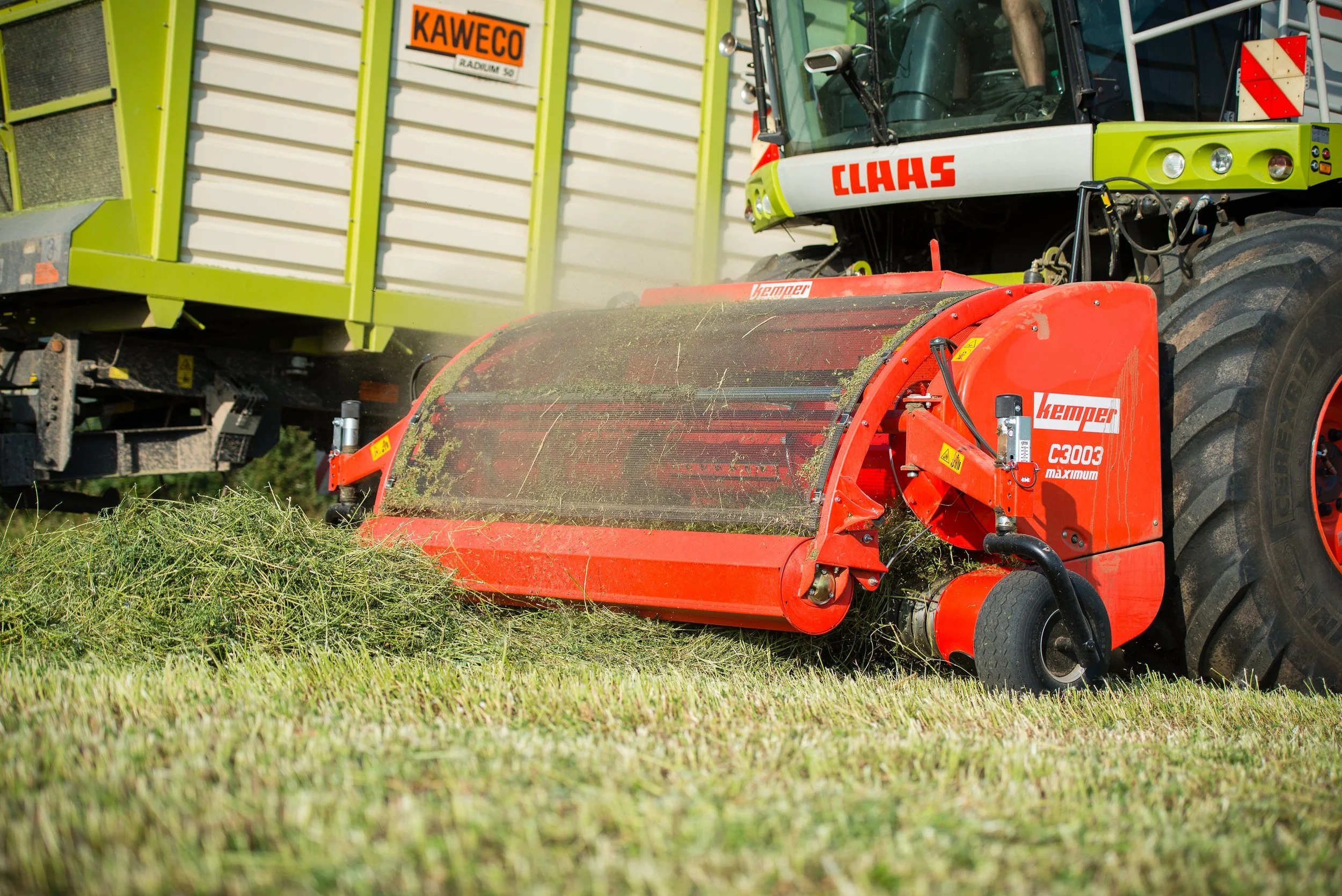
It is a challenge that has driven the development of the Kemper C3003 and N3003 pickup headers, now available in New Zealand through Ag and Civil Machinery Direct Ltd to suit Claas and New Holland forage harvesters. Rather than focusing purely on working width, the engineering centres on delivering a smooth, continuous stream of crop into the harvester regardless of windrow shape or field conditions.
Modern forage harvesters can process enormous volumes of material in a remarkably short time, but they remain entirely dependent on what happens at the front of the machine. Any hesitation between the pickup reel and the feed rollers creates fluctuations in crop loading that affect chopping consistency, increase stress on the driveline and reduce overall productivity. Maintaining even crop flow has therefore become one of the most important engineering objectives in forage header design.
The foundation of the C3003 and N3003 is a large 560 mm intake auger equipped with heavy-duty 150 mm flighting. While the dimensions alone are impressive, it is the geometry of the auger that makes the difference. Instead of using a constant flight pitch, Kemper has designed the screw pitch to progressively open towards the centre of the header. This guides material smoothly into the feed channel, preventing large surges of crop entering the harvester while maintaining a more consistent feed rate across the full working width. By reducing sudden changes in crop loading, the system lowers stress on the machine while helping maintain throughput under demanding harvesting conditions.
Ahead of the auger sits a 4 x 40-tine-bar pickup with a split reel designed specifically for high-output harvesting. The number of tine bars allows the reel to operate at lower rotational speeds while maintaining pickup capacity. Splitting and offsetting the tines allows for smoother flow across the front. Strong 6.5 mm tines further improve durability, particularly where contractors are working long hours through short harvesting windows.
Crop flow remains one of the defining features of the Kemper design. Once the crop reaches the auger, a single compression roller system maintains positive control as material enters the feed channel. Uneven windrows have traditionally presented difficulties for pickup headers, particularly where one section of the crop is considerably heavier than another. Kemper addresses this by allowing the roller height to be adjusted to the crop height and then the hydraulic accumulator keeps constant pressure on the crop. The result is smoother feeding in light, heavy and uneven crops, particularly where wet conditions make crop handling more difficult.
Maintaining crop flow is only part of the challenge. The pickup must also follow the ground accurately without contaminating the forage or damaging the sward. Kemper has addressed this through a substantial pendulum frame combined with large 360-degree swivelling gauge wheels that closely follow ground contours. The independent movement allows the pickup to remain in contact with the surface while negotiating uneven terrain, corners and headlands without excessive soil disturbance. On particularly rough paddocks, wide centre support wheels prevent the pickup tines from digging into the ground, protecting both the machine and the pasture while reducing soil contamination within the harvested crop. Cleaner forage not only improves silage quality but also reduces wear throughout the harvesting system.
Durability and reliability has also been a significant focus of the design. Relying on conventional heavy-duty chain drives with automatic lubrication, the C3003 and N3003 utilise simplicity and strength to provide drive to the front. Ease of maintenance converts directly into more harvesting time and fewer unexpected interruptions during critical weather windows.
Cleaning and maintenance have likewise been simplified. An optional service door on the left-hand side provides quick access for removing accumulated crop residue, particularly valuable during dry, dusty harvesting conditions. A full-width dust net further reduces material build-up around the intake channel and chopping drum, helping keep both the machine and cab windows cleaner while improving operator visibility throughout the day. These details may appear minor individually, but collectively they contribute towards higher machine availability across a demanding harvest season.
Contractors also spend considerable time moving between paddocks, making transport efficiency an important consideration. Kemper has incorporated a quick-coupler driveline that allows rapid attachment and removal of the pickup. Hydraulic gauge wheels fold automatically into their transport position when the pickup is raised, allowing operators to prepare for transport without leaving the cab. Reducing the number of manual adjustments required during field changes helps maintain productivity across multiple jobs while improving operator safety.
The availability of both the C3003 and N3003 in New Zealand reflects the continuing evolution of forage harvesting technology. As harvesters become larger and more productive, every component ahead of the feed rollers must work harder to maintain machine performance. Pickup headers are no longer simply lifting crop from the ground. They have become sophisticated crop-feeding systems, where auger geometry, pickup reel design, suspension, contour following and driveline engineering all contribute to maximising the output of the forage harvester behind them.
For operators, the benefits extend well beyond headline specifications. A pickup capable of maintaining smooth crop flow through heavy, wet or inconsistent windrows allows the harvester to operate closer to its full capacity while reducing mechanical stress and improving chopping consistency. Cleaner crop intake, lower maintenance requirements and better ground following all contribute towards greater productivity over the course of a season.
The Kemper C3003 and N3003 demonstrate how much engineering now goes into what was once considered a relatively simple attachment. Every feature has been developed around a single objective: keeping high-capacity forage harvesters fed consistently under real-world harvesting conditions. In modern forage production, where every hour of suitable weather counts, that ability to maintain uninterrupted crop flow may be just as important as the horsepower driving the machine itself.