
Engineering slurry from the bottom up
Moving slurry is relatively straightforward. Moving millions of litres of dense, settled slurry from the bottom of an 18 m lagoon without starving the pump is an entirely different engineering problem.
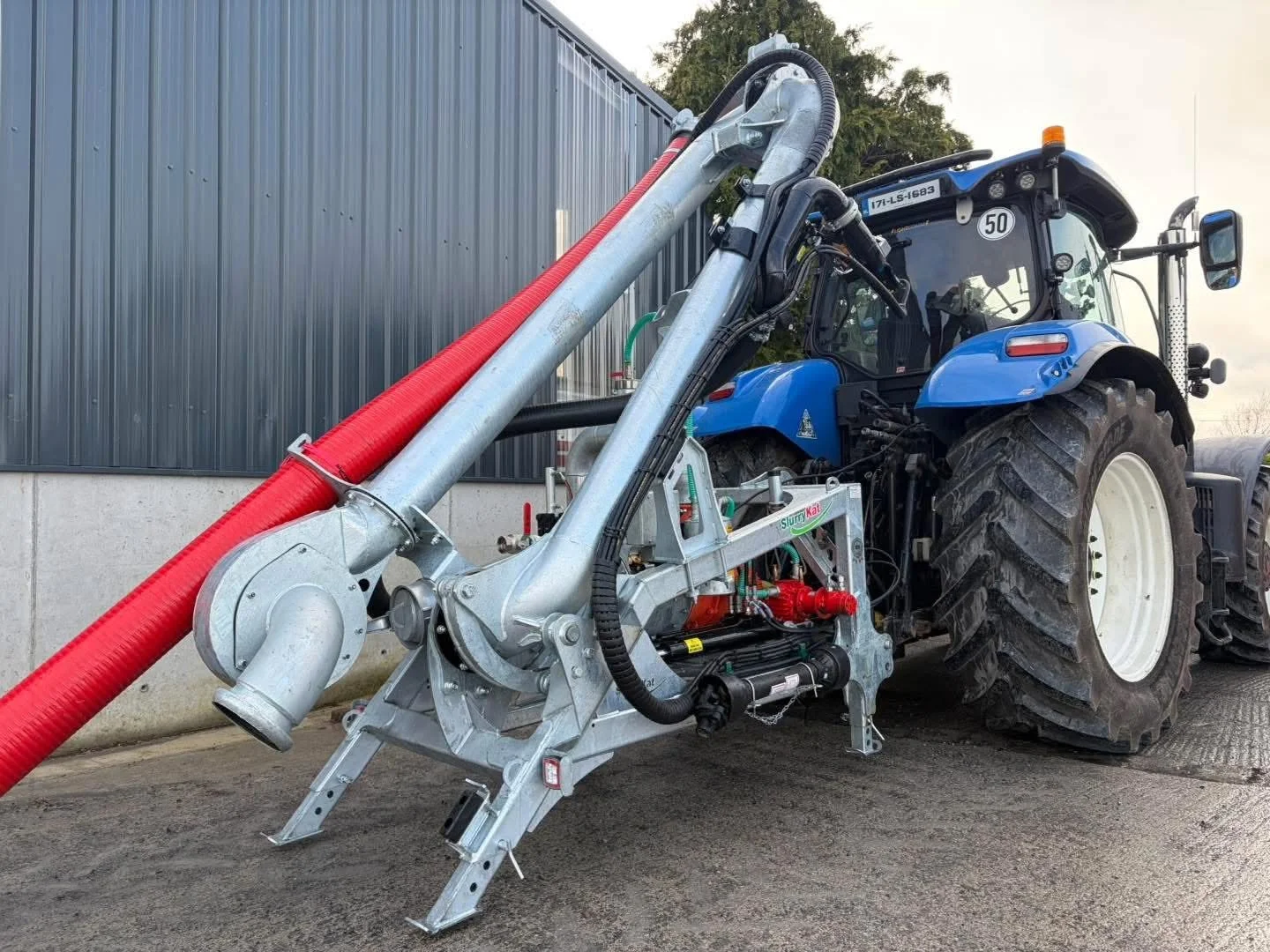
As livestock systems continue to intensify and storage volumes increase, slurry pumping equipment is being asked to do far more than simply transfer liquid from one location to another. Modern umbilical spreading systems depend on a constant, uninterrupted flow of material, regardless of whether the lagoon contains free-flowing slurry or dense solids that have settled over months of storage. Any interruption to that flow reduces spreading efficiency, increases wear and places enormous strain on both pumps and tractors.
That challenge sits at the centre of the SlurryKat Skorpion range, distributed in New Zealand by Brownrigg Agri Gear. Rather than relying on a conventional pump positioned above the slurry surface, the Skorpion has been engineered around a force-feeding principle that keeps the primary pump continuously supplied, even when operating in deep storage lagoons.
The concept appears relatively simple, but the hydraulics behind it solve one of the biggest limitations of conventional slurry pumping. Surface-mounted pumps rely on suction to lift slurry from the lagoon before pressure can move it into the umbilical system. As pumping depth increases, suction efficiency declines and the risk of cavitation rises sharply. Dense solids, fibrous material and partially settled slurry further increase the load, forcing pumps to work harder while reducing output.
The Skorpion approaches the problem differently. Depending on the model, a hydraulic submersible turbo pump is positioned at the bottom of the boom, directly within the slurry. Instead of asking the main pump to draw material upwards under vacuum, the turbo pump actively force-feeds slurry into the primary Doda pump. Maintaining positive inlet pressure significantly improves pumping efficiency while reducing the likelihood of cavitation and inconsistent flow.
This force-feeding arrangement becomes increasingly valuable as lagoon depth increases. The Mega Skorpion combines an 8-inch hydraulic submersible pump with the Doda AFI HD45 centrifugal pump, allowing slurry to be recovered from depths approaching 18 m. Where additional reach is required, an optional 6 m suction extension increases the working depth even further, allowing operators to recover slurry that would otherwise remain inaccessible using conventional pumping systems.
Moving slurry efficiently, however, depends on far more than pump capacity alone. The consistency of the material entering the pump has an equally important influence on output. Slurry naturally separates during storage, with heavier solids settling towards the bottom while lighter liquids remain above. Attempting to pump this stratified material often results in fluctuating nutrient content, inconsistent application rates and rapidly changing pump loads.
To overcome this, the Skorpion incorporates a dedicated recirculation system with a low-ejection mixing nozzle mounted on the lower section of the boom. Rather than simply extracting slurry, the system continually circulates material throughout the lagoon, re-suspending settled solids before they reach the pumping system. This creates a more homogeneous slurry while maintaining consistent flow throughout the pumping operation.
For particularly challenging storage systems, operators can specify a rotating mixing gun with hydraulic vertical adjustment. This allows the mixing pattern to be directed precisely where required, breaking up heavier deposits that have accumulated over extended storage periods. Instead of relying on separate mixing equipment before pumping begins, the Skorpion integrates mixing and pumping into a single operation.
Maintaining uninterrupted flow also becomes critical whenever slurry application pauses. Traditional systems often allow slurry to settle inside the pipework while operators turn at the headland or wait for spreading equipment to resume. Every interruption increases the risk of blockages, pressure fluctuations and inconsistent application.
SlurryKat addresses this through an optional headland management system that automatically recirculates slurry whenever pumping temporarily stops. Keeping material moving through the system prevents settling within the pipework while ensuring full flow is immediately restored when spreading recommences. The principle mirrors hydraulic bypass systems used in many industrial pumping applications, where continuous circulation protects both equipment and product quality.
The Skorpion range has also been designed around different operating scales. The Mini Skorpion utilises the Doda HD35 pump and is suited to tractors around 250 hp. While more compact than its larger counterpart, it retains the same engineering philosophy and can also be equipped with the hydraulic force-feeding turbo pump where deeper lagoons demand greater suction performance.
The Mega Skorpion targets larger contractors and intensive livestock operations where pumping capacity becomes a limiting factor. Depending on configuration, output can reach approximately 740 m³/h, allowing substantial slurry volumes to be transferred into modern umbilical systems with minimal interruption. Alternative configurations capable of around 350 m³/h provide additional flexibility where operating requirements differ.
Automation has also become increasingly important as slurry systems continue to grow in complexity. ISOBUS compatibility allows key machine functions to be controlled directly through the tractor terminal, while options including hydraulic fill arms, 360-degree discharge outlets, heavy-duty primer pumps and automatic boom functions reduce manual intervention throughout the pumping cycle. Rather than adapting the operator to the machine, these systems allow the machine to adapt more closely to individual farm layouts and operating practices.
What becomes clear when examining the Skorpion is that it has not been designed simply as a larger slurry pump. Every component, from the force-feeding turbo pump through to the recirculation system and hydraulic controls, has been developed around maintaining continuous hydraulic efficiency under demanding operating conditions. It is an engineering solution to a hydraulic problem rather than simply an exercise in increasing pump size.
As New Zealand dairy and livestock businesses continue expanding storage capacity and adopting umbilical spreading systems, the demands placed on slurry handling equipment will only increase. Deeper lagoons, larger nutrient volumes and higher daily outputs require machinery capable of maintaining consistent performance regardless of slurry condition or pumping depth.
The SlurryKat Skorpion range reflects that evolution. By combining positive-pressure feed systems, integrated mixing, high-capacity centrifugal pumps and intelligent hydraulic control, it has been engineered to maintain slurry movement where conventional pumping systems begin to reach their limits. For contractors and farmers managing increasingly sophisticated nutrient systems, the ability to move slurry efficiently from the bottom of the lagoon to the paddock may ultimately prove just as important as the spreading equipment waiting at the other end.