
Engineering the forage harvest
Producing high-quality forage has become an increasingly technical process. Higher stocking rates and larger harvesting programmes mean every pass across the paddock has a direct influence on feed quality. From the moment the mower enters the crop through to the final bale leaving the paddock, each machine in the harvesting chain contributes to the quality of the finished product.
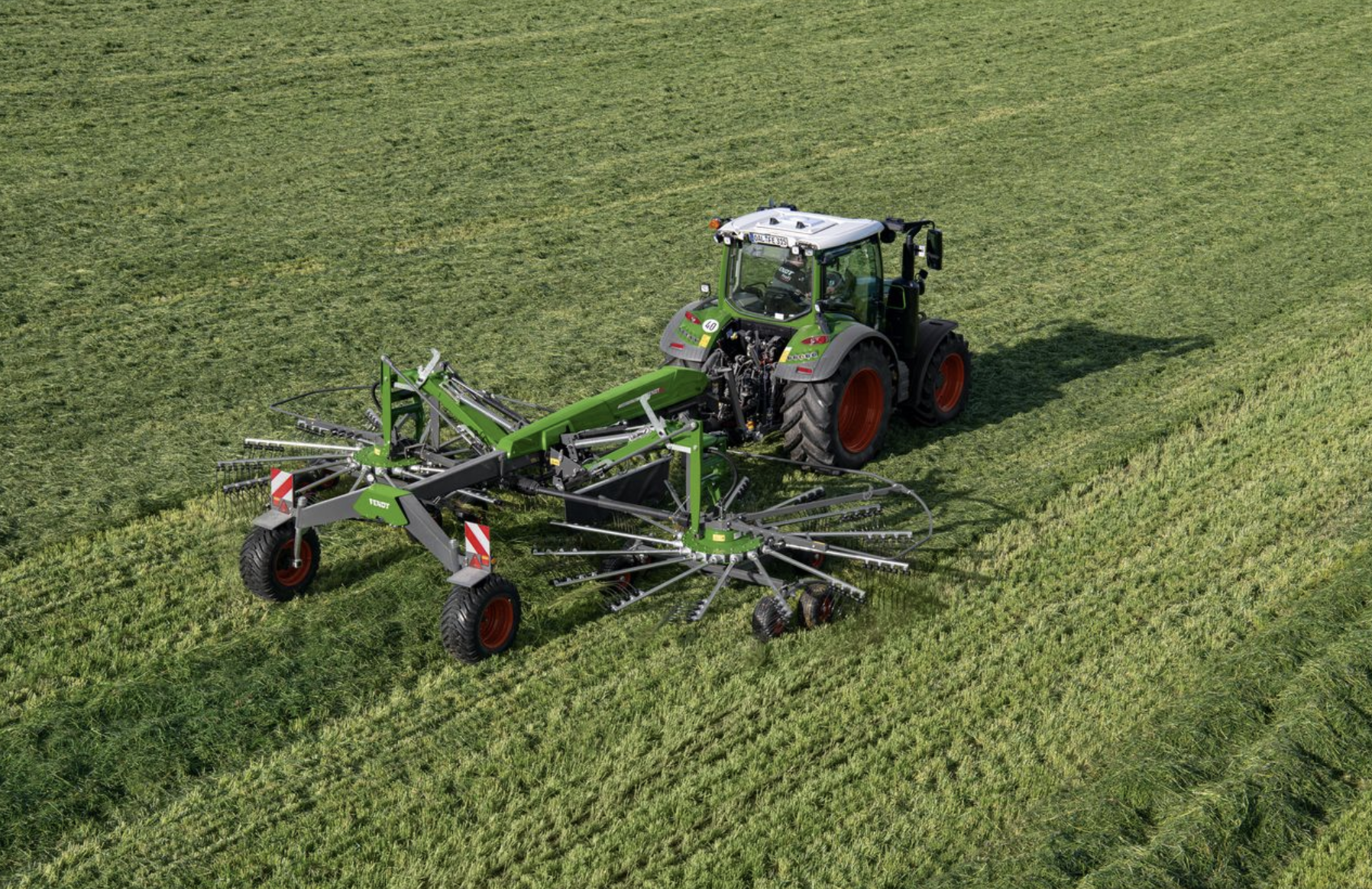
That philosophy underpins the 2026 Fendt hay tools range. Rather than developing individual machines in isolation, Fendt has engineered an integrated harvesting system covering every stage of forage production, including mowing, tedding, raking and baling. The objective is simple: maximise crop quality while improving efficiency across the entire harvesting operation.
The process begins with the cut. A mower's role is no longer simply removing the crop from the paddock. It must leave a clean, even stubble, minimise contamination and prepare the crop for rapid wilting without unnecessarily damaging the plant. The Fendt Slicer range addresses those requirements through a comprehensive line-up of front-mounted, rear-mounted, conditioner and butterfly mower combinations capable of working across operations of every size.
For contractors and larger dairy businesses, butterfly combinations offering working widths of up to 10.1 m provide the capacity required to keep pace with modern harvesting systems. Equally important is the availability of conditioning systems tailored to different crops. Tine conditioners, rubber rollers and steel rollers allow operators to match the machine to the crop, accelerating moisture loss while protecting valuable leaves in more delicate forage species. Faster, more controlled wilting shortens the interval between mowing and harvesting, helping preserve feed quality while reducing exposure to changing weather conditions.
Fendt has also continued integrating precision technology throughout the Slicer range. Automatic conditioning adjustment, Isobus compatibility and section control allow operators to optimise machine performance while reducing unnecessary overlap and improving consistency across every hectare. These technologies have become increasingly valuable in New Zealand, where harvesting opportunities are often measured in hours rather than days.
Once the crop begins to wilt, the emphasis shifts from cutting performance to drying efficiency. The objective is to expose as much crop surface area as possible while handling the forage gently enough to minimise leaf loss. This is where the Fendt Lotus tedder range has been developed to make a difference.
Available in working widths from 7.7 m through to semi-trailed 12.5 m models, the Lotus range has been engineered for medium- and large-scale operations requiring high daily outputs. At the heart of the design is the Fendt Performance Tine, allowing operators to increase forward speed while reducing rotor speed. Covering more hectares with fewer revolutions reduces fuel consumption and machine wear while treating the crop more gently. The combination of higher productivity and improved forage handling is particularly valuable for contractors working against short weather windows.
As moisture levels fall towards the target for harvesting, attention turns to forming a windrow capable of feeding the next machine efficiently. Uniform swaths allow balers and forage harvesters to maintain consistent throughput, improving both machine performance and forage quality.
The Fendt Former rake range has been developed around that principle. Twin-rotor and four-rotor models provide solutions across a wide range of farm sizes, while maintaining clean crop collection remains a primary objective. Every tine passing through the crop has the potential to introduce soil contamination if ground following is compromised.
One of the most significant developments for 2026 is flexHIGH technology. Rather than maintaining a fixed raking height, the system automatically adjusts tine height according to forward speed. As travel speed increases, the rake raises slightly to reduce the likelihood of tines contacting the soil. When speed decreases, the system returns to its optimum working position. The result is cleaner forage, more consistent swath formation, reduced forage losses and less operator intervention. Because the adjustment is controlled through Isobus, the machine continually optimises itself throughout the day without requiring manual changes from the operator.
The final stage of the harvesting chain places another set of engineering demands on the machinery. Producing dense, consistent bales while maintaining productivity requires precise control throughout the entire baling cycle.
The 2026 Rotana range continues to offer both fixed and variable chamber balers. The Rotana F is designed for operators concentrating on dry hay and straw production, while the Rotana V allows bale diameter to be adjusted according to crop type and customer requirements. For contractors moving between different crops and clients, that flexibility provides considerable operational advantages.
Perhaps the most significant technology within the Rotana range is Tractor Implement Management (TIM). Rather than simply receiving commands from the tractor, TIM allows the baler to control selected tractor functions during the baling process. Once the baler reaches its programmed size and the wrapping cycle is complete, the tractor can automatically stop, allowing the tailgate to open, the bale to be discharged and the chamber reset before work resumes. Reducing operator involvement not only improves productivity but also delivers greater consistency throughout long harvesting days while reducing fatigue.
Viewed individually, each machine represents another step forward in forage harvesting technology. Viewed together, they demonstrate a broader philosophy centred on integrating every stage of the harvest. Every machine prepares the crop for the next operation while protecting forage quality and reducing unnecessary field traffic.
That integrated approach has become increasingly relevant for New Zealand farmers and contractors. Higher-output harvesting equipment, larger seasonal workloads and increasingly compressed weather windows mean the harvesting chain is only ever as efficient as its weakest link. Optimising one machine while compromising another simply limits the performance of the entire system.
The 2026 Fendt hay tools range has been engineered with that reality in mind. From precision mowing and conditioning through to intelligent tedding, automated raking and TIM-controlled baling, every component has been designed to improve the quality and efficiency of the complete forage harvesting process. Rather than thinking in terms of individual machines, Fendt has focused on engineering an integrated harvesting system, one that reflects the increasingly sophisticated demands of modern forage production.