
Farming from the air
For much of New Zealand’s hill country, the helicopter has become another piece of agricultural machinery.
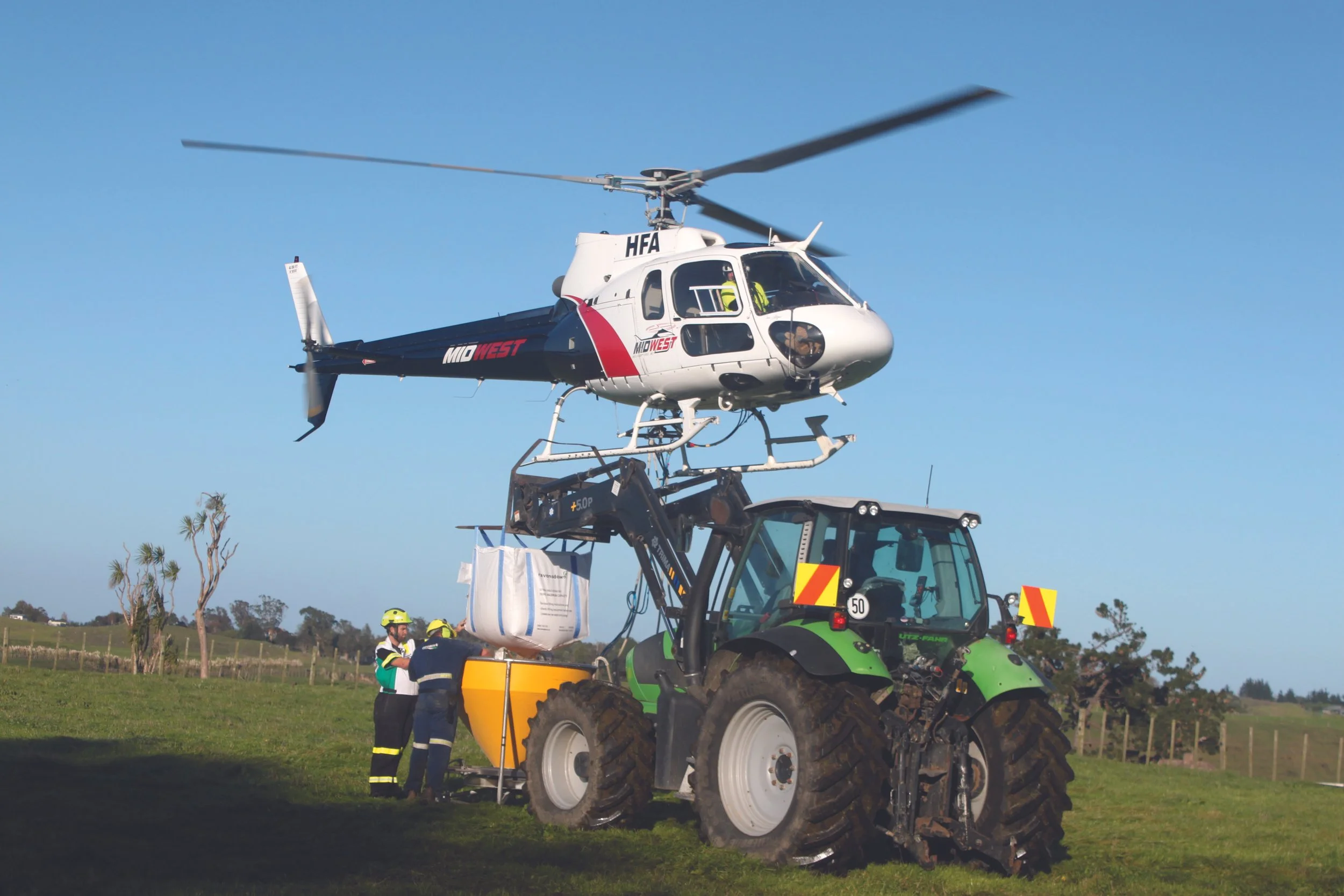
It may spend considerably less time on the farm than a tractor or side-by-side, but when country becomes too steep, wet or inaccessible for conventional equipment, the ability to put seed, fertiliser or spray exactly where it is required can make the aircraft an important part of the farming system.
That agricultural connection sits at the heart of Mid West Helicopters. Although the Whanganui-based company now undertakes a wide range of aviation work throughout New Zealand, it describes its roots as lying deep within the agricultural sector, servicing rural communities for decades. Today it operates 11 helicopters, with a particularly strong presence across the Lower and Central North Island.
What makes the agricultural side of Mid West particularly interesting is that many of the people flying the aircraft understand farming from the ground as well as from the air. The company says its agricultural pilots come from farming backgrounds and several continue to farm themselves, giving them an understanding of livestock, terrain and the practical outcome the farmer is trying to achieve.
Chief pilot and Director Dean Lithgow is a farmer who began flying with Whanganui Aerowork in the late 1980s before later flying for Ravensdown Aerowork. Operations Manager and Director Owen Harvey grew up on a farm and began his flying career with Whanganui Aerowork in 2004, including a period flying in Canada before returning to Ravensdown Aerowork. Director Peter Larsen is also a farmer. He gained his helicopter licence in 1993 and began operating his own Robinson R22 in 2007, initially carrying out agricultural work for himself before joining Ravensdown Aerowork in 2010.
It is a useful distinction because agricultural flying involves considerably more than getting an aircraft from one side of a paddock to the other. A pilot needs to understand what is happening below, where stock are likely to move, how terrain influences a job and why accuracy matters when expensive products are being applied to productive land.
The company’s agricultural work covers spraying, fertiliser and seeding, pest control, frost protection and mustering. Aircraft are positioned across several locations, with Mid West listing bases or pilots at Whanganui, Taihape, South Taranaki, Taranaki and Raetihi/Taumarunui, while a Hughes 300 is also positioned at Springfield for work in Canterbury.
Aerial spraying is one of the major components of the agricultural operation and an area where the ability to match equipment and application method to the job becomes particularly important. Mid West offers boom, spot, wand and long-line spraying, allowing work to range from broader paddock applications through to individual weeds and difficult areas where conventional spraying equipment cannot safely reach.
The company currently says eight helicopters are equipped for spraying, with GPS fitted and proof of placement available where required. Some aircraft also carry flow-control units, specialised nozzles and agitation systems to maintain product mixing and application accuracy.
The use of GPS has become particularly important as expectations around agricultural application have changed. Farmers increasingly require records showing where products have been applied, while accurate mapping helps avoid gaps and unnecessary overlaps.
Mid West uses TracMap systems across its helicopter fleet, providing pilots with precision navigation and creating mapping records from completed jobs. The system also allows several helicopters working on the same operation to see in real time where the other aircraft have already applied product, something particularly useful when larger jobs require multiple machines.
For the farmer, the benefit is not simply knowing that a helicopter has flown over a particular block. A digital application record provides evidence of where the aircraft has worked, something that has become more important as farm record keeping and proof of application have become part of everyday nutrient and agrichemical management.
The practical logistics around spraying can be just as important as the equipment in the air. Mid West has a 12,000 L water tanker available where a suitable water source is not close to the operating site. Reducing the distance between the aircraft and loading point helps limit ferry time and keeps the helicopter working productively over the target area.
Spot spraying is particularly suited to the helicopter because it allows scattered weeds to be targeted without necessarily treating the surrounding land. Mid West uses the technique for everything from weeds across farmland through to wilding pines and willow control.
The same emphasis on getting product accurately onto difficult country carries into fertiliser and seeding. For hill-country farmers, aerial application can provide access to land that simply cannot be economically or safely covered by ground machinery. That becomes particularly apparent during wet conditions, when even relatively accessible paddocks can become unsuitable for heavy equipment.
Mid West specialises in aerial bucket work, including grass seeding and fertiliser application, with experience in hill-country cropping. Its fertiliser capability includes high-analysis products, lime and lime prills, with spinner systems used to produce an even spread.
For many hill-country operations, the calculation therefore extends beyond a simple cost per tonne spread. The amount of product required, distance to the loading site, terrain, paddock size, accessibility and accuracy all influence which application method makes the most sense.
Mid West uses a range of loading systems depending on the operation, including crane trucks capable of carrying and loading up to five tonnes in bags, smaller loaders, telehandlers and tractors. The company has also developed automatic conveyor loading systems aimed at speeding the turnaround between loads and can arrange both fertiliser supply logistics and cartage.
Ground crews are an important part of Mid West’s agricultural operation. The company requires its ground personnel to hold qualifications, including Growsafe, dangerous goods endorsements and first aid, while ongoing training and workshops form part of its safety management approach. The importance of the person on the ground is sometimes overlooked when attention naturally gravitates towards the helicopter and pilot. Agricultural aviation depends on product being mixed and loaded correctly, equipment being checked, fuel and loading areas being managed safely and communication between the aircraft and ground operation remaining clear.
The rural background of the pilots becomes particularly apparent when helicopters move from application work into aerial mustering.
Mid West musters cattle, sheep and deer, particularly across steep or extensive country where gathering stock conventionally can require significant labour and time. The company predominantly promotes the Hughes 300 for this work, with aircraft based at Whanganui, Taihape and Springfield. The Springfield aircraft gives the business access to Canterbury high-country stations as well as its established North Island operating area.
A helicopter can cover country quickly, but speed alone does not make a good mustering pilot. The aircraft has to be used to influence where stock move without unnecessarily pressuring them, and that requires an understanding of animal behaviour as well as flying ability.
Mid West places considerable emphasis on that stockmanship, pointing to the farming backgrounds of its pilots as an important part of the service.
That makes aerial mustering a particularly clear example of why agricultural aviation remains a specialised field. The pilot is effectively working stock with a helicopter, reading terrain, anticipating where animals are likely to break and coordinating with people on the ground.
The Hughes 300 is well suited to that role because of its size and manoeuvrability, while its relatively low operating cost compared with larger turbine helicopters helps make it a practical agricultural tool where the job does not require greater lifting capacity.
The same aircraft also plays a role in pest control. Mid West carries out aerial control of hares, goats, pigs and deer, using the Hughes 300 where appropriate and larger Hughes 500 and AS350 helicopters where an operation requires two shooters. The Hughes 300 can also be fitted with a hook for animal recovery, with a chiller freezer truck available for holding and delivery.
For farmers dealing with pest animals across extensive or difficult country, aerial control can provide access to places that would otherwise take considerable time to cover from the ground. The objective is again to match the aircraft to the scale and nature of the operation rather than assume that the largest helicopter is automatically the best choice.
Technology within those aircraft has developed beyond application GPS. Mid West has invested in cockpit video and engine-recording systems under its Eye in the Sky programme, with the technology fitted to six of its larger helicopters and intended to be extended further across the fleet. The recordings are used for safety, training and maintenance purposes.
That investment reflects the importance aviation places on recording and reviewing operations. Agricultural flying is frequently carried out close to the ground, around hills, trees, wires and other obstacles, while pilots may also be managing application equipment or coordinating with ground crews.
Mid West operates a formal Safety Management System covering hazard identification, risk management, reporting, audits, investigations, remedial actions and safety education. The company says the system has been audited by the Civil Aviation Authority as operating and effective.
Safety and productivity are not opposing objectives in this environment. A well-planned loading site, correctly prepared equipment, good communication and an experienced pilot can improve both. Reducing unnecessary ferrying saves operating time, while matching the right helicopter to the job avoids carrying cost and capability that are not required.
For Mid West, having experienced agricultural pilots is also about maintaining that judgement within the business.
Agricultural flying is a specialised skill that cannot be developed solely through general helicopter experience. Pilots have to learn application work, low-level operations, the behaviour of the aircraft under changing loads and the practical realities of working around farms.
The company has also supported the progression of ground staff into agricultural flying, recognising that developing the next generation of pilots is important both to Mid West and to the wider agricultural aviation industry.
That commitment to developing future pilots extends beyond Mid West’s own commercial operation through the New Zealand Helicopter Training Academy (NZHTA), which forms part of the wider Mid West Helicopters group.
The academy was established after Mid West Helicopters took over helicopter training operations at Whanganui following the retirement of long-time instructor Ian Wakeling in 2020.
Today it operates from Whanganui and a second training base near Springfield in Canterbury, using Hughes 300 helicopters for much of its flight training.
While the academy provides training towards private and commercial helicopter licences, instructor ratings and advanced flying qualifications, its agricultural training pathway is particularly relevant to Mid West’s farming operation.
Agricultural aviation requires considerably more than gaining a commercial helicopter licence. Pilots wanting to progress into agricultural flying must first build substantial helicopter experience before undertaking specialist agricultural training, alongside the industry qualifications required for agrichemical application and low-level agricultural operations.
That creates a direct connection between the training academy and the commercial agricultural work carried out by NZHTA. Students are learning within a business where experienced pilots are regularly involved in spraying, fertiliser application, mustering, pest control and other agricultural aviation operations.
The academy also encourages practical exposure to the wider industry, allowing trainee pilots to gain an understanding of agricultural aviation from the ground as well as from the cockpit. That includes appreciating the importance of loading operations, farm logistics, terrain, livestock and communication between pilots and ground crews.
For someone wanting to build a career in agricultural aviation, that broader understanding is every bit as important as learning to fly the helicopter itself. The Springfield training base provides another valuable dimension, giving students access to Canterbury farms, high-country stations and mountain flying environments.
For NZHTA, the training academy represents an investment in the future of an industry where experience, judgement and practical farming knowledge remain essential qualities.
For farmers, much of that background may never be particularly visible. What matters on the day is that the aircraft arrives, the job is completed accurately and safely and the result on the ground justifies using a helicopter in the first place. Yet the farming knowledge behind the operation is significant.
Aerial agriculture occupies an unusual position between aviation and agricultural contracting. The machinery happens to fly, but many of the considerations are familiar to any contractor. Product has to be applied accurately. Machinery needs to be matched to the job. Weather dictates when work can be completed. Downtime costs money and good operators make an enormous difference to the finished result. From its Whanganui base and network of pilots and aircraft around the country, the company has retained the rural connection on which it was built.