
Filling the gaps: How OC Aerial is strengthening modern spray operations with drone technology
There is a growing layer within New Zealand’s contracting sector that is not replacing traditional spray systems but working alongside them to fill the gaps where timing, access and precision become limiting factors.
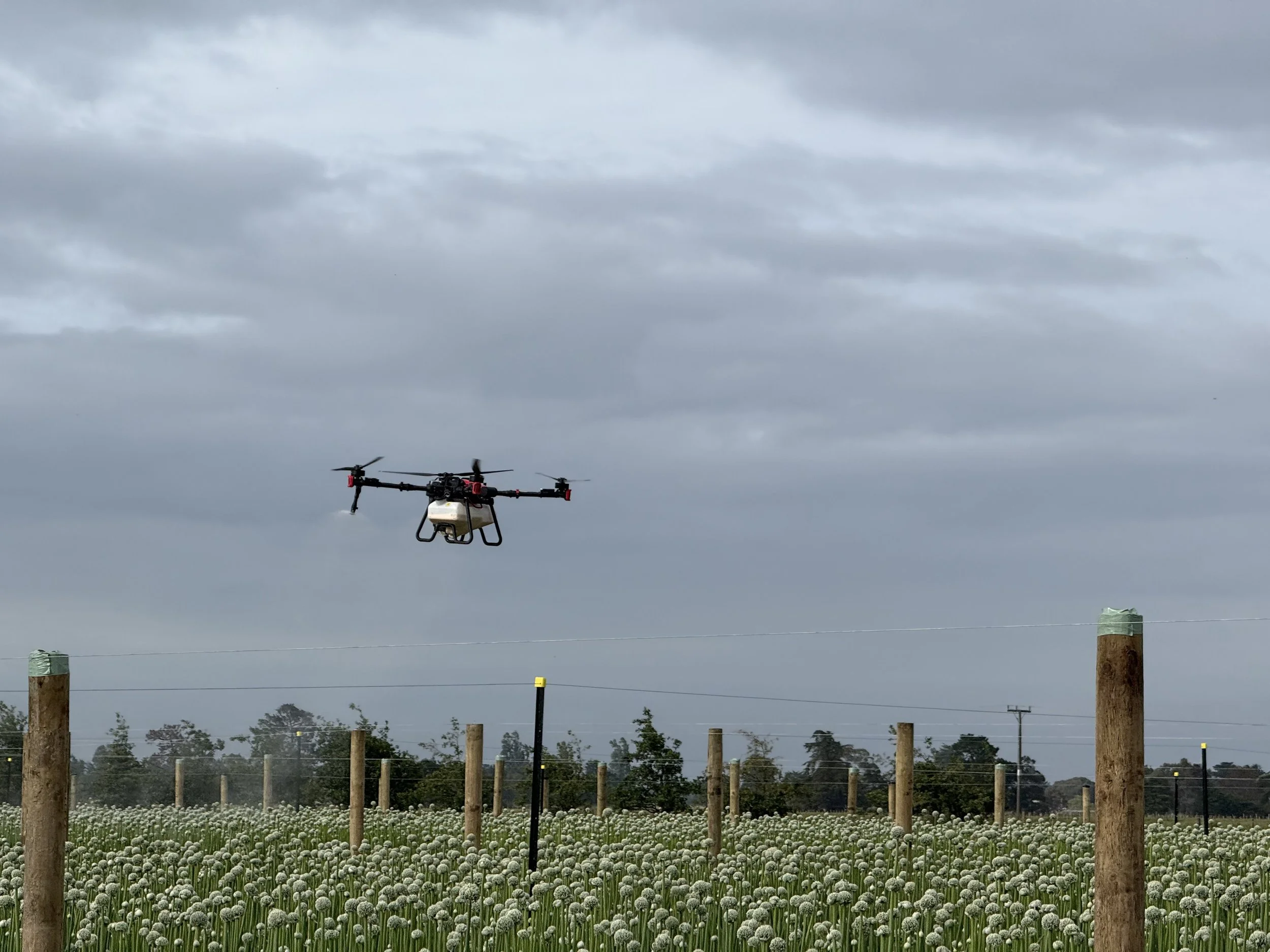
In a landscape where ground rigs and aerial application still do the heavy lifting, drone operators are emerging as a complementary tool, extending capability into areas that would otherwise be difficult, delayed or simply uneconomic to treat.
At the centre of that shift is OC Aerial, a Manawatū-based business that, while only recently established, reflects a much broader evolution in how contractors are approaching spraying, spreading and mapping work across modern farming systems. Built on a foundation of aviation awareness and practical agricultural experience, the business has positioned itself as a specialist provider of drone-based services that sit alongside traditional contracting operations, adding flexibility rather than replacing what already works.
Alex Owen-Cooper, director of OC Aerial, says the business was founded on exactly that premise.
“I started OC Aerial because I could see there was a gap between what ground rigs and helicopters can do, and what farmers actually need on the day. Drones aren’t there to completely replace those systems, but they’re a really effective tool for filling in the gaps, especially when timing, access and cost-effectiveness are critical. Another tool in the toolbelt for farmers to ensure that they are as efficient and productive as possible.”
What becomes clear early on is that this is not a hobby-driven entry into the market or a side offering built around a single machine. OC Aerial has been structured from the outset as a contracting business, with a clear focus on solving practical problems for farmers and other contractors, particularly in situations where conventional equipment is either inefficient or simply unable to operate.
That approach is reflected in the range of work the business is undertaking. Agricultural spraying remains the core, but it is supported by spreading, aerial mapping, infrastructure work such as roof treatment, and a growing role in equipment supply and support. It is a model that mirrors traditional contracting businesses in its breadth, but with a different set of tools delivering the work.
The key difference, of course, is that those tools are airborne.
At the centre of operations are purpose-built agricultural drone platforms, specifically the XAG P150 Max and XAG P100 Pro, machines that sit at the top end of current drone capability. These are not lightweight units designed for small-scale application. With payload capacities of up to 80 kg, they are engineered to handle meaningful workloads across commercial farming operations.
Owen-Cooper says the choice of platform was deliberate.
“We’ve gone with XAG because they’re built for proper commercial work. The payload, output and flexibility mean we can actually get meaningful work done, not just small-scale jobs. It’s about having gear that stacks up in real contracting conditions. Also, knowing that there is a large support network within New Zealand means that, when accidents happen, we can be up and running in hours instead of weeks with some other drones.”
Spray performance is one of the areas where the technology has advanced rapidly. OC Aerial’s systems are capable of delivering up to 46 L per minute, with droplet sizes ranging from 65 through to 1,500 microns. That range allows operators to tailor application depending on the product being used and the target, from fine coverage for crop protection through to much heavier droplets where drift control is critical.
Those output levels translate into practical efficiency in the field. The drones are able to cover ground effectively in smaller or fragmented blocks, where a tractor-mounted sprayer would spend as much time turning and repositioning as it would spraying. That efficiency becomes more pronounced when working in irregular paddocks, hill country or areas broken by shelter belts, drains or infrastructure.
Where drones come into their own, however, is not in replacing large-scale blanket spraying, but in complementing it. For broadacre work on flat, accessible ground, high-capacity sprayers remain the most efficient option. The value of drone application sits in the margins of those operations, in the missed corners, the wet patches, the steep faces and the areas that require targeted treatment rather than full coverage.
In those situations, the ability to deploy quickly, operate without ground contact and apply product precisely where it is needed changes the dynamic of the job.
Wet conditions are a good example. Where a ground rig may be parked up to avoid damaging soil structure or becoming stuck, a drone can continue operating, maintaining spray timing and avoiding the knock-on effects of delayed application. In a season where weather windows are challenging, that flexibility is becoming increasingly valuable.
“I’m timing is everything in spraying,” Owen-Cooper says. “If a paddock’s too wet or conditions aren’t ideal for ground gear, we can still get in and get the job done without causing damage or delays. Even when there are small weather windows overnight, we can get into the paddock and spray crops in the dark to ensure product is applied as soon as it needs to be.”
Steep terrain is another area where the technology is gaining traction. Traditional ground equipment is often limited by safety and traction, while manned aerial application can be expensive and less precise for smaller jobs. Drone systems sit in between, offering targeted application with a lower cost structure and the ability to work safely in areas that would otherwise be difficult to access.
Spreading capability adds another dimension. OC Aerial’s drones can deliver up to 300 kg per minute, handling granular products up to 10 mm in size with no minimum size restriction. While that does not replace large-scale fertiliser spreading, it provides a practical option for spot treatments, over-sowing and targeted nutrient application, particularly in areas where ground access is limited.
The technology behind these systems is a significant part of what enables that flexibility. GPS-guided flight paths allow for repeatable accuracy, ensuring that application is consistent across the target area. Integrated radar systems provide obstacle detection, allowing the drones to operate safely around trees, fences and other infrastructure while maintaining a steady flight path.
Operators are not manually flying each pass in the traditional sense. Instead, they are managing the system, setting parameters, monitoring performance and making adjustments as required. This shift from manual operation to system management is an important part of how drone contracting is evolving, bringing it closer in line with other precision agriculture technologies.
Battery and logistics management is another area where the operation becomes more technical than it might first appear. High-output drone work requires a constant cycle of battery use, charging and rotation, often supported by generator systems in the field. Alongside that sits product handling, mixing and loading, which mirrors many aspects of traditional spray operations but within a more compact and mobile setup.
A typical day’s work is structured around efficiency. Equipment is transported by ute, set up on-site and operated by a single skilled operator, with workflow built around minimising downtime between loads and flights. While hectare-per-hour figures will vary depending on terrain and application rates, the real efficiency comes from the ability to keep working in conditions where other systems cannot.
Alongside application work, aerial mapping is becoming an increasingly important part of the business. Using platforms such as the DJI Mavic 3M, OC Aerial is able to capture high-resolution multispectral imagery, providing insight into crop health, variability and emerging issues within paddocks.
This data can then be used to inform application decisions, creating a feedback loop between observation and action. Rather than applying product uniformly across a block, operators can identify specific areas that require attention and target those zones directly. It is a level of precision that aligns closely with the broader direction of modern farming systems.
Compliance and safety sit behind all of this. Operating under Civil Aviation Authority Part 102 certification, OC Aerial is able to carry out more advanced drone operations while meeting strict regulatory requirements. This includes not just flight operations, but also maintenance, record keeping and operator training.
The business also provides inspection, repair and modification services for drone platforms, recognising that uptime and reliability are just as important in this space as they are in any other form of contracting. As the technology becomes more widely adopted, that support infrastructure will play an increasingly important role.
From an environmental perspective, the advantages are clear. Reduced chemical use through targeted application, elimination of soil compaction and lower fuel consumption all contribute to a smaller operational footprint. At the same time, removing operators from direct exposure to chemicals and difficult terrain improves safety outcomes.
“What we’re seeing now is that we’re genuinely competitive with helicopters in a lot of situations,” Owen-Cooper says. “Where we add the most value is in the areas that are hard to get to or easy to miss, wet ground, steep faces, awkward corners. But with the latest gear, we’re now genuinely competitive with helicopters, especially with fuel and parts costs continuing to rise. Because drones have such low running costs, we can cover larger areas at a lower price point while still achieving the same, if not better, coverage.”
What is perhaps most important, however, is how the technology is being positioned. OC Aerial is not presenting drones as a replacement for existing contracting systems, but as an additional tool that strengthens the overall operation. That positioning is likely to be key to long-term adoption.
For contractors, the question is not whether drones will replace tractors or aircraft, but how they can be integrated into existing services to improve efficiency and expand capability. For farmers, it is about having access to the right tool for the job, whether that is a high-capacity ground rig, a helicopter or a drone.
OC Aerial’s model reflects that thinking. It is a business built around practical application, using technology to solve specific problems rather than chasing novelty. In doing so, it highlights a broader shift within the sector, where success is increasingly defined not just by the scale of machinery, but by how effectively different tools are combined.
As pressure continues to build around efficiency, compliance and environmental performance, that ability to integrate new technology into existing systems will only become more important.
Drone operations are still a relatively new addition to the contracting landscape, but their role is becoming clearer.
They are not the centre of the system, but they are becoming an increasingly valuable part of it. And for businesses like OC Aerial, that position, working alongside established contracting methods while extending what is possible, may prove to be where the greatest opportunity lies.