
KP Contracting: built on reliability in a region that demands it
KP Contracting has never been a business built around noise. In a region like the Manawatū, where farming systems are diverse and the weather can redraw the season in a matter of days, reputation rests on something far more practical than marketing.
It rests on whether a contractor turns up when they say they will, whether the job is done properly and whether farmers feel confident handing over responsibility at the moments that matter most. That is the foundation KP Contracting has operated from since its early days and nearly two decades on from its last feature in this magazine, much of that foundation remains unchanged.
When revisiting the business today, the most striking thing is not how much has altered but how steady the core has remained. As Heather, the company’s office manager put it when reflecting on the earlier profile, “If you look back at the 2007 article, things are pretty much the same. We have kept to what we know and what works.” That continuity speaks volumes in an industry that has seen significant technological, regulatory and structural change over the same period.
KP Contracting was established to serve a local farming community that required dependable support across cultivation, planting and harvesting. From the outset the business was structured around practical fieldwork rather than diversification for its own sake. Over time it expanded steadily as demand grew and as relationships deepened across the district. The growth was organic rather than aggressive, driven by repeat clients and referrals rather than headline expansion.
There have however, been some changes. The drainage side of the business once a component of the service offering, has since been sold. That decision reflected a focus on refining rather than broadening the operation. “We made a conscious decision to concentrate on the areas where we felt we could add the most value,” KP Contracting says. “Selling the draining side allowed us to put more energy into cultivation, planting and the crop protection work that our clients rely on.” In a region where soil conditions vary widely and timing is critical, sharpening that focus has proven more valuable than maintaining a broader but thinner service range.
Ownership has also evolved. Kerry, who played a role in earlier years has since retired from the business. Today KP Contracting is directed by three shareholders: Peter who remains a constant presence from the early days, alongside Jason Brown and Tom Welsh. The structure is deliberately straightforward, with responsibilities shared and communication constant. “Everything is shared between the three directors,” the directors say. “Jason looks after the spraying side more closely, Peter oversees cultivation and Tom helps run the team and supports both of them. But they all step in where needed.”
That flexibility reflects the practical realities of contracting. In smaller to mid-sized operations, rigid divisions of responsibility rarely survive peak season. When weather windows open, everyone is involved in coordination, logistics and field decisions. The shared leadership model at KP Contracting allows for that adaptability while still ensuring each core area has clear oversight.
The services offered today mirror the central needs of Manawatū farms. Cultivation and planting remain the backbone of the operation, forming the starting point for crop establishment across mixed and dairy support systems. From ground preparation through to drilling, the work undertaken in spring often determines how the season unfolds. Soil variability across the region means that machinery setup, depth control and timing cannot be approached generically. Experience remains as important as horsepower.
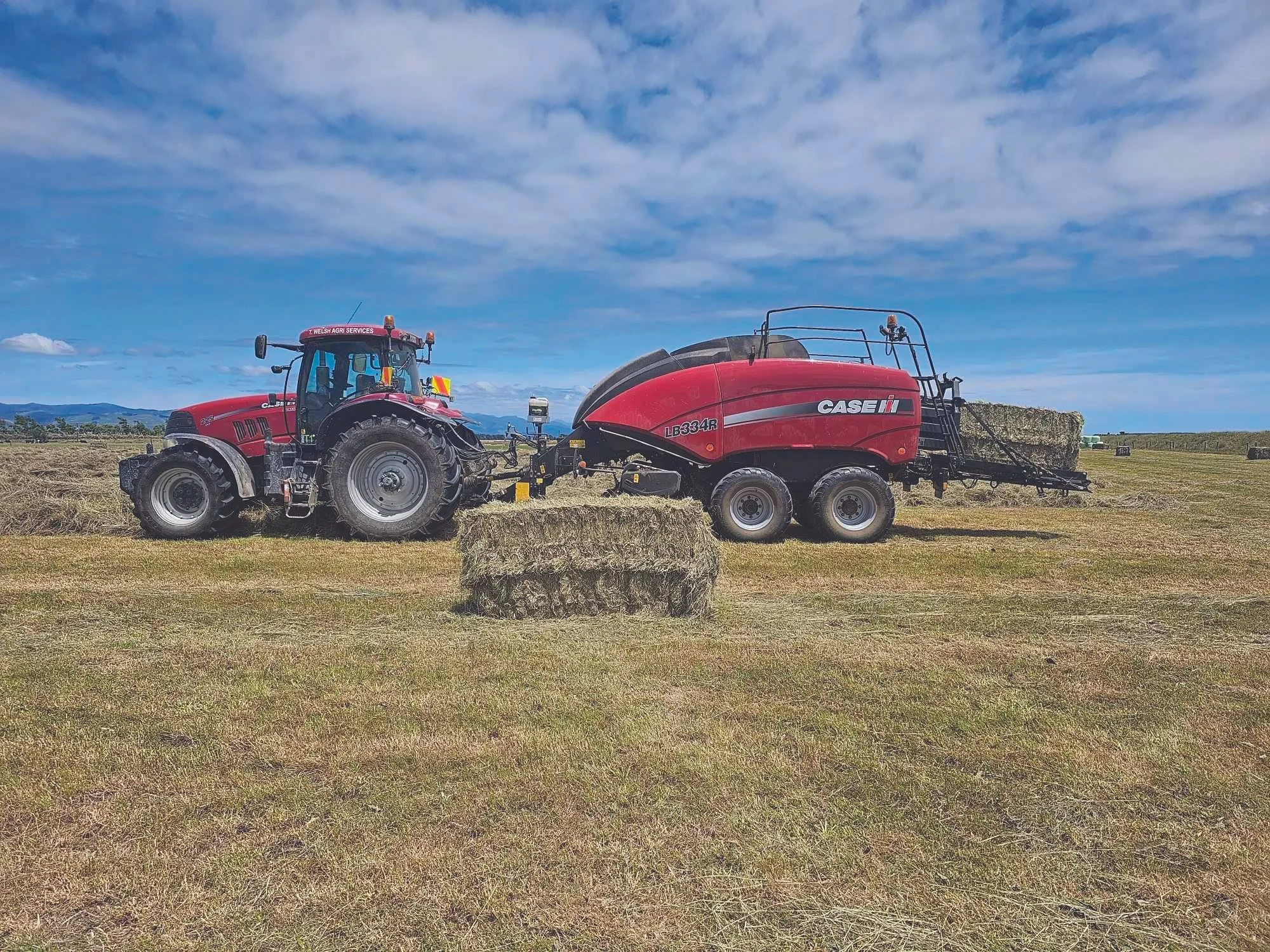
Harvesting, hay and baleage production also form a significant part of the annual cycle. Interestingly, KP Contracting noted a shift in workload patterns in recent seasons. “We have noticed that harvesting has slowed a little and hay production has increased,” they said. That change reflects broader trends within farming systems, where feed conservation strategies have adapted to market pressures and climatic variability. Baleage and haymaking windows have become more tightly managed, with contractors expected to respond quickly when conditions align.
Spraying rounds out the core service offering and operates across the calendar. “We spray all year round as required,” KP Contracting said. Unlike some seasonal tasks, crop protection and pasture management demand continuity. Modern plant protection work carries increased expectations around precision, record keeping and compliance. The contractor’s role extends beyond simply applying product to ensuring that timing, rate and method align with both agronomic and regulatory requirements.
Locally, KP Contracting has developed a reputation particularly in plant protection. “We are well known for everything that goes with plant protection, from prep to harvest,” KP Contracting said. That phrase encapsulates a broader strength of the business: involvement across the full cycle rather than isolated tasks. From initial cultivation and planting through to crop maintenance and eventual harvest, continuity of service allows for better planning and smoother execution.
Machinery underpins that delivery. The fleet today is predominantly Case, reflecting a preference that has developed over time. While other brands sit in the shed where appropriate, Case equipment forms the backbone of the operation. Brand loyalty in contracting is rarely about image. It is about reliability, dealer support and familiarity for operators. Consistency in fleet selection simplifies maintenance, parts management and operator training.
Investment decisions are approached pragmatically rather than aspirationally. “We maintain our vehicles well and replace as we need to update the fleet and replace older equipment,” KP Contracting said. That measured approach avoids both over-capitalisation and reactive spending. In contracting, machinery must earn its place. New purchases are justified by efficiency gains, reliability improvements or the need to meet evolving client expectations, not by novelty.
A typical year at KP Contracting follows a rhythm familiar to many rural operators, yet within that rhythm lies constant variation. Winter is devoted largely to maintenance. Machinery is stripped, serviced and prepared for the intense months ahead. Planning conversations with clients begin early, mapping likely workloads and identifying potential pressure points.
Spring signals the acceleration. Cultivation and planting dominate the schedule as soil conditions allow. Operators move between properties with careful coordination, chasing workable windows while monitoring moisture levels and forecasts. Summer shifts the focus toward crop maintenance and hay or baleage production. The pace rarely slows. “Summer is when everything seems to happen at once,” KP Contracting says. “You have crop maintenance, mowing, baling and all the coordination that goes with it.”
Autumn brings harvesting and regrassing. Crops reaching maturity across multiple farms can compress the workload dramatically. Weather remains the overarching variable. In the Manawatū, where rainfall patterns can shift quickly, contractors must remain poised to act. KP Contracting was clear about the greatest challenge facing the business. “Weather is our biggest challenge,” they said. “It dictates everything we do.”
That dependence on weather is not new, but variability appears to be increasing. Shorter, less predictable windows place greater pressure on scheduling and staff. When conditions align, the team must operate efficiently and safely for extended periods. KP Contracting runs with a deliberately lean structure: three permanent staff, three casuals and the three directors themselves, all of whom operate as all-rounders. “Everyone can turn their hand to most jobs,” the directors say. “That flexibility is what keeps us moving.”
Retaining skilled staff remains one of the defining challenges of modern contracting. Experienced operators bring not only machinery competence but judgement. They read paddocks, adjust to changing conditions and represent the business on farm. In a tight labour market, maintaining a stable team becomes a competitive advantage. Smaller teams also reinforce accountability. Each person understands their role within the broader schedule and the importance of communication.
Behind the visible fieldwork sits careful organisation. Contracting may appear reactive but success depends heavily on preparation. Planning conversations with clients, forward booking, equipment servicing and staff coordination ensure that narrow windows are used effectively. Communication has become increasingly important. “There is a lot more planning involved now,” KP Contracting says. “Farmers want to know what the schedule looks like and how weather might affect things. Keeping those lines open makes a big difference.”
What has also changed, even if the structure of the business has not, is the complexity of the environment in which contractors operate. Twenty years ago expectations around documentation, chemical traceability and environmental oversight were present but comparatively light. Today they are embedded in daily workflow. Spray diaries are scrutinised, buffer zones are clearly defined and communication with neighbouring properties has become routine rather than optional. For a business known locally for plant protection, that responsibility carries weight. “There is definitely more paperwork than there used to be,” KP Contracting said. “But it is part of being professional. Farmers need those records and we need to be able to stand behind what we have done.”
That shift reflects a broader maturation of the sector. Contractors are no longer simply machinery providers. They are accountable operators within increasingly regulated farming systems.
There is also the question of generational transition. With Peter remaining involved and Jason and Tom stepping into directorship roles, the business now carries both institutional memory and forward momentum. Knowledge of paddocks, clients and seasonal patterns cannot be replicated quickly, yet new leadership brings fresh perspective and energy. In smaller rural enterprises, that blend is often what sustains longevity.
Risk management has become more deliberate. Machinery represents significant capital and downtime during peak periods is costly. Preventative maintenance is therefore not a winter formality but a strategic decision. Likewise, workload management is balanced carefully to avoid overextension. In contracting, chasing volume without capacity can erode the very reliability that built the business in the first place.
The Manawatū itself remains a demanding region in which to operate. The mix of dairy support, cropping and pasture-based systems means contractors must move between very different tasks across short distances. Soil types shift, paddock shapes vary and access can change dramatically with rainfall. That variability rewards operators who are observant and measured rather than purely mechanical.
Looking ahead, the three directors are conscious that the contracting environment will continue to evolve. Market volatility, input costs and environmental policy will shape farm decisions and by extension, contractor workloads. Adaptability remains central. “We know things will keep changing,” KP Contracting said. “The key for us is staying flexible and keeping the relationships strong.”
Those relationships remain the thread running through the business. In rural communities, longevity is earned. Farmers remember who turned up during difficult seasons and who communicated clearly when plans shifted. They value contractors who understand the local soils and systems, who anticipate rather than react and who treat each job as part of a longer partnership.
Revisiting KP Contracting after nearly two decades reveals a business that has resisted the temptation to chase scale for its own sake. Instead, it has focused on doing core work consistently well. The sale of the drainage arm and the retirement of Kerry did not signal contraction but refinement. The arrival of Jason and Tom alongside Peter reflects continuity combined with renewal.
In many ways, KP Contracting embodies the quiet strength of regional contracting in New Zealand. It operates without fanfare yet underpins critical stages of the farming cycle. It adapts where necessary but holds fast to principles that have always mattered. Reliability, straightforward communication and practical competence remain its defining characteristics.
As farming systems in Manawatū continue to adjust to climatic variability and economic pressure, the need for dependable contractors will only intensify. Machinery may become more advanced and compliance frameworks more detailed, yet the core expectation remains simple. Farmers require partners who will stand behind their commitments.
KP Contracting’s story, stretching from its early years through to its present structure under Peter, Jason and Tom, demonstrates that stability and adaptability are not opposing forces. They are complementary. By maintaining a clear focus on core services while adjusting structure and emphasis where needed, the business has sustained relevance across changing seasons.
KP Contracting reflection perhaps captures it best. “We have not tried to reinvent ourselves,” they said. “We have just kept working hard, looking after our gear and looking after our clients.”
In a region that demands reliability above all else, that approach continues to hold its value.