
On-farm nitrogen – it's electrifying
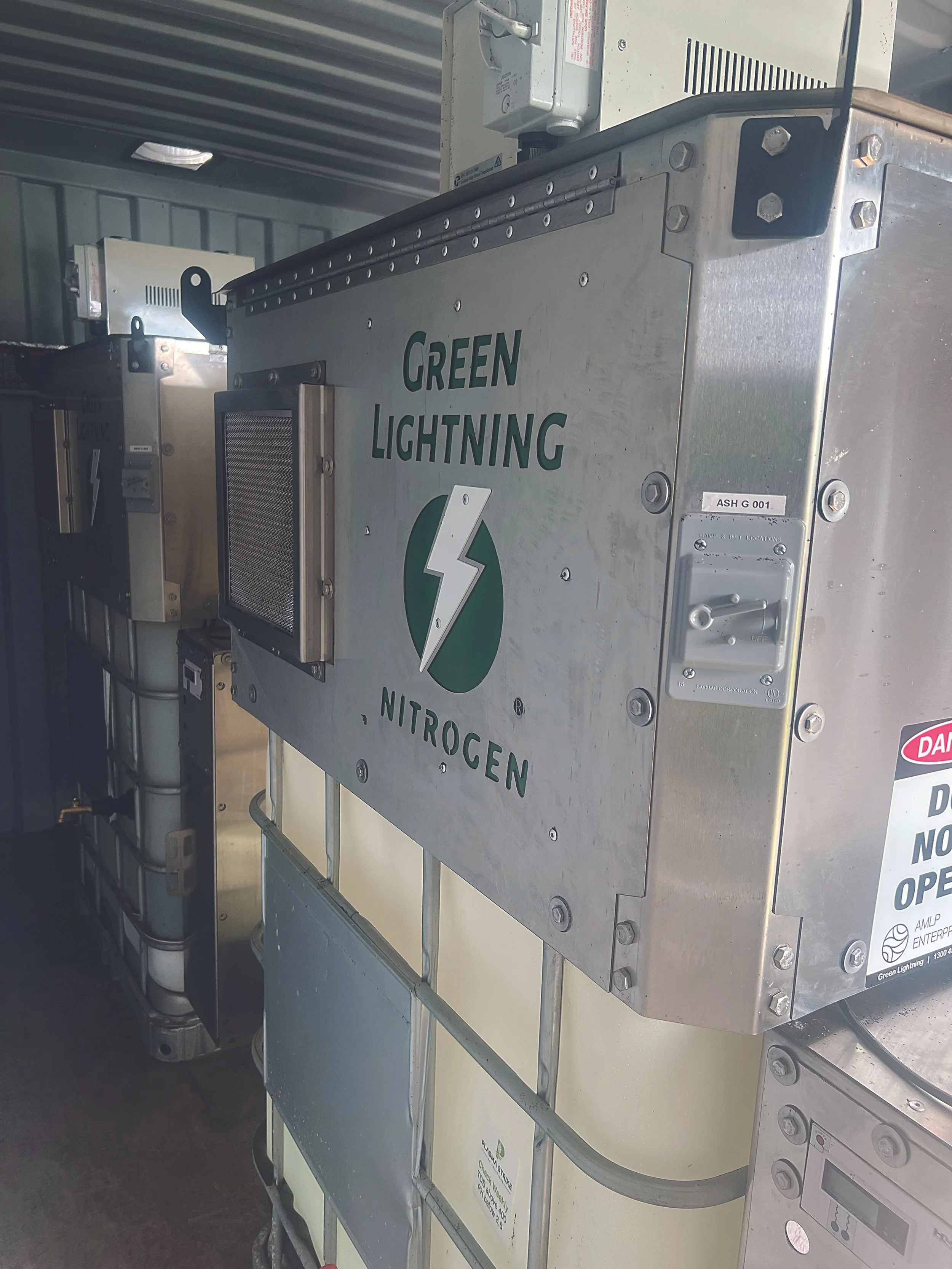
Victoria dairy farmer Ash Gristiede is one of a growing number of farmers producing nitrogen fertiliser on-farm using Green Lightning technology.
Scramble for urea
When conflict in Iran disrupted shipping through the Strait of Hormuz earlier this year, it exposed just how dependent Australian agriculture remains on imported urea.
Around 60% of Australia's urea imports pass through the Persian Gulf, along with roughly half of its diesel imports. The disruption sent fertiliser prices soaring and left many growers reconsidering their cropping plans. Some reduced winter cereal plantings in favour of nitrogen-fixing legumes, while others delayed planting altogether.
The Australian Government responded by establishing the $7.5 billion Fuel and Fertiliser Security Facility (FFSF), securing 38,500 tonnes of agricultural-grade urea from Brunei. To date, six cargoes totalling 209,000 tonnes have been imported through the programme.
While the additional supply has eased immediate shortages, the concentration of imports through a small number of suppliers has created concerns elsewhere in the fertiliser industry.
Pulling nitrogen out of the air
For Ash Gristiede, however, the urea shortage has had far less impact.
Although he still uses some urea, it is only around half the amount he previously applied, and he says he could eliminate it entirely if necessary.
"We were one of the early ones to say we'll give it a crack," he says of the two Thunder 365 Green Lightning machines installed on the family's dairy farm near Port Campbell in south-west Victoria. "It was a fair bit of money to put out — about $130,000 for each machine."
After almost a year of operation, Ash says the investment has exceeded expectations and the family plans to install a third unit.
Manufactured in the United States, Green Lightning machines use plasma technology to replicate the natural process that occurs during lightning storms.
The atmosphere contains almost 80% nitrogen. During lightning strikes, that nitrogen becomes ionised and bonds with oxygen, eventually returning to the ground in rainfall as plant-available nitrate.
Green Lightning recreates that process using electricity, converting air and water into a liquid nitrate fertiliser produced entirely on-farm.
The approach offers several advantages over conventional urea.
Because the nitrogen is already in nitrate form and dissolved in water, it is immediately available for plant uptake. It also reduces the amount of unused nitrogen remaining in the soil, lowering the risk of losses through leaching.
The liquid contains virtually no salts, allowing it to be safely applied as a foliar fertiliser without burning foliage, even at relatively high application rates. Its low salt content also reduces impacts on soil biology compared with traditional urea.
Independent maize trials conducted by Beck's Hybrids in the United States found Green Lightning performed best when replacing between 25% and 55% of conventional urea while being applied as regular foliar "spoon-feed" applications rather than a single large nitrogen dressing.
Those trials found the strongest returns came through lower fertiliser costs rather than increased production, with estimated payback periods of one to three years.
Ash says his own experience has been similar.
"One of the machines has already paid for itself in a year."
Instead of relying on large urea applications, he applies between 100 and 200 litres per hectare of Green Lightning after each grazing rotation, typically every 30 to 40 days through winter.
He estimates that 200 litres of Green Lightning replaces approximately 100kg of urea.
The product is applied using a Tow and Fert sprayer manufactured by Metalform (Dannevirke) Ltd in New Zealand.
Ash has also found the liquid performs well as a carrier for other foliar products.
"They always say put a bit of urea in your Roundup because the plant takes it up better," he says.
This season the farm applied almost 300 litres per hectare of Green Lightning alongside herbicides across 16 hectares of silage maize.
"It had a really good weed kill."
Solar and lightning make a good combination
The two Green Lightning units operate inside a shipping container with space available for a third machine.
Each draws water from an external storage tank before pumping the finished product into sealed holding tanks.
Water quality is critical.
Rainwater is ideal, while good-quality bore water is also suitable.
Ash initially attempted to use dam water but found suspended clay and silt rapidly clogged filtration systems.
"We went through about $1,200 worth of filters."
The farm now purchases treated bore water from nearby Port Campbell at around $150 per tanker load while planning to install a 250,000-litre rainwater storage tank.
Electricity requirements are modest.
Each unit uses approximately 1.1kWh per day, with Ash estimating that producing 1,000 litres of Green Lightning costs around $50 to $60 in electricity.
The farm's 80kW solar system and battery storage comfortably supply that demand.
"You need to put it on at 200 litres a hectare," he says. "But even if you had to put on 400 litres a hectare and got the same result as 100kg of urea, the power cost is bugger all compared with buying urea, especially at current prices."
Farming on the Shipwreck Coast
Ash and Michelle farm near Port Campbell on Victoria's rugged Shipwreck Coast.
Although many assume coastal farms are sandy, the property typically has just 100 to 150mm of topsoil over heavy clay, creating persistent drainage challenges through winter.
Mole drainage has been installed across parts of the farm, with additional work continuing as finances allow.
Wet winters have prompted some local farmers to adopt composting barns similar to those increasingly used in Southland, New Zealand.
Ash and Michelle instead built a straw-bedded calving shed around five years ago, although Ash says he is now considering a composting barn as another way to reduce pasture damage.
He has also investigated growing his own bedding materials, including miscanthus and purpose-grown trees for woodchip.
Once composted, the bedding becomes a valuable source of organic nutrients, while also reducing nutrient losses by absorbing urine before it reaches waterways.
The approach aligns with Ash's broader goal of making the farm more resilient while reducing environmental impacts.
Long, dry summers also present challenges.
Traditional ryegrass struggles to persist, prompting a gradual shift towards cocksfoot and clover-based pastures.
"You can replace just about everything in the cow's diet, but you still need, ideally, a couple of kilos of grass," he says. "Which we quite often don't have."
The farm relies heavily on maize silage, grass silage and some vetch to maintain production.
Ash has also introduced the Halter virtual fencing system, which has already improved labour efficiency.
"We're finding we're saving a lot of time moving cows back and forth up the paddock."
From small beginnings
Ash grew up on his parents' sheep and beef farm before beginning his dairy career at just 13 years old, milking cows for a neighbouring farmer alongside his older brother Richard.
By 16 he had begun share farming the property, eventually purchasing it at the age of 22 with support from his parents.
Michelle also grew up locally on a dairy farm.
Despite once insisting she would never marry a dairy farmer, the couple have now worked together on the farm for more than 30 years and raised three children.
What began with a small walk-through dairy has expanded over the decades into a 450-hectare milking platform, a 60-bail rotary dairy and a herd of around 750 cows.
The business produces approximately 630kg of milk solids per cow annually through a year-round calving system.
Their eldest son, Mitchell, has returned to the business after completing a cabinet-making apprenticeship and also operates a small baleage contracting business.
Looking ahead
For Ash, producing nitrogen on-farm is about much more than responding to short-term fertiliser shortages.
He believes reducing reliance on imported urea offers significant long-term economic and environmental benefits.
"If we can cut out urea completely and produce our own nitrogen on farm, it's a massive cost saving," he says. "It's also a massive environmental plus because it takes a hell of a lot of energy to make urea granules in the first place."
Producing fertiliser on-farm also removes the need to transport, store and spread granulated urea.
"If practices like using the Green Lightning machine break the nitrogen cycle open and we don't need as much of it, well bloody great. Not for the fertiliser companies, but I'm pretty sure everyone else will be happy."
Green Lightning machines have been available in Australia for just over a year and are distributed by Plasma Strike – Ag Solutions.