
Redefining foliar application
Modern nutrient management is increasingly about more than the fertiliser product itself. The challenge also lies in how those nutrients are delivered. The ability to dissolve, suspend and accurately apply products that traditionally could not be sprayed has become one of the more significant engineering developments in pasture nutrition, shifting the focus from simply what is applied to how it reaches the plant.
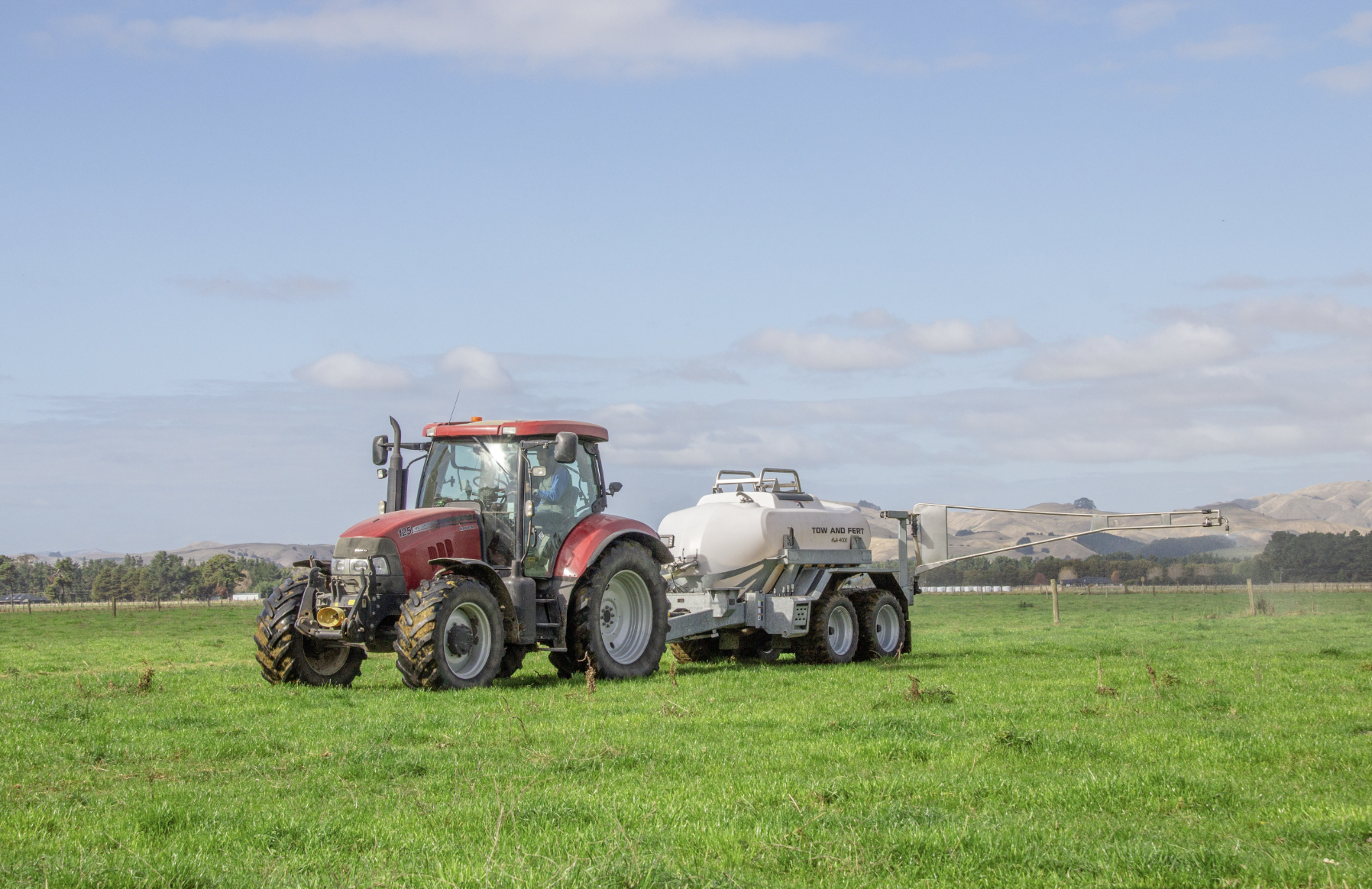
That philosophy sits behind the Tow and Fert system. While it is commonly associated with foliar fertiliser application, the machine itself is fundamentally an exercise in fluid engineering. Every component has been designed around one objective: transporting products with very different physical characteristics through a spray system without separation, settling or damage before they reach the target.
Conventional boom sprayers were developed to handle liquids with relatively consistent viscosity. Once operators begin introducing dissolved fertiliser, fine mineral suspensions, biological products or small seeds, the limitations quickly become apparent. Heavy particles settle in the tank, nozzles begin to block, pumps experience excessive wear and delicate biological products can be damaged by high operating pressures. Solving those problems requires considerably more than a larger tank and a bigger pump.
Tow and Fert approached the problem by redesigning the entire application process. One of the system's defining features is its ability to dissolve granular urea at concentrations of one part urea to two parts water while also being capable of suspending two parts lime flour to one part water. Achieving that consistently requires continuous agitation and circulation throughout the entire spray system rather than simply mixing products before application.
Keeping heavy particles suspended may sound straightforward, but from an engineering perspective it is one of the more difficult challenges in liquid application. Gravity is constantly working against the operator. As soon as circulation slows, heavier materials begin settling towards the bottom of the tank while lighter fractions remain suspended. The result is uneven nutrient concentration, inconsistent application rates and blocked plumbing. Tow and Fert's solution uses continuous hydraulic movement to maintain a homogeneous mixture from the tank through to the spray boom, ensuring every nozzle is applying the same product concentration across the full working width.
The boom itself has also been re-engineered. Instead of allowing product to remain stationary within the boom until spraying resumes, Tow and Fert uses a recirculating boom system that continuously moves product through every section of the plumbing. This virtually eliminates dead spots, where sediment would otherwise accumulate and significantly reduces the likelihood of blocked nozzles when working with fine particles or suspended materials. It also means the correct product concentration reaches every nozzle immediately when spraying begins, rather than requiring operators to flush inconsistent material from the boom before achieving an even application.
Pump design is another area where conventional sprayers can struggle once operators move beyond standard liquid fertilisers. Abrasive materials, such as lime flour, place enormous demands on pumps, seals and impellers. Rather than adapting existing components, Tow and Fert developed its own purpose-built 3-inch stainless steel pump after finding commercially available alternatives were unable to withstand prolonged exposure to abrasive products. Stainless construction provides durability, while the pump's design maintains the high circulation volumes needed to keep heavy materials in suspension throughout the spraying operation.
Pressure management becomes equally important when biological products enter the equation. Many beneficial microbes can be damaged when exposed to excessive pumping pressures or high shear forces. Tow and Fert addresses this by operating at approximately 22 psi, substantially lower than many conventional boom sprayers. The lower operating pressure allows biological products to pass through the system with significantly less physical stress while still maintaining effective application. As biological inputs continue gaining interest across both pasture and cropping systems, machinery capable of handling living organisms without compromising viability is becoming increasingly relevant.
The engineering also extends beyond the hardware itself. Integrated weigh scales allow operators to accurately measure product loading, while the Companion Mix application calculates mixing rates, nozzle selection and operating speeds to match individual products and application rates. These digital tools reduce operator error while improving repeatability, an increasingly important consideration as nutrient programmes become more tailored to individual paddocks and seasonal requirements.
The system's versatility has attracted interest from contractors looking to offer more than traditional fertiliser application. Being able to dissolve granular fertiliser on farm rather than transporting pre-mixed liquid products creates greater flexibility while reducing freight and storage requirements. Equally important is the ability to apply multiple product types through a single machine, from dissolved fertilisers and fine mineral suspensions through to biologicals and small seeds, reducing the number of separate field operations required throughout the growing season.
That flexibility was one of the reasons Align Farms adopted the system. Chief Executive Rhys Roberts said the business chose Tow and Fert because of "the ability of the machine to take granular product in its cheap, core form, mix it with water or effluent from our own sources and apply it paddock-by-paddock". Following the change to foliar application across the group's dairy farms, Align Farms reduced nitrogen inputs by up to 33% while maintaining production, demonstrating how application technology can influence nutrient efficiency as much as the fertiliser programme itself.
For contractor Ricky Taylor, the attraction was equally practical. "We eventually found the Tow and Fert system and immediately could see the benefits. Farmers can cart in their dry product, dilute it down and away we go," he said. His experience highlights another aspect of the design philosophy. Rather than requiring growers to purchase specialist liquid fertilisers, the machine allows widely available granular products to be converted into high-concentration spray solutions directly on farm.
The broader significance of Tow and Fert extends beyond foliar fertiliser alone. As agriculture continues adopting biological products, trace elements, fine mineral suspensions and increasingly complex nutrient programmes, machinery capable of accurately handling a wider range of products will become just as important as the products themselves. The engineering challenge is no longer simply building a sprayer that moves liquid from tank to nozzle. It is designing an application platform capable of handling almost any nutrient input while maintaining consistency, protecting sensitive products and delivering every hectare at the same rate. In that respect, Tow and Fert represents a shift from conventional spraying equipment towards purpose-built nutrient application technology, where fluid dynamics, materials engineering and precision delivery become just as important as the chemistry inside the tank.