
Why this Southland machinery expert rates Samasz for mowing
When Charlie Milne decided it was time to update the mowing equipment on his own farm, he found himself facing the same decision many of his customers do.
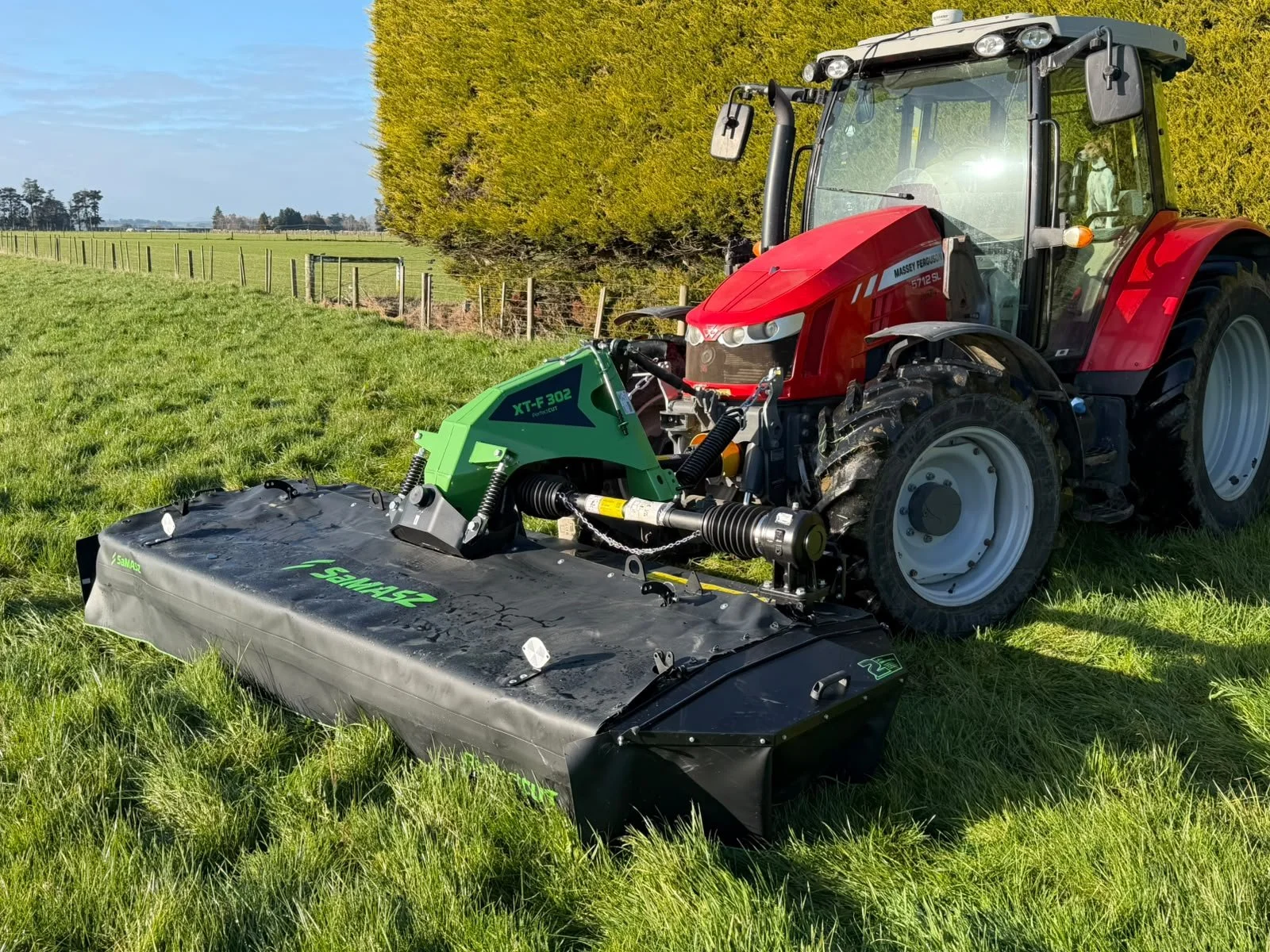
As the owner of Thornlie Park in Edendale, Southland, Milne sells and services agricultural machinery, including the growing range of Samasz mowers. Yet, until recently, the front mower on his own tractor wasn’t green and black.
“I’d been running a Krone front mower and a Samasz rear,” Milne explains. “When you’re selling Samasz, people naturally ask what you’re running yourself, so I thought I’d better put my money where my mouth is.”
For Milne, investing in the XT-F was about backing a product he genuinely believes in. That decision saw him purchase a new Samasz XT-F front mower, pairing it with his existing Samasz KT341 rear mower on his 110 ha property.
“It is well priced compared to anything else on the market. I don’t think there’s anything that comes close to it.”
While Milne is still waiting for the spring growth to put the XT-F through its paces, the decision to buy wasn’t based on guesswork. As a Samasz dealer and service agent, he has seen the mowers operating across a range of conditions and has built confidence in both the machinery and the support behind it.
“I’ve sold a few now and seen them in action, and everyone seems to be very happy with them, which is encouraging.”
The XT-F also suits the way Milne works. With a busy machinery workshop to run alongside the farm, simplicity is important, and he doesn’t want to spend valuable time setting up a machine before getting into the paddock.
“We’re flat-out in the workshop all the time, so when I’ve got to go and mow a paddock, I don’t want to be mucking around. It’s just clip it on and go.”
Mounted on the front of the tractor, the XT-F gives the operator good visibility while its compact design makes attachment and operation straightforward. The mower uses Samasz’s welded Perfectcut cutterbar, designed to provide a clean cut while allowing quick knife changes and keeping ongoing maintenance relatively simple.
Weight and power requirements are also important considerations, particularly for farmers who want the productivity of a front and rear combination without moving into a much larger tractor. The XT-F uses a compact design and spring relief system to reduce ground pressure and tractor load while allowing the mower to follow changes in the ground contour.
Milne runs his XT-F alongside the KT341 rear mower behind a 120 hp tractor, giving him a productive mowing combination without requiring excessive horsepower.
One of the biggest reasons behind his decision, however, was value. With machinery prices continuing to climb, Milne believes the XT-F gives farmers and contractors another option when the alternative might be buying an older machine with an unknown history.
Buying new brings the benefit of knowing exactly what the machine has done from day one, along with straightforward maintenance and a two-year factory warranty, which is longer than that offered with a number of competing machines. For buyers weighing up new against second-hand equipment, Milne sees that combination of purchase price, warranty and expected working life as a significant part of the equation.
His approach to selling machinery is equally practical. Rather than recommending one mower for every situation, Milne works with customers to determine which machine best suits their country and the work they expect it to do.
The XT-F is particularly suited to flat and gently rolling country, where the front-mounted design provides good visibility and an efficient mowing setup. Its ground-following ability is designed to maintain a consistent cut across uneven terrain while limiting unnecessary contact with the turf.
Cutting height can be adjusted steplessly from 45 mm to 70 mm, while optional topping plates allow a higher residual where required. The mower can also be configured to work with other forage harvesting equipment, including balers and self-loading wagons, while reversible gearbox options cater for tractors with either left or right PTO rotation.
For steeper country with more pronounced humps and hollows, Milne may instead recommend one of Samasz’s pull-type mower combinations.
“I’ll always review the area before recommending which Samasz mower will suit best.”
That approach becomes particularly important in Southland, where machinery can be expected to work in some demanding conditions. Milne says customers in his part of the country are looking for a considerable working life from their equipment, “at least ten years, at this end of the country anyway”.
Some of the machines he supports operate in particularly tough environments, including coastal properties where sand, rough ground and deep ruts can quickly expose weaknesses in equipment. Despite those conditions, Milne says feedback from Samasz operators has been consistently positive.
Long-term ownership is also helped by keeping the mower relatively straightforward. Low operating costs and simple maintenance mean many routine servicing jobs can be handled by the owner, while Thornlie Park continues to expand its stock of Samasz spare parts and provides servicing and technical support for customers throughout the region.
Adding another layer to that support is FarmFix, FarmShop’s AI-powered technical assistant for Samasz machinery. Developed in-house by FarmShop, FarmFix is designed to give farmers and contractors quick access to verified information drawn from Samasz operator manuals, spare parts catalogues and FarmShop’s own technical knowledge.
Accessible from a smartphone, tablet or computer, it means an operator dealing with an issue in the paddock can troubleshoot a problem, identify a part or find technical information without having to work through a manual or wait until someone is available to answer the phone.
For Milne, that support is part of the wider equation when choosing machinery. Purchase price matters, but so does simplicity, access to parts, the ability to maintain the machine and knowing there is support available when something does go wrong.
His own XT-F now gives him the opportunity to experience the machine from the same side of the fence as his customers. The Perfectcut cutterbar, adjustable cutting height, relatively light power requirement, ground-following system and two-year warranty all contributed to the decision, but ultimately the coming Southland season will provide the test that matters.
“Ask me this time next year. I’m looking forward to putting it through its paces.”