
Turning stubble into opportunity
There is a point in every cropping rotation when residue management becomes the difference between a clean start and a compromised one. Stubble may look harmless on the surface, but how it is handled determines how quickly soils warm, how evenly seedbeds form and how efficiently nutrients cycle back into the system. That is why the role of modern stubble cultivators has shifted from simple surface scratching to purposeful soil management, and machines like the Kuhn Optimer XL sit squarely in that evolution.
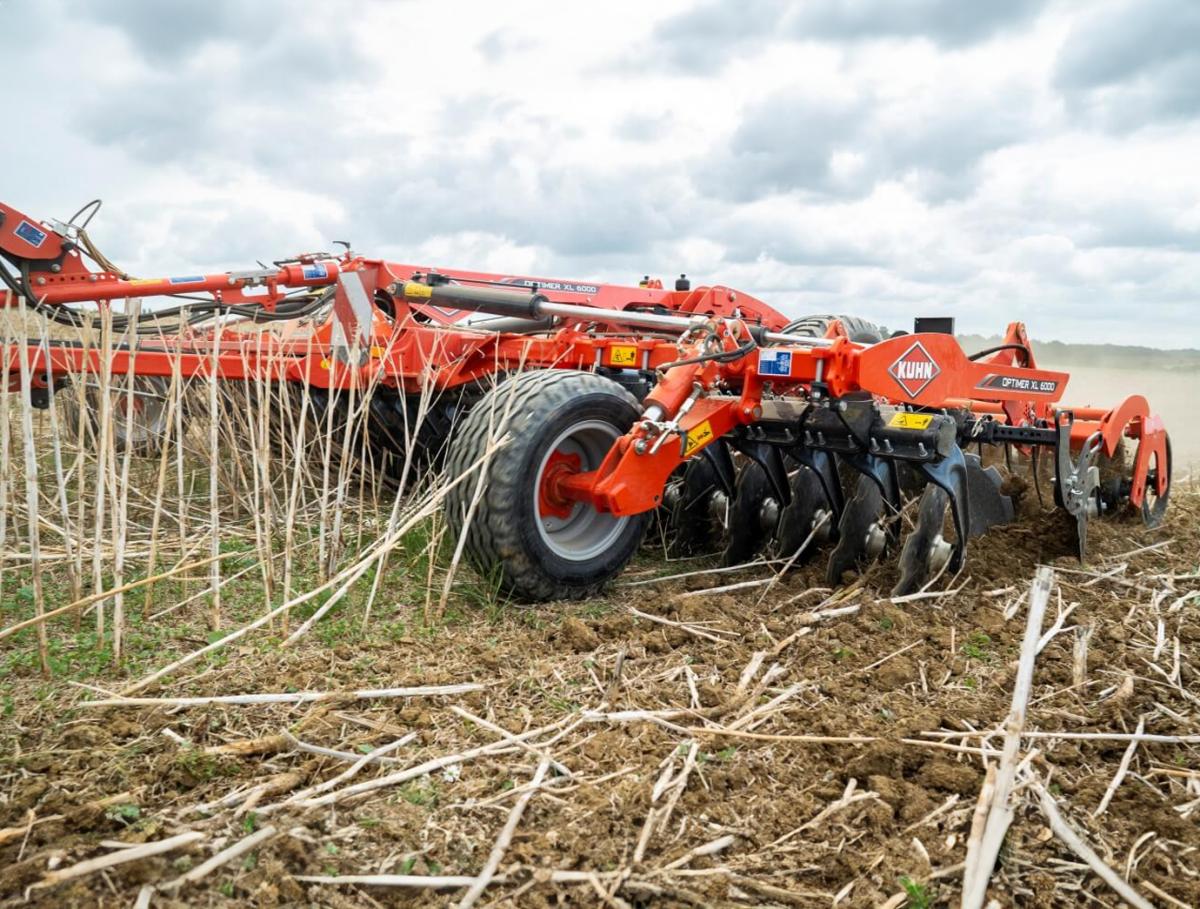
At its core the Optimer XL is designed for one job done well, which is to cut, mix and incorporate residue consistently across large working widths while maintaining speed and uniform depth. The machine uses large diameter independent discs 620 millimetres in size, allowing it to work from roughly five to fifteen centimetres deep. That working window matters because it gives operators the ability to tailor cultivation to the job in front of them, whether that is shallow mixing to stimulate volunteers and weeds or deeper incorporation of heavier straw and crop residue.
In practical terms that flexibility reflects the realities of New Zealand systems. Contractors are rarely working in identical conditions from paddock to paddock. One day may involve light cereal stubble on irrigated ground, the next heavy maize residue or green cover crops that need to be cut and blended quickly. A cultivator that can move between those tasks without constant adjustment becomes valuable, not because of its specification sheet but because of the time and consistency it saves.
The Optimer XL’s independent disc layout is central to that consistency. Each disc is mounted individually, allowing it to follow ground contours rather than ride over them which helps maintain an even working depth across the full width of the machine. That uniformity is critical because uneven cultivation rarely shows immediately yet it can affect seed placement, germination and early crop growth weeks later. Uniform mixing also improves residue breakdown which in turn supports soil biology and nutrient cycling.
Speed is another defining factor. Modern cultivation windows are often tight, particularly in regions where weather dictates drilling schedules. The Optimer XL is designed to operate at higher working speeds while maintaining mixing quality, allowing contractors to cover more hectares per hour without sacrificing the finish. That productivity becomes especially relevant on larger arable units or for contracting businesses managing multiple clients, where machine output directly affects seasonal profitability.
One of the less obvious but increasingly important aspects of modern disc cultivators is how they contribute to moisture management. Shallow to medium depth cultivation interrupts capillary action in the soil, helping retain moisture beneath the surface while still allowing residue to decompose. In dry conditions this can help preserve seedbed moisture, while in wetter conditions the mixing action helps create a more uniform soil structure that drains and warms more predictably. These effects are subtle but they influence crop establishment in ways that become clear once the drill follows.
The Optimer XL also reflects a broader shift toward machines that can perform multiple functions in a single pass. The ability to fit rollers, levelling boards or even small seeding units means the cultivator can prepare the seedbed, consolidate the surface and establish a cover crop in one operation. For contractors this reduces the number of passes required, lowering fuel use and soil disturbance while increasing overall efficiency. For farmers it shortens the turnaround between harvest and the next crop, which can be critical in tight rotations.
From a soil health perspective, that reduction in passes is increasingly relevant. Repeated cultivation can quickly lead to compaction and loss of soil structure, particularly in heavier soils. A machine that achieves the desired mixing and levelling in one operation helps preserve soil integrity while still delivering the residue incorporation needed for the following crop. That balance between disturbance and protection is becoming a defining challenge in modern cultivation, and it is one that equipment manufacturers are clearly responding to.
The Optimer XL’s range of working widths, extending into larger trailed models suited to higher horsepower tractors also speaks to the scale of today’s operations. Large farms and contracting businesses need machines that can match tractor capability and deliver consistent results across wide working spans. Stability, transport width and ease of adjustment all influence whether a machine becomes a reliable seasonal tool or a constant source of compromise. In this regard the Optimer XL’s trailed configuration, central axle layout and depth control systems are aimed squarely at maintaining stability and uniformity across uneven terrain.
Ultimately the value of a stubble cultivator is measured not in the work it does on the day, but in the crop that follows it. Good residue mixing accelerates decomposition, reduces pest pressure and creates a more even seedbed. That, in turn supports stronger germination and more uniform early growth. The cultivator is therefore not just a post-harvest tool, it is the first step in establishing the next crop.
For contractors and large-scale farmers the challenge is always to balance speed, consistency and soil care. Machines that achieve all three tend to become mainstays in the fleet, because they deliver results without requiring constant adjustment or compromise. The Kuhn Optimer XL is built around that idea offering the penetration, mixing capacity and operational flexibility needed to handle modern residue loads while still producing a consistent finish.
In the end, stubble cultivation is less about breaking soil and more about preparing opportunity. When residue is managed well the following crop begins with a cleaner, warmer and more uniform start. That is where machines like the Optimer XL earn their place, not just in the paddock after harvest but in the success of the crop that comes next.