
Built by farmers, for farmers
There are plenty of agricultural contractors who come from farming backgrounds, but fewer who continue to farm while building a contracting business alongside it. For Justin Sanson and Sara Greene, the two have always gone hand in hand.
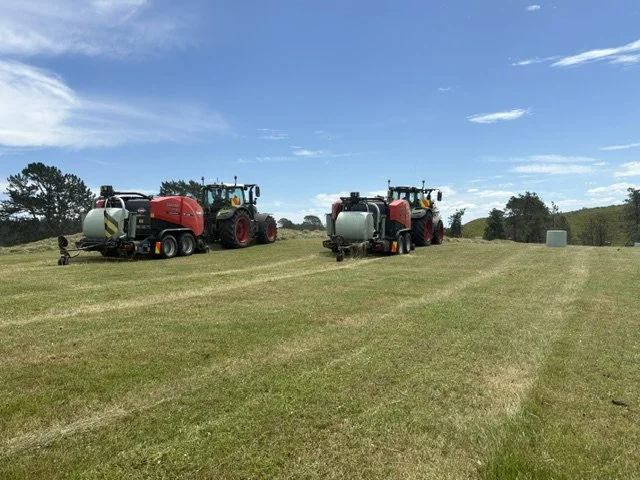
Their contracting business has never operated separately from the dairy farm, with each helping shape the other through practical farming experience, machinery purchases, service development and the way Sanson Agriculture works alongside clients throughout the South Waikato.
Established in 2001 and based at Waotu, Sanson Agriculture has steadily grown from a small owner-operated business into a diverse agricultural contracting operation providing cultivation, precision planting, forage harvesting, hay and silage, effluent management, spreading and bulk cartage. While the machinery fleet has expanded considerably over the years, the philosophy behind the business has remained remarkably consistent. Invest in equipment that delivers real value for farmers, provide reliable service when the work needs doing and continually look for ways to improve efficiency, both on their own farm and on the farms of their clients.
That practical approach has been central to Sanson Agriculture’s development. The business has largely expanded because Sanson identified services they needed themselves before recognising that neighbouring farmers were looking for the same capability. The result is a business that has evolved alongside the farming systems of the region rather than simply responding to seasonal demand. Every major investment has been made with a clear purpose, whether improving establishment, harvesting forage more efficiently or helping clients manage nutrients and effluent more effectively.
Running a dairy farm while operating a contracting business also provides a perspective that cannot easily be replicated. Every machine purchased, every technology introduced and every new service offered is first viewed through the eyes of a working farmer. If it doesn’t improve efficiency or deliver measurable value on their own operation, there is little point expecting clients to invest in it. That philosophy gives Sanson and Greene confidence when discussing machinery or recommending different approaches because those decisions are based on practical experience rather than sales brochures.
Over the past two decades, Sanson Agriculture has continued to broaden its capability while remaining firmly focused on supporting the farming systems of the South Waikato. Dairy farming remains the dominant land use throughout the region, but supporting those farms now involves considerably more than seasonal cultivation or making silage. Farms require contractors capable of handling multiple tasks across the year, often with sophisticated machinery and technology. Sanson Agriculture has deliberately built its capability around meeting those changing expectations.
Cultivation remains one of the foundations of the operation. Good crop establishment starts long before seed enters the ground and achieving consistent results depends on careful attention to soil conditions, timing and machinery setup. Every paddock presents different challenges, from heavier soils requiring more intensive preparation through to lighter country where minimising soil disturbance may become the priority. Rather than adopting a single approach, Sanson Agriculture has developed the flexibility to tailor cultivation systems to individual farm requirements, recognising that successful establishment is influenced by far more than simply making passes across a paddock.
An important part of that capability is an eight-row mechanical strip tiller, which allows Sanson Agriculture to cultivate only the planting zone while leaving the soil between the rows relatively undisturbed. Importantly, the machine can also place fertiliser directly into the trench during the same pass, banding nutrients beneath the future crop row rather than applying them across the full paddock. This allows cultivation and targeted fertiliser placement to be completed in a single operation, positioning nutrients close to the developing root zone while reducing unnecessary soil disturbance.
The investment also gives clients access to an establishment option that has not previously been widely available locally. It represents a considerable investment for the business, but one they see as providing farmers with another choice when considering how crops are established and nutrients applied.
As cropping programmes have become more sophisticated, precision planting has become a key part of that process. Farmers are placing greater emphasis on seed placement, plant populations and maximising the performance of every hectare. Machinery capable of delivering accurate spacing and consistent seed depth has therefore become a valuable investment, particularly for crops where establishment directly influences final yield.
Sanson Agriculture has invested heavily in precision planting technology, including the Väderstad Tempo planter, equipment recognised internationally for its ability to maintain planting accuracy at higher operating speeds. The machine allows seed to be placed with exceptional consistency while maintaining productivity across large areas, helping farmers establish maize and other crops with the uniformity needed to maximise production. For Sanson Agriculture, precision agriculture is not simply about adopting the latest technology. It is about producing measurable improvements in crop performance while making better use of seed, fertiliser and time.
That same emphasis on precision continues into the forage harvesting operation. Making quality silage has become considerably more technical than simply cutting grass and filling a stack. Harvest timing, chop length, kernel processing, compaction and nutrient preservation all influence the quality of the final feed. Contractors therefore play a role in helping farmers maximise feed value rather than simply harvesting volume.
To support that objective, Sanson Agriculture has invested in modern Claas forage harvesters equipped with Near Infrared technology. The system allows forage quality information to be collected during harvesting, providing valuable insight into crop performance while supporting better feed management decisions. Machinery is no longer judged solely on capacity. It is also expected to provide information that assists management decisions and improves overall farm performance.
Sanson Agriculture’s forage harvesting capability extends beyond self-propelled harvesting. Hay and silage remain important components of the annual workload, but baling, in particular, has become one of the cornerstones of Sanson Agriculture. It is an area Sanson and Greene take considerable pride in, because they understand that for the farmer receiving the finished product, the quality of the bale matters just as much as how quickly it was made.
Kuhn FBP 3135 fixed chamber baler-wrappers form an important part of the operation, combining baling and wrapping in a single machine. While the capability of the machinery is important, Sanson and Greene place just as much emphasis on the operators behind it. Their drivers understand that producing a tight, well-formed bale is important to the farmer at the other end. Producing a consistently tight, well-formed bale requires an understanding of the crop, conditions and machine setup, particularly when working through variable harvesting windows.
For Sanson Agriculture, the objective is not simply to get grass into a bale. Density, shape and wrapping all contribute to how well that forage is preserved through storage and ultimately the quality of feed available when the bale is opened. Getting those details right protects the work that has already gone into growing and harvesting the crop and helps ensure clients are putting the best possible feed in front of their cows.
That attention to bale quality also reflects the advantage of being farmers themselves. They know first-hand that a well-made bale is about more than appearance–it is about protecting feed quality through storage and delivering good feed at the other end. It is that combination of exceptional machinery, experienced operators and pride in the finished bale that has made baling one of the cornerstones of Sanson Agriculture.
Organisation, communication and the ability to respond quickly to changing conditions often determine whether quality forage is harvested at the optimum time. That flexibility becomes particularly important when weather windows are tight. Contractors are frequently balancing the requirements of multiple clients while trying to maximise forage quality across a limited number of suitable harvesting days. The ability to mobilise machinery efficiently and maintain reliable output under pressure has therefore become one of the defining characteristics of successful agricultural contracting businesses.
Sanson Agriculture has also continued to expand beyond traditional cultivation and harvesting work. Effluent management has become a significant part of dairy farming as environmental expectations have evolved, with nutrient management now more closely integrated into everyday farm operations.
Sanson Agriculture’s nine-metre Slurry Quip umbilical dribble bar allows effluent to be applied efficiently and accurately, with up to two kilometres of lay-flat hose providing the reach to work across larger areas. A high-capacity pump, capable of moving an average of 200 m³ per hour, allows effluent ponds to be emptied efficiently while maintaining a consistent application rate.
The business has also added a Cannon stirrer to its effluent equipment, helping break up and agitate years of accumulated build-up in ponds and bring those stored nutrients back into suspension. This allows more of the nutrients to be pumped out and returned to the paddock rather than remaining trapped in the pond.
The dribble bar then provides controlled placement of the effluent onto the soil surface, helping farmers make better use of those nutrients while reducing unnecessary disturbance. The system also provides proof of placement, giving farmers confidence that effluent has been applied where intended and helping meet environmental requirements.
Together, the Cannon stirrer, high-capacity pumping system and umbilical dribble bar give Sanson Agriculture a practical and efficient solution for managing effluent from pond to paddock.
Together with cultivation, planting, harvesting, baling and spreading, it contributes to Sanson Agriculture’s ability to take care of a broad range of its clients’ requirements rather than farmers having to coordinate numerous contractors across the season.
Sanson Agriculture also provides spreading services, recognising that fertiliser application continues to play a critical role in maintaining pasture production across the region. Accurate placement, reliable timing and efficient logistics have become just as important as application capacity, particularly as nutrient management planning becomes more closely linked with environmental compliance. Farmers expect contractors to provide both operational capability and confidence that work has been completed accurately.
Supporting many of these operations is Sanson Agriculture’s bulk cartage capability. Farming relies heavily on efficient movement of materials, whether transporting silage, feed, fertiliser or machinery between properties. By integrating transport alongside contracting services, Sanson Agriculture provides clients with a more complete service while reducing reliance on multiple contractors. That integrated approach reflects a broader trend occurring throughout the agricultural contracting sector, where businesses are expected to deliver complete solutions rather than individual services.
Machinery naturally sits at the centre of any contracting business, and Sanson Agriculture has built a fleet reflecting both productivity and reliability. Fendt tractors form an important part of the operation, providing the versatility needed to support cultivation, planting, harvesting and transport throughout the season. Their reputation for efficiency, operator comfort and advanced technology aligns closely with Sanson Agriculture’s broader approach of investing in equipment that delivers genuine operational benefits rather than simply increasing horsepower.
The same philosophy extends across the rest of the machinery fleet. Equipment has been selected to complement existing capability while ensuring high utilisation throughout the year. In today’s contracting environment, capital investment represents one of the largest costs facing any business. Machines therefore need to perform multiple roles wherever possible while maintaining the reliability expected by clients during peak seasonal workloads.
Running both a contracting business and dairy farm also creates valuable opportunities for continual improvement. New machinery and technology can be evaluated under real farming conditions before becoming part of the wider contracting service. Practical experience gained on the family farm often influences operational decisions, while knowledge gained working across numerous client properties feeds back into improving their own farming system. That relationship works in both directions and has become one of Sanson Agriculture’s greatest strengths.
The growth of Sanson Agriculture also reflects the changing role of agricultural contractors within the wider farming industry. Twenty years ago, many contractors were primarily machinery owners hired to complete specific seasonal tasks. Today, they are expected to become part of the decision-making process, providing advice on establishment methods, harvest timing, machinery selection and the practical application of new technology. Farmers are investing more capital into every hectare they cultivate and every tonne of forage they harvest, so the expectation is that contractors will not only complete the work efficiently but also contribute towards achieving the best possible result.
That shift has driven continual investment throughout the contracting sector. Machinery is capable of far more than simply covering hectares. Precision guidance, variable rate technology, yield mapping and real-time machine monitoring have all become common, allowing contractors to deliver a level of accuracy and consistency that was almost unimaginable only a decade ago. While the capital cost of that equipment continues to rise, the operational benefits are equally significant, particularly where efficiency gains can be measured across hundreds or thousands of hectares each season.
For Sanson Agriculture, those advances have been adopted, where they provide genuine value rather than simply because they represent the latest technology. Precision planting is a good example. Accurate seed spacing and placement directly influence crop establishment, allowing farmers to maximise plant populations while reducing unnecessary seed costs. Likewise, forage harvesting technology capable of monitoring crop quality provides valuable information that extends well beyond the harvesting process itself, supporting feed management decisions long after the machines have left the paddock.
Maintaining that level of capability also depends on having experienced operators who understand both the machinery and the farming systems they are working within. Agricultural contracting has become a specialised industry and attracting skilled staff remains one of the biggest challenges facing many businesses. Modern equipment is more productive than ever before, but it also requires operators capable of understanding sophisticated control systems while maintaining the practical judgement needed to work efficiently in changing conditions. Every season presents different challenges, and no amount of technology replaces experience when weather windows become tight or ground conditions deteriorate unexpectedly.
The advantage of operating from an active farming business is that those decisions are rarely theoretical. Sanson and Greene continue to deal with the same seasonal pressures as their clients, whether that involves waiting for suitable planting conditions, making silage ahead of changing weather or managing feed through difficult periods. That shared experience creates a strong understanding of the pressures farmers face because they are making many of the same decisions themselves.
It also reinforces the importance of reliability. When contractors promise to be on a farm, there is usually a reason timing matters and maintaining that trust becomes one of the most valuable assets any contracting business can build.
Looking ahead, agricultural contracting is likely to continue evolving as environmental expectations, labour availability and technology reshape the way farms operate. Precision agriculture will become more integrated into everyday contracting work, while advances in automation, machine connectivity and data collection are likely to provide farmers with even greater insight into the performance of both crops and machinery. Contractors capable of combining practical farming knowledge with those emerging technologies will be well placed to support the next generation of farming systems.
After more than two decades of steady growth, Sanson Agriculture is well positioned for that future. The business has never been built around chasing scale for its own sake, but rather around identifying practical solutions that improve efficiency for both its own farming operation and the clients it works alongside.
From cultivation and precision planting through to forage harvesting, baling, nutrient and effluent management and transport, Sanson Agriculture has developed into a genuine full-service agricultural contracting business while remaining firmly grounded in the realities of day-to-day farming.
That combination of farming knowledge, ongoing investment and a willingness to embrace new technology has enabled Sanson Agriculture to grow steadily while remaining firmly connected to the industry it serves. In many respects, Sanson Agriculture reflects the changing role of agricultural contracting. Contractors are no longer simply machine operators called in during busy periods. They have become long-term partners in helping farms improve productivity, efficiency and sustainability.
For Justin Sanson and Sara Greene, that partnership has been built over more than two decades of working alongside the farming community they are still very much part of.