
Contractor's mobility drives business success
Agricultural contractor Jack Bartlett says a lucky break when he was just out of school got his business to where it is today.
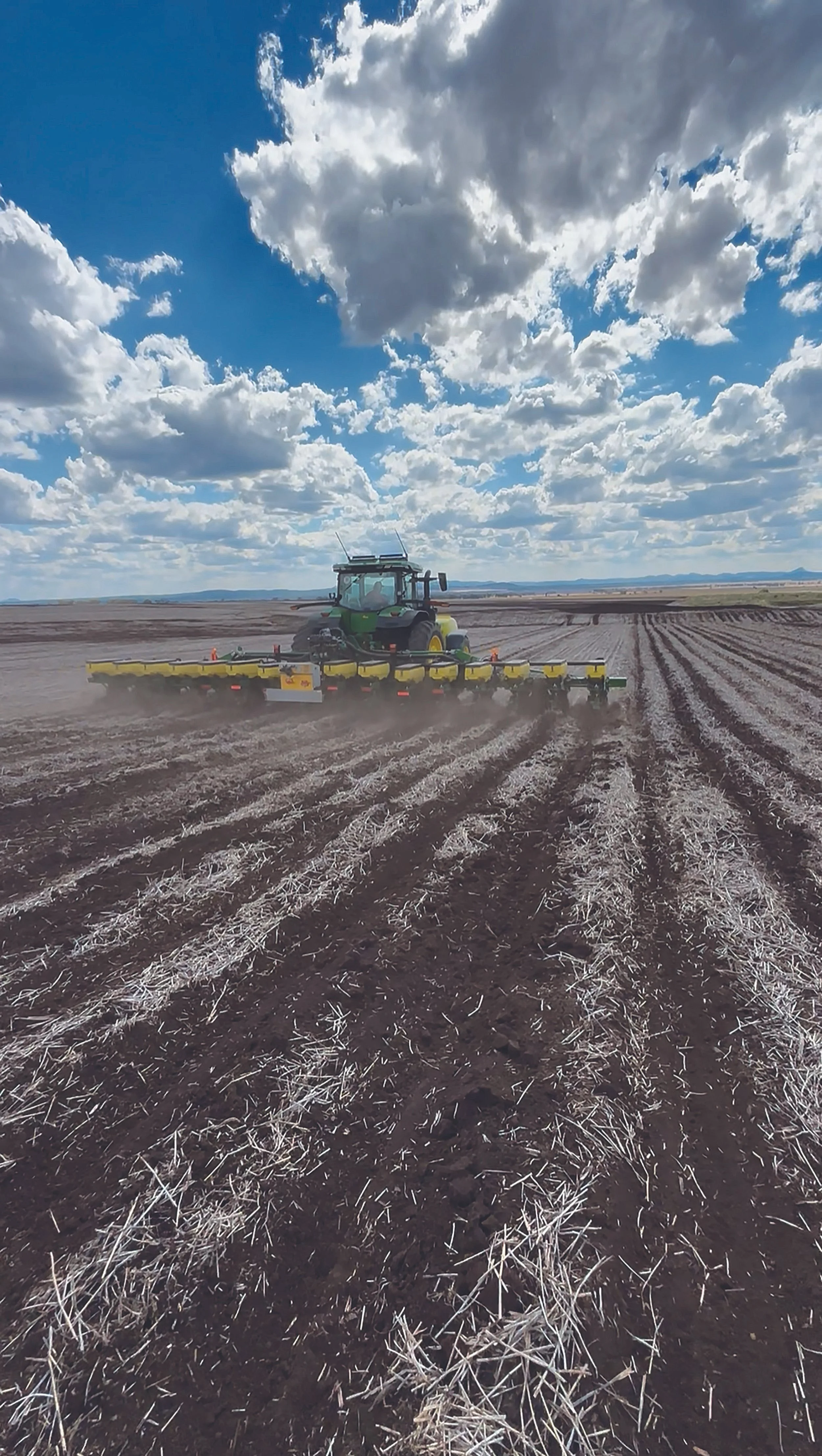
Jack and his wife Mel own and operate JAB AG, working from Gunnedah in New South Wales.
He services large scale broad acre cropping farmers, who need cotton and dry land cereals such as wheat, canola, barley and oats put in the ground and fertilised.
Around 90% of Jack’s work is cotton related.
They run two 12 metre Schulte FX-742 slashers, with slashing making up the bulk of his income, one 12 metre summer crop planter, one Bredal urea spreader, one speed tiller and multiple John Deere tractors.
He also carts grain and machinery anywhere between Southern Victoria to Central Queensland.
Jack, now 29, left school in year nine and ‘did a couple of trades’, and then worked in weed and pest control across South Australia.
His love of machinery got him into this job, he says.
His lucky break came when in 2014 he bought an excavator from an auction.
“It went for cheap, I put a stupid [low] bid on it and won it, and away we went.”
He says he was lucky because building relationships in the industry is tricky for new entrants, but he had a neighbour who had an earth moving company, who started passing jobs to him.
“It kicked off from there.”
He always liked farming, and bought a John Deere header in 2016, moving away from earth moving.
“That was the start of contracting.”
A drought in 2018-2020 almost brought his business to a close, but he pushed through and, in 2020, he bought his first tractor.
Jack's work takes him from Southern Queensland to Central Victoria.
Working different regions means he faces different challenges, but he says he just works around those.
“Having such a broad footprint means we can basically pick where we go, depending on weather”.
If one area gets rain, taking time to dry out, he can head somewhere else.
“It means we don't stop; we chuck the gear on the truck and make it work that way.”
One industry challenge everyone faces is rising costs, and being mobile is one way of beating these costs.
He says to be efficient, gear also has to be bigger, covering more ground in a shorter timeframe, and operations have to be run on a tight schedule.
Practically it also means all his gear needs to fit on one truck so he can move in one go, and not have to head back somewhere to pick up gear.
He also tows gear, freeing up time and labour.
“The little things we do saves money.”
His biggest cost is labour, costing $45-$50 an hour; this rate was around $35 an hour three years ago.
One of the pieces of kit that he has begun to really rely on is the LQS70 Liquid module and liquid section controlled by Liquid Systems.
Jack says clients are almost equally split between those who want to use liquid fertiliser, and those that prefer granular.
As a contractor he made the decision to go liquid, and opted for the LQS70 Liquid module and liquid section controller simply for the ease of not having to tow air carts.
The system was retrofitted to his John Deere gear.
“Being able to move your equipment from property to property without having to tow an aircart is massive”.
“We've got a front nose tank on the tractor; we just unhook the bar off the back, put it on the trailer, and then we can go pretty much anywhere”.
Besides ease of movement, using the system has many other additional benefits.
The LQS70 is a single liquid auto-rate pump and control module.
It provides enough capacity for applying liquids at rates with good tank circulation for up to 4000L tank capacity, and is engineered to deliver target rates in-furrow.
Jack says the system is precise, with the added benefit of being foolproof.
A pressure transducer and pump speed sensor makes on-screen monitoring possible.
“It’s all there on the screen,” he says.
The system provides full section control, allowing him to shut off units, which then shuts off rows.
This means the hectares planted are more accurate, he says.
“It's a very technical system, but somehow they've kept it simple.”
The unit allows target inputs in-furrow with measured and controlled placement in the soil.
It is also easy to install or, as Jack puts it, a complicated system made easy.
The unit can also be upgraded to section control, like Jack’s is, and to multiple liquids or chemical injection.
It accurately controls flow rate to cater for variable rate application, variations in operating speed and shutting off sections automatically.
Because there’s input use efficiency with section control, variable rate application and improved rate control responsiveness, farmers save money in the end.
He can lay down as little as 25-litres of liquid fertiliser per hectare.
Jack says the system lets him “change speed on the go”, making it easier to simply drive the tractor, “and not have to try and keep to a speed”.
He adds that “not having to stick to a speed like other units” also reduces equipment strain.
Because the guesswork is removed, and application is more precise, using the unit allows for a more sustainable business, both for the farmer and for Jack.
Being able to see bar pressure from the cabin is another benefit, he says.
Jack checks for blockages every 30 hectares, something he says is merely a procedure, not a necessity.
“It's the ease of it. You type the number litres you want to put down into the screen and away you go”.
The unit is also reliable, with Jack saying he hasn’t had any major blockages in the system”.
“It's worth its weight in gold, purely by not having to spend the time constantly setting it up.”
Jack says it’s not easy for new entrants to start contracting, with both the cost of new and second hand gear skyrocketing.
The first tractor he bought under his own banner was a John Deere 8530.
It had 10,000 hours on the clock and he paid $55,000 for it.
He then bought a John Deere 8345R for $110,000 and a John Deere 8345R, for $150,000 and a John Deere 8370R for $200,000.
He sold the 8530R for $95,000 when it had 13,500 hours on it.
He also sold the other gear for much more than he bought it for, all after he had put many extra thousands of hours on them.
“A new tractor back in the day was around $300,000. The last one I purchased was pushing around $700,000”.
“I was lucky to get in prior to the Covid pandemic, putting hours on tractors and making money from selling them, that saved my contracting, if I wasn't able to do that the business would not have grown so much in such a short time”.
Jack says in the future he just hopes to keep contracting.
He did not have a father growing up, losing his dad early in life, and says he hopes to keep cracking on, until his boys decide if they want to take over or not.