
Contractors prove more diverse than expected
Words: Dan Smith, Lincoln University
Over the past year I have been surveying New Zealand’s rural contracting industry as the final stage of my PhD, Understanding Small Rural Farm-Support Agribusiness.
After nearly five years working on the PhD part-time, I am now at the submission stage. It has been quite a journey and I sincerely thank all the rural contractors who have contributed along the way.
One of the more interesting findings from the latest survey is just how diverse rural contracting businesses are.
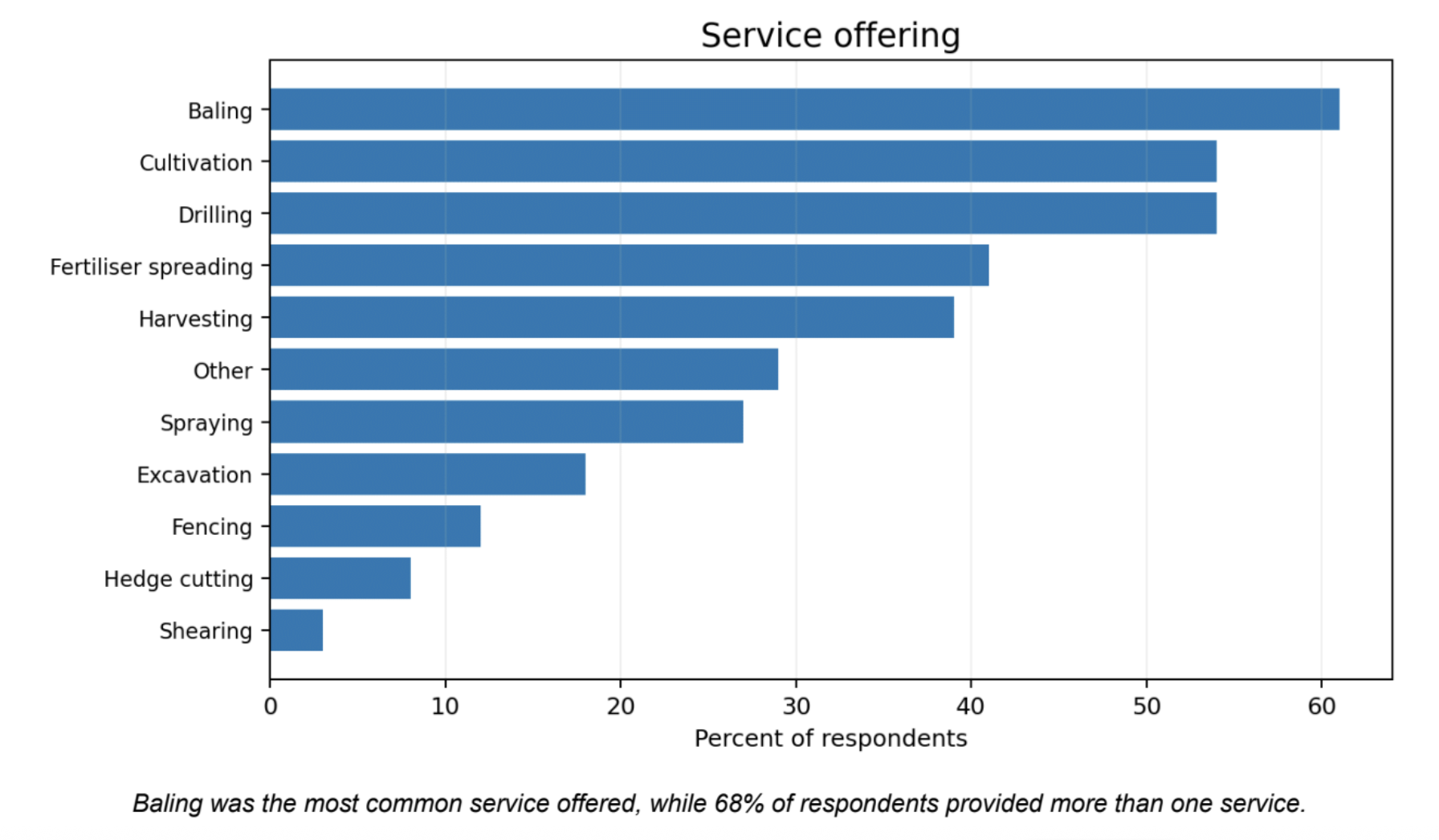
I had expected, following the earlier interview stage of my research, that most contractors would concentrate on a single service. Instead, 68% of survey respondents offered more than one service and almost half, 45%, offered more than four.
Baling was the most commonly offered service at 61%, followed by cultivation and drilling at 54% each, fertiliser spreading at 41% and harvesting at 39%. Other services included spraying, excavation, fencing, hedge cutting and shearing.
In fact, when all the services offered by respondents were added together, the total was approximately four times the number of contracting businesses that completed the survey.
That provides an interesting picture of the modern rural contracting business and is one of several findings I am beginning to share with the industry.
My research began with a review of global academic literature published on rural contractors over the previous 20 years. I brought the main findings together in one article and used that work to develop a conceptual model of the rural contracting industry.
The second stage took me around Canterbury interviewing rural contractors. Those conversations helped improve my understanding of how contracting businesses operate and allowed me to further develop the model.
The final stage was the nationwide survey, where I attempted to rank the importance of the different parts of that model.
All three studies have been published in peer-reviewed international academic journals and I am now combining them into my PhD through a process known as a Thesis by Publication.
Now that the academic part of the project is largely out of the way, I can get back to talking to the industry about what I found.
Along with the individual rural contractors who participated in interviews and surveys, I have been fortunate to have support from Rural Contractors New Zealand and Rural Contractor & Large Scale Farmer. That support has allowed me to keep the industry updated during the research and provided a way of inviting contractors to participate in the nationwide survey.
There is plenty in the research that I find interesting. In fact, it has probably generated another 20 potential research projects for future students. There are some particularly interesting questions around the relationship between farmers and rural contractors that I hope to have students researching next year.
For now, however, I want to begin sharing some of the findings that are likely to be most useful to the people actually doing the work.
I am guessing busy rural contractors aren't particularly interested in literature search terms, statistical significance, p values or Wilcoxon Signed Rank tests, so we will leave those aside and look at what the survey tells us about the industry.
The first thing to consider is who responded.
Most survey participants were aged between 36 and 65, with the largest groups falling within the 36 to 45 and 46 to 55 age brackets. There were considerably fewer respondents aged under 35, while another group was aged over 65.
Geographically, respondents came from throughout New Zealand, with the largest representation from Waikato, Canterbury, Otago and Southland. That was broadly what I expected, given the concentration of farming activity in those regions.
The amount of business experience among respondents was also interesting.
Most had owned or managed their current contracting business for more than 10 years and the largest individual group had been doing so for 20 years or more.
There are several possible ways to interpret that result. It could suggest that many rural contractors remain in business for a long time. It might indicate that businesses surviving their early years tend to have considerable longevity, or it could simply mean that people who have been operating for longer are more likely to respond to a survey such as this.
That distinction is important because survey results need to be considered in the context of who responded rather than assuming they necessarily describe every contracting business in New Zealand.
The diversity of services being offered was therefore particularly interesting.
Rather than finding an industry dominated by businesses concentrating on one specialised activity, the survey showed that many contractors provide several different services.
For farmers, that means the contractor arriving to bale silage may be part of a business that also carries out cultivation, drilling, fertiliser spreading, harvesting or a range of other work during different parts of the season.
For the contracting business, providing multiple services potentially creates work across a broader part of the farming calendar rather than relying entirely on one operation or a relatively narrow seasonal window.
Another encouraging result came when contractors were asked how satisfied they were with the performance of their businesses.
Participants rated their satisfaction on a scale from zero to 100. Only 10% gave a score below 50, meaning 90% were at least on the positive side of the midpoint. The vast majority rated their satisfaction above 70.
These initial results are primarily descriptive. They tell us something about the contractors who participated in the survey, including their age, location, business experience, range of services and how they feel their businesses are performing.
The next stage becomes more interesting because I asked contractors to rank the importance of the different characteristics surrounding their industry.
Those results begin to move beyond describing who rural contractors are and towards understanding what matters to them and their businesses.
I will look at those findings in the next article.