
Forestry’s growth must strengthen farming, not replace it
There is no denying the scale or significance of the announcement that PF Olsen and Forest360 intend to merge to form what will become the largest independent forestry management company in Australasia, managing close to half a million hectares of forest and servicing more than a thousand clients across New Zealand and Australia. On paper, it is a statement of confidence in forestry as an industry and in professional forest management as a long-term investment. It brings together decades of experience, deep regional networks and a breadth of services that span everything from nurseries through to harvest and carbon accounting. For many in the forestry sector, this is being framed as a natural evolution, a sensible consolidation and a platform for growth.
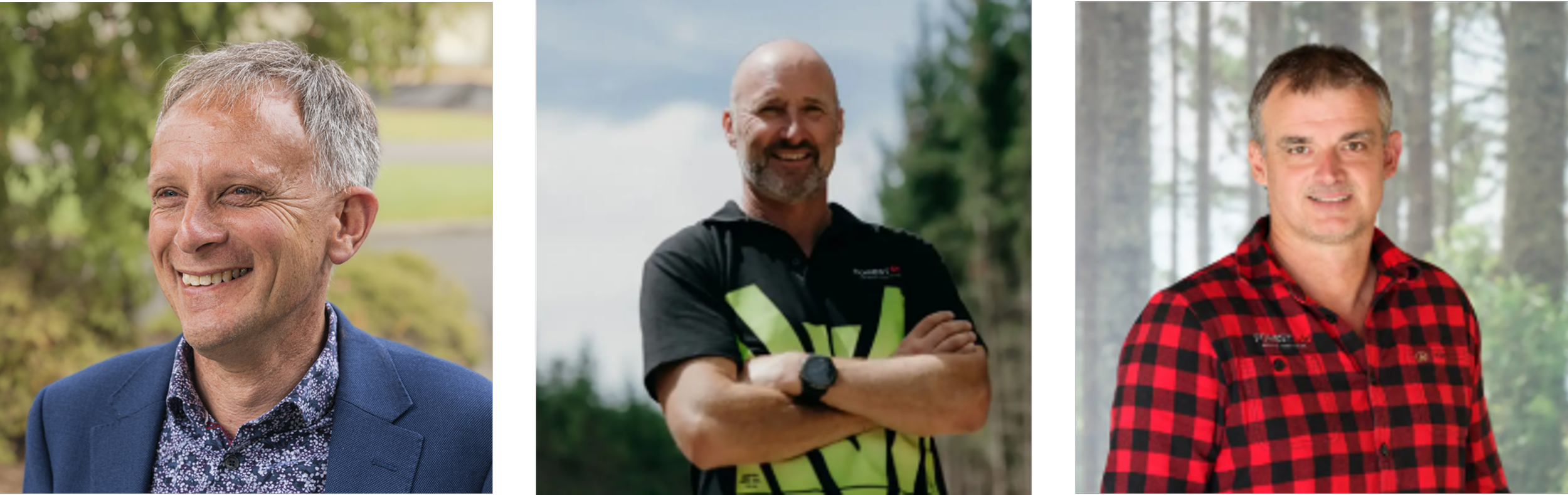
Group Chief Commercial Officer Ross Larcombe, Group CEO Dan Gaddum, and Group Chief Commercial Officer Marcus Musson.
But from a farming and rural New Zealand perspective, this announcement deserves more than polite applause. It deserves scrutiny, challenge and context, because forestry does not exist in isolation from the rest of the land use economy and nor should it. Forestry is important to New Zealand, and carbon farming has a role to play, but only when it strengthens rural communities, complements productive farming systems and keeps value circulating locally rather than extracting it offshore or concentrating it in corporate balance sheets.
The merger brings together two respected operators. PF Olsen has been active in forestry for over 50 years, growing from a consultancy into a major player offering planting, silviculture, harvest planning, log marketing, sustainability consulting and carbon accounting. Forest360 has built its reputation on integrated forestry services and a customer-centric model that appeals to a wide range of forest owners. Combined, they will manage around 480,000 hectares of forest and support more than 1,000 clients, ranging from large institutional investors to family-run businesses and private landowners. That scale matters, because scale shapes influence, policy engagement and ultimately land use outcomes.
Forest360 Managing Director Dan Gaddum has been appointed Group CEO, with PF Olsen’s Ross Larcombe becoming Group Chief Commercial Officer and Forest360’s Marcus Musson taking on the role of Group Chief Operating Officer. Dan says, “We are looking forward to partnering with the experienced teams at PF Olsen. These businesses are about people and by combining our skills and services, we can better service clients across the entire forest management value chain – from seed orchards and nurseries through to harvest management, forest management, and consulting services.”
There is nothing in that statement that farmers would necessarily disagree with. Good forestry management matters. Professional standards matter. Safety matters. Environmental stewardship matters. Where concern begins is not with the competence of the people involved, but with the direction of travel for land use in New Zealand and who ultimately benefits from it.
Dan continues, “Marcus and I are both excited to be part of the leadership team for the combined group and continue to pursue our joint ambition of being the management provider of choice for forest owners across New Zealand and Australia, whether they be large institutional owners or farm foresters.” That final phrase matters. Farm foresters are not the same as large institutional owners, and policy settings that treat them as interchangeable risk doing real damage to the mixed farming systems that underpin rural economies.
PF Olsen CEO Ross Larcombe echoes the optimism, saying the merger will combine experienced teams into one single purpose. “We are a trusted provider to our clients, having provided forestry services in Australia and New Zealand for over 50 years. We are excited to combine forces with the team at Forest360 and establish a more resilient business with diversified services, a larger scale footprint and shared customer-led values.”
He goes on to say, “I’m genuinely excited about the opportunity to bring our team at PF Olsen into a newly merged business with the talented people at Forest 360, together both groups share a deep commitment to sustainable forestry, operational excellence, and supporting the communities we work in. This merger brings together complementary strengths, and I’m confident it will create a stronger, more resilient business for our clients and the industry.”
Supporting communities is the phrase that rural New Zealand will hold this merger to. Because for many farming regions, the experience of large-scale forestry expansion has not always aligned with that aspiration. We have seen productive sheep and beef farms converted wholesale into carbon forests with minimal labour input, reduced school rolls, shrinking rural services and the quiet hollowing out of communities that once supported contractors, vets, transport operators and local businesses. That outcome is not inevitable, but it is a consequence of policy and investment settings that reward land use change without sufficient regard for social and economic impact.
The involvement of Adamantem Capital as an investment partner adds another layer to the conversation. Adamantem is investing through its Environmental Opportunities Fund, which aims to support the transition to a net-zero economy. Director Callum Morrison says, “We can’t wait to partner with Dan, Ross, Marcus and their teams, all experienced forestry industry veterans who are highly committed to the success of the combined business.” He adds, “More broadly, Adamantem is a strong believer in the role the combined business can play in improving the environmental and natural capital outcomes for New Zealand and landholders across the country.”
Environmental outcomes matter, but so does the definition of success. Improving natural capital should not come at the expense of productive capital, food security or the viability of family farming. Carbon farming can be part of a mixed model, where woodlots, riparian planting and selective forestry complement livestock and cropping systems, improve resilience and diversify income. What it cannot become is a blunt instrument that prices farmers out of their own land and replaces people with permanent trees.
Quayside Holdings, which invested in PF Olsen in 2022, has welcomed the merger. Chief Executive Officer Lyndon Settle says, “We are excited to support two market-leading businesses, alongside an experienced capital partner to help shape a resilient, future focused forestry sector that delivers sustainable value for all stakeholders.” Again, the words are right. The test is in how that value is distributed and whether farmers and rural communities genuinely sit within that stakeholder group or merely exist at the margins of it.
To be clear, this is not an argument against forestry. New Zealand needs forestry. We need timber, we need export earnings, we need carbon sinks and we need well-managed forests that meet high environmental and safety standards. Companies like PF Olsen and Forest360 play an important role in delivering that. But the rapid scaling of professional forest management, backed by private capital and driven by carbon markets, cannot be separated from the wider debate about land use balance.
When forestry is layered into a farming system, when it supports erosion control, biodiversity, shelter and long-term income alongside food production, it strengthens the resilience of farms. When forestry displaces farming entirely, particularly on versatile land, it weakens the social and economic fabric of rural New Zealand. That distinction is often lost in national conversations that focus narrowly on emissions targets without considering how they are achieved.
The merged group will manage approximately 480,000 hectares of forest. That is a significant footprint. With that scale comes responsibility, not just to clients and investors, but to the country. It means engaging honestly with farmers who are under pressure from land price inflation driven by carbon demand. It means advocating for policy settings that favour integrated land use rather than monocultures of any kind. It means recognising that mixed farming models are not a nostalgic ideal, but a practical pathway to balancing environmental and economic outcomes.
There is an opportunity here. A company of this scale and influence could actively promote forestry as part of farming, rather than a replacement for it. It could work with farmers to design systems that keep people on the land, maintain production and still contribute to climate goals. It could push back against simplistic narratives that frame carbon forestry as the easiest solution while ignoring its unintended consequences.
Staff will transition into the merged organisation, with operations continuing from all current locations across New Zealand and Australia. The merger is expected to be completed in February this year. For the people involved, this is a moment of change and opportunity. For rural New Zealand, it is a moment to ask hard questions.
Forestry is important. Carbon farming has a place. But neither should be allowed to undermine the very farming communities that have carried this country for generations. If this new entity is serious about supporting communities and delivering sustainable value for all stakeholders, then it must be willing to engage with those concerns, not dismiss them as resistance to change.
New Zealand does not need an argument between farmers and foresters. It needs leadership that understands how land, people, food and climate fit together. This merger could be part of that solution, but only if it recognises that the future of forestry in New Zealand is inseparable from the future of farming, and that balance, not scale alone, is what will determine whether this growth truly benefits the country.