
Keeping high-horsepower forage harvesters fed
There was a time when the pickup header was little more than a conveyor between the windrow and the forage harvester. As harvesting capacity has increased, that thinking has changed. Today's self-propelled forage harvesters can process extraordinary volumes of crop, but they remain entirely dependent on one thing: maintaining a constant, unrestricted flow of material into the feed rollers. Every interruption, surge or hesitation reduces throughput, increases driveline loading and limits the machine's ability to operate at full capacity.
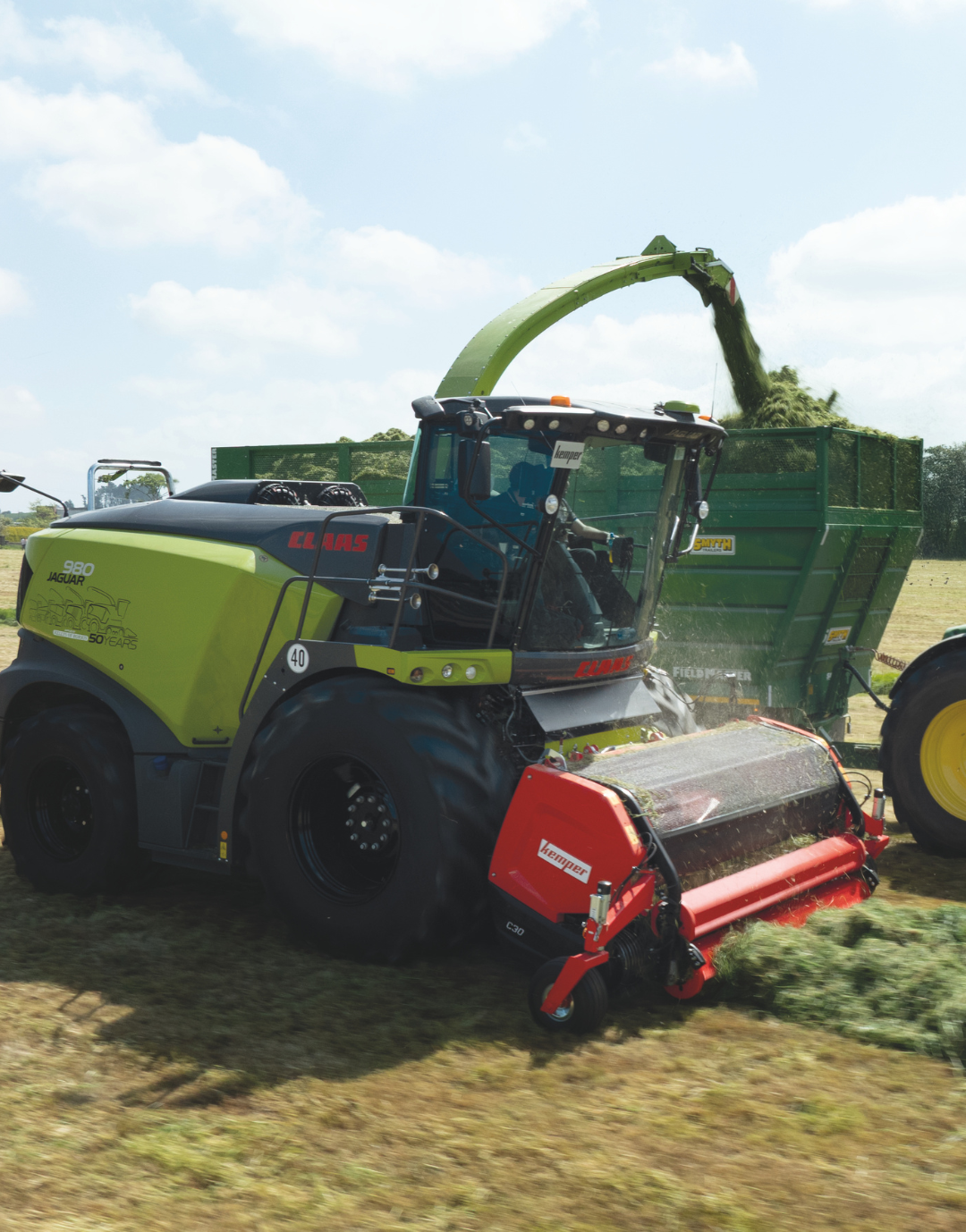
That is the engineering challenge behind the new for 2026 Kemper C30 and C35 large-capacity grass pickups, now available in New Zealand through Ag and Civil Machinery Direct Ltd to suit Claas high-horsepower forage harvesters (e.g., Jaguar 990 and 1200). Rather than simply increasing pickup width, Kemper has redesigned almost every stage of crop intake to create a header capable of maintaining smooth crop flow through heavy, wet and inconsistent windrows while reducing wear throughout the harvesting system.
Forage harvesting is ultimately about consistency. Modern chopping systems perform best when they receive an even supply of crop. Uneven feeding affects chop length, increases fuel consumption and places unnecessary shock loads on the driveline. As forage harvesters continue to increase in power, pickup headers have become one of the most important components in maintaining overall machine performance.
At the centre of the Kemper design is a large-diameter intake auger measuring 790 mm, equipped with heavy-duty 200 mm flighting. While the dimensions contribute to the pickup's capacity, the real innovation lies in the shape of the auger itself. Instead of using a constant screw pitch, the flighting gradually opens towards the centre of the machine. This patented design guides material progressively into the feed channel, preventing crop from arriving in large slugs while maintaining a smooth and continuous flow across the full working width. The result is lower mechanical stress, improved fuel efficiency and the ability to keep high-capacity forage harvesters operating closer to their maximum output.
The pickup reel follows the same philosophy. The C30 and C35 utilise six tine bars fitted with robust 6.5 mm tines, providing more pickup points across every revolution. Increasing the number of tine bars allows the reel to operate at lower rotational speeds without sacrificing capacity. Lower reel speeds reduce wear while ensuring even high-yielding crops are lifted cleanly from the windrow. More importantly, the additional tine bars help prevent crop being left behind, an increasingly important consideration where contractors are harvesting valuable, high-quality forage.
Crop control continues after the material leaves the pickup reel. Kemper has incorporated a pivoting double compression roll system, designed to manage one of the most common problems in forage harvesting: inconsistent windrows. Light sections, heavy bunches and irregularly shaped rows can all interrupt crop flow before the material reaches the feed rollers.
The double roll arrangement addresses this by allowing the first roller to react independently while a second roller remains fixed against the main frame. Even when the first roller lifts over heavier crop, the second continues guiding material towards the auger, maintaining positive crop control and helping smooth out variations before they reach the chopping system. This becomes particularly valuable when harvesting lodged crops, wet grass or unevenly raked windrows.
Maintaining throughput also depends on how accurately the pickup follows the ground. Uneven terrain creates two problems: crop can be left behind if the pickup rides too high, while excessive ground contact increases soil contamination and accelerates tine wear. Kemper has addressed this through a substantial pendulum frame, automatic centring system and oversized 360-degree swivelling gauge wheels that closely follow the contours of the paddock. On particularly rough ground, additional centre support wheels prevent the pickup tines penetrating the soil, protecting both the pasture and the machine while helping maintain clean forage. The smooth wheel surfaces and integrated scrapers also reduce soil build-up, particularly during damp harvesting conditions.
Reliability has been another major focus of the design. Traditional pickup drives rely on chains requiring regular adjustment, lubrication and replacement as wear develops throughout the season. Kemper has eliminated this requirement by adopting a chainless gearbox drive. Removing chains reduces routine servicing while eliminating one of the more common maintenance tasks faced by contractors during harvest. Less downtime means more time harvesting, particularly valuable during short weather windows where every available hour counts.
Maintenance extends beyond the driveline. During dry harvesting conditions, crop residue and dust can accumulate inside the pickup and around the feed area, reducing efficiency and increasing cleaning time. An optional service door provides rapid access for removing accumulated material, while a full-width dust protection net helps prevent debris entering critical areas around the intake channel and chopping drum. Cleaner internal components improve visibility, reduce maintenance requirements and contribute to higher machine availability across the season.
Contractors and farmers moving between multiple farms also benefit from several practical design features. The driveline incorporates a quick-coupler system for rapid attachment, while the hydraulic gauge wheels fold automatically into their transport position when the pickup is raised. Operators can prepare the machine for road transport without leaving the cab, reducing downtime during field changes and improving overall operating efficiency.
Perhaps the most significant aspect of the C30 and C35 is that every engineering decision supports the same objective. The auger geometry, pickup reel, compression rollers, suspension system and driveline have not been developed as isolated components. Together they form an integrated crop-feeding system designed to keep increasingly powerful forage harvesters working at their full potential. As harvesting speeds increase and weather windows continue to tighten, maintaining uninterrupted crop flow becomes just as important as the performance of the chopping drum itself.
The evolution of forage harvesters over the past decade has placed increasing demands on every attachment fitted to the front of the machine. Pickup headers are no longer passive implements following behind developments in harvester technology. They have become active crop-management systems responsible for regulating crop flow, protecting forage quality, reducing machine wear and maximising productivity throughout the harvesting process.
For New Zealand contractors operating Claas high-horsepower forage harvesters, the Kemper C30 and C35 represent far more than large-capacity grass pickups. They have been engineered as high-performance feeding systems capable of matching the output of today's most productive forage harvesters while maintaining the smooth, consistent crop flow required to deliver maximum harvesting efficiency under the demanding conditions that define modern silage production.