
One pass with purpose: Why the Kverneland U-Drill fits New Zealand seeding reality
There is a point in every season when preparation gives way to commitment, because once the drill goes in the ground the decisions are largely made and the outcome becomes a matter of execution rather than intention. That moment is where the Kverneland U-Drill earns its keep not by promising miracles but by bringing together cultivation, consolidation and seeding into a single controlled process that suits the way modern New Zealand farms operate. Distributed locally by Power farming, the U-Drill has been developed around the idea that efficiency only matters when it protects seed placement and emergence because speed without consistency is simply a faster way to lock in problems.
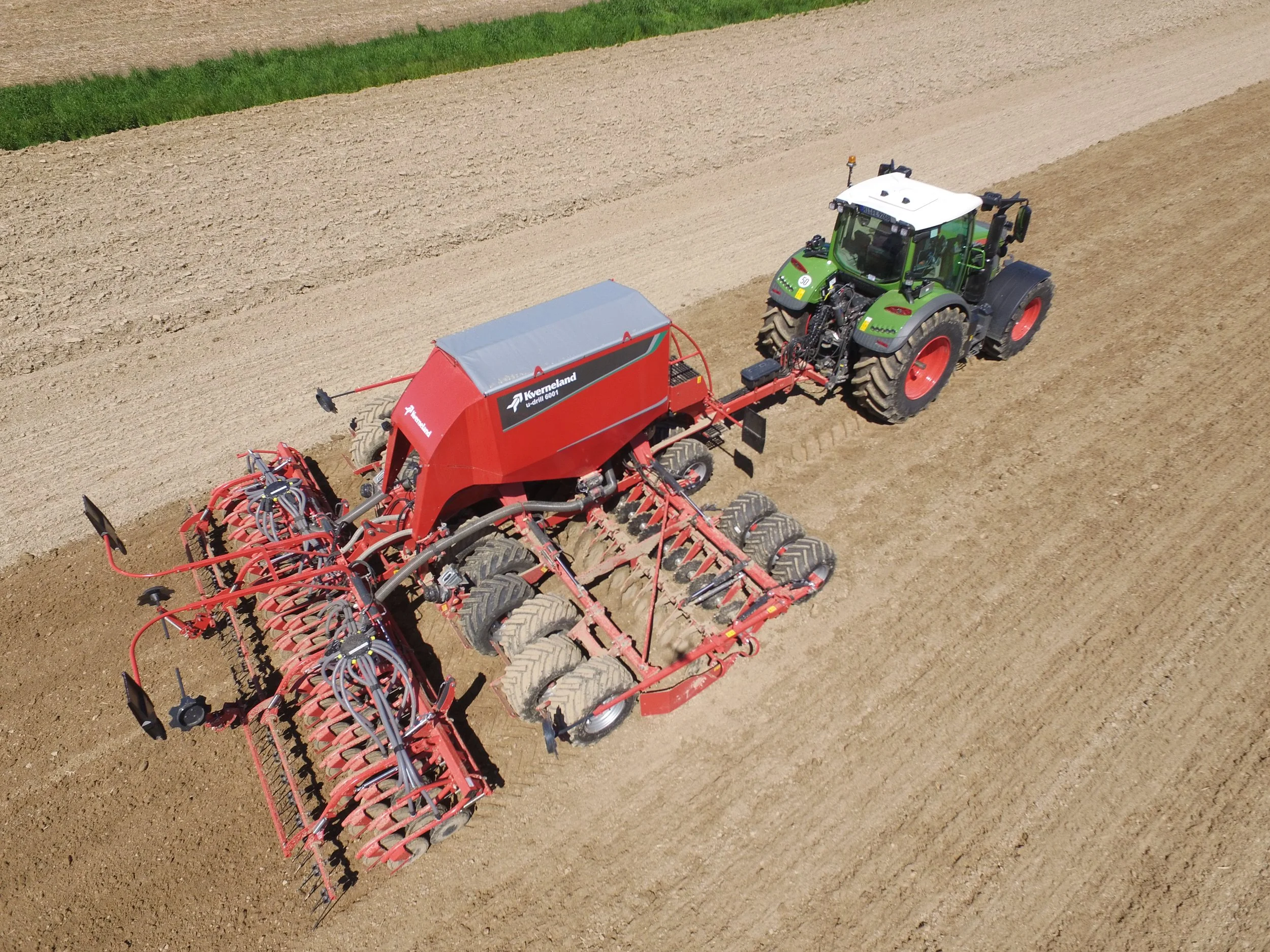
At a mechanical level the U-Drill is designed as a true one-pass system rather than a drill that has been asked to do too many jobs at once. The working sequence is deliberate and it starts with soil levelling and pre consolidation ahead of the seeding units. A large front packer stabilises the surface and sets the base for the cultivation that follows, while the dual rows of conical discs work the soil evenly across the full width of the machine. This is not aggressive cultivation for its own sake, it is about creating a uniform profile so the coulters are not forced to chase variable ground conditions from one metre to the next. By the time the seed is placed the second packer has already consolidated the seedbed, which is a detail that matters far more than many operators realise because seed depth control is only as good as the soil consistency directly beneath it.
The coulter system itself is based around Kverneland’s CD concept, which has been refined to deliver accurate depth control at forward speeds that reflect the scale and time pressure of modern operations. Working speeds of up to 18 kilometres an hour are realistic in suitable conditions but the real story is not speed, it is stability. When the seed is placed into a firm and even bed and followed immediately by press wheels that ensure consistent seed to soil contact, the result is even emergence across the paddock rather than staggered rows that tell a story of uneven preparation. In practice that uniformity is what underpins crop performance later in the season, because plants that start together tend to finish together.
From a technology perspective the U-Drill has been built to integrate cleanly into Isobus based tractor systems which means operators can control depth, coulter pressure and seeding rate directly from the cab without relying on manual adjustments or compromises. The electric ELDOS metering system is a key part of that package, allowing accurate rate control across a wide range of seed sizes and sowing rates while also opening the door to section control and variable rate seeding when paired with GPS guidance. In real terms that means fewer overlaps, reduced seed waste and the ability to respond to changing conditions within a paddock rather than treating every hectare the same.
Calibration is often where complex drills lose favour in busy seasons, yet the U-Drill has been designed to keep this process straightforward and repeatable. Electric drive removes the need for mechanical gear changes and simplifies the process of switching between crops, while monitoring sensors provide reassurance that seed is flowing as intended. For contractors and large scale farmers this matters because time lost calibrating is time lost planting, and the best systems are the ones that reduce friction between the operator and the machine rather than adding to it.
Flexibility is another area where the U-Drill fits New Zealand conditions particularly well. With working widths ranging from 3 to 6 metres and row spacing options that suit a wide variety of crops, the platform can be configured to match different farming systems without becoming overly specialised. Hopper capacity is generous and practical filling options reflect the reality of modern seed handling using loaders and telehandlers rather than manual labour. This adaptability is not a minor detail, because the economics of a drill improve when it can be used across multiple jobs and regions rather than being tied to a single narrow role.
Headland management is one of those features that tends to be appreciated most once it has been used, and the U-Drill’s automatic sequencing is designed to reduce stress and error at exactly the point in the paddock where both are most likely. By lifting the working elements in a timed sequence and stopping the metering automatically the system avoids over application and keeps headlands tidy, which saves seed and leaves a more consistent finish. Over a season that sort of control can add up to meaningful savings and a more professional result, particularly for operators covering large areas.
What makes the U-Drill relevant is not any single feature but the way the whole system works together. It is a drill built on the assumption that conditions will not be perfect, that soil types will change within a paddock and that planting windows will be tight. Rather than asking the operator to constantly intervene it is designed to provide a stable and repeatable process that protects the fundamentals of seed placement while allowing the machine to move at a pace that suits modern farming.
As it finds its place in New Zealand through Power farming, the Kverneland U-Drill stands as a reminder that good seeding is not about complexity, it is about control. Control of depth, control of consolidation and control of rate, delivered in a single pass that respects both the agronomy and the clock.