
W & J Mair Agricultural Contractors
Even in the depths of January, W & J Mair Agricultural Contractors, based at Hill Farm in Cumnock, Scotland, was a hive of activity.
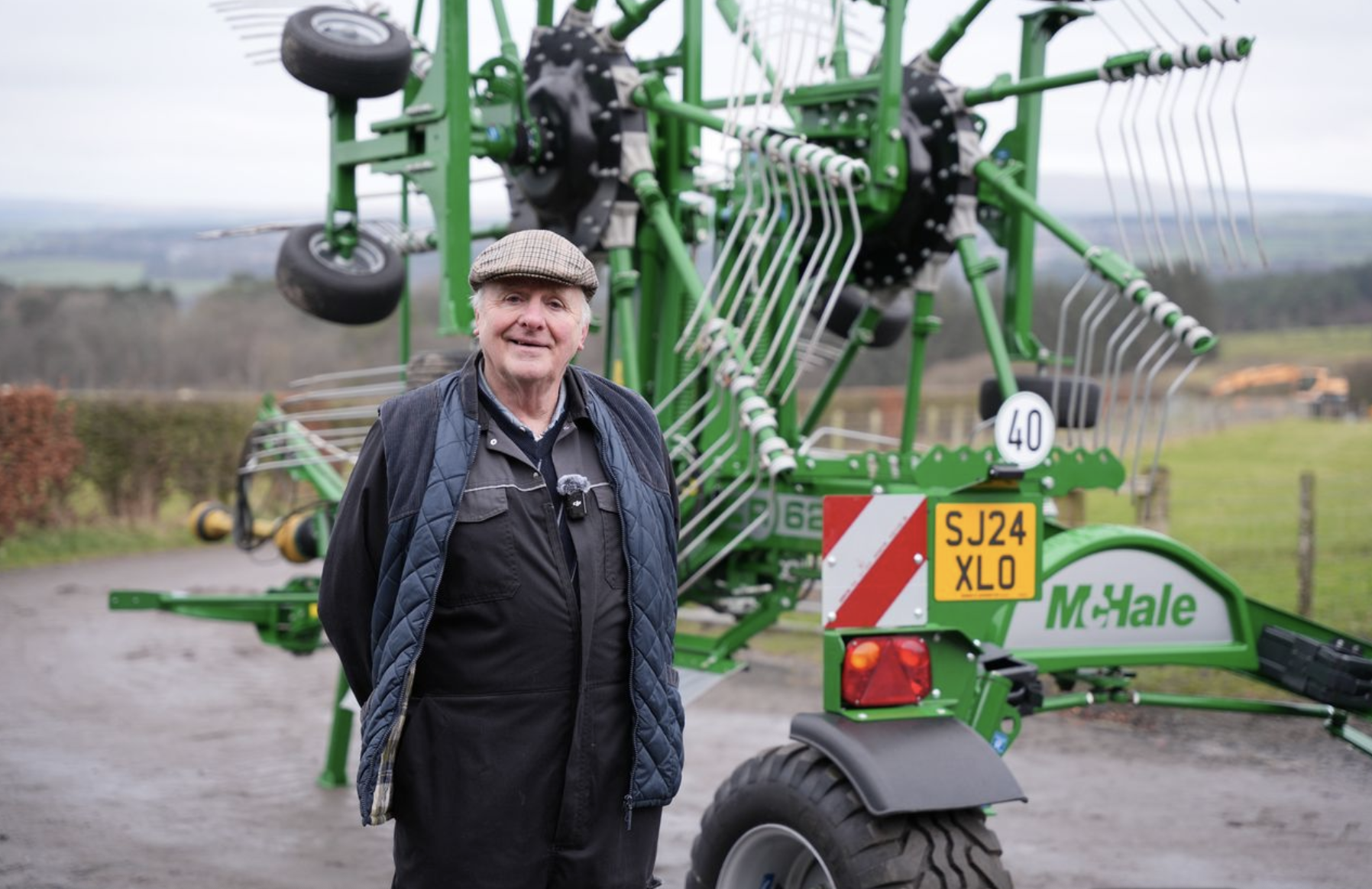
We were welcomed by owner Jim Mair, or “old Jim from the hill” was how he introduced himself, and what a picturesque spot Hill Farm is, surrounded by the Cumnock Hills.
Jim explained they own 110 acres and rent a further 400 acres for prominently grazing and silage making for the farm’s 400 breeding ewes and 150 strong suckler herd running predominately Shorthorn bulls with a further 60 acres of barley grown as a cash crop.
Aside from the farming enterprise, the family have run a hugely successful contracting business for the past 68 years, with Jims’s father William establishing the business in 1958. Jim himself started working in the enterprise at 15 years old and took over in his twenties. With help from his wife May, Jim expanded to the point it is today, with the third generation now heavily involved. Jim’s daughter, Margaret, manages the companies’ books and wages and two sons, James and Ian (Archie), who both started working with Jim straight out of school, now manage separate sides of the business.
James is responsible for the silage, slurry and dump trailers work and Ian is responsible for organising ploughing, seeding, combining and fertiliser work.
Jim proudly added that he has grandsons who are very keen to be involved coming through also.
The family were recently nominated for ‘Contractor of the Year’ at the Scottish Agriculture Awards in 2025, and with Jims’s passion and drive at the helm it’s easy to see why.
“We are a 365 day of the year contractor, from the spring were we are starting to plough, sow and then working into slurry which is now a major part of our business we go into about five different shires slurry spreading–Ayrshire, Stirling, Lanarkshire, Dumfriesshire and even down to Wigtownshire, where we Slurry at the most southernly farm in Scotland.”
Once slurry season slows and heading into summer, “it’s all hands on deck for mowing, raking, baling and leading on from there is combining- harvest”. Through autumn and winter, the business has clients for reseeding, groundwork and even snow ploughing.
Since starting out, silage has always been a staple for the contracting business, but Jim has seen a massive increase in demand for round baling and wrapping from his customers in his time, with several McHale machines now at its centre.
“We run two McHale Fusion balers now, but I remember many years ago Kieran Hughes [McHale sales representative] came to demonstrate a Fusion baler. And I said, no, I can’t justify a Fusion baler, as I didn’t see us baling enough to justify it. I used to bale everything with a Welger baler and have May follow on behind me with a McHale wrapper 991B.
“And here we are in 2026, and we now have two Fusion 4 balers. We swap them every four years, and this must be our fifth or sixth.”
When asked what keeps the business going back to the Fusion, Jim explained that having the patented bale transfer system and vertical wrapping ring contained neatly in the one unit not only increases throughput but also aids in how well the machine travels in all conditions, a must for contractors like Jim.
“The Fusion has it all. There is no reason I would ever change. Every time we buy a new one there is always improvements you don’t think they could improve but they do constantly.”
The company’s most recent McHale purchase was the McHale R62-72 centre delivery rake. After adding a square baler to the companies’ impressive fleet of machines, it was decided that a second rake was also needed.
“We have worked with other manufacturers of rakes through the years, and McHale had announced this new one, so we looked at that along with other rakes but we decided the McHale rake had one or two points above the rest, mainly number one, the adjustable cam, which meant we can adjust our swath to suit every pick-up of every baler or even our foragers. Making the swath wider for the Fusions and narrower for the square baler. To get a perfect swath. Which is a big plus for the McHale.”
Apart from the easy adjustments of the McHale, the rake’s ground following capabilities have also stood out to Jim.
“I am usually on the McHale rake and there is a certain farm that we have baled at for about twenty years, a long-established customer, and he has one field which is about twenty-six acres that is the old-fashioned runrigs, so it’s very angulated. Our previous rakes had done a reasonable job, and we had never had any complaints about the performance. I went with the McHale for the first time jut a wee bit unsure about how it would do, and I came out of that field absolutely delighted. It was the best job of any rake that had ever been in that field. Followed the contours whether on an angle or straight across these rigs. It followed the ground better than any other rake that we had. Which surprised me. I must admit it did surprise me. It was the best one we had ever had in that field.”
The McHale’s durable build quality has also impressed Jim. “The whole machine seems to be very, very strong. That’s a great feature. Not a tine has been put on that machine in 2200 acres ... I wouldn’t think twice about going back to Ramsay and Jackson [local dealer] today and buying another one. When our other rake is needing replaced, I will be buying another McHale. They have done our job and on certain fields they have done a better job which really has surprised me. I’m delighted with the McHale rake.”
When it comes to the maintenance of his kit, Jim has one firm belief: “The cheapest mechanic you can get is a good grease gun.”
And in regard to maintenance of all his McHale equipment – in Jim’s experience “it’s barely none as long as you have a good operator on the machine”, Jim says, coughing, referring to himself.
Jim and the team have found the equipment to be incredibly reliable, but if ever there is an issue the back up and support from their local dealer Ramsay & Jackson is “excellent, day or night”.